
Have you ever typed a message, paused for a moment, and wondered whether to write alright or all right? You’re not alone. Both spellings appear in everyday English, from text messages and social media posts to books and professional conversations.
The confusion comes from the fact that they look different but often express the same idea. The good news is that the choice becomes easier once you understand how each spelling is used.
All right is the safer option for formal writing, academic assignments, and professional emails. Alright is common in casual communication, although some dictionaries and style guides still consider it nonstandard.
In this guide, you’ll learn the difference between alright and all right, explore their meanings, see natural examples, and discover which spelling to use in different situations. By the end, you’ll be able to choose the right form without second-guessing yourself.
Alright or All Right: The Quick Answer
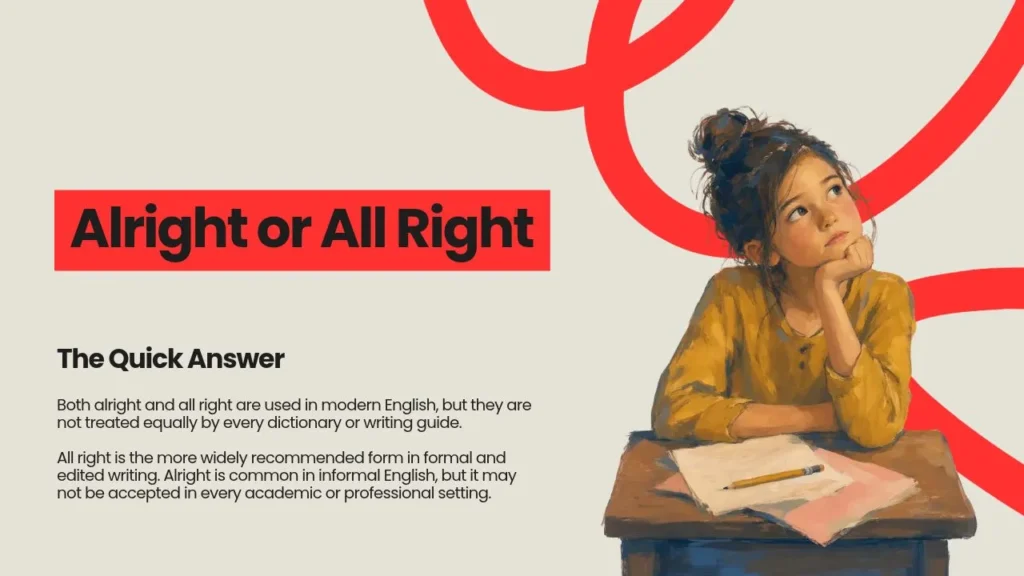
Both alright and all right are used in modern English, but they are not treated equally by every dictionary or writing guide. All right is the more widely recommended form in formal and edited writing. Alright is common in informal English, but it may not be accepted in every academic or professional setting.
For example:
- All right: Are you all right after the long journey?
- Alright: I’m alright, thanks for asking.
- All right: Your answers are all right.
- Alright: Alright, let’s get started.
In many sentences, the two spellings communicate the same meaning. The main difference is their acceptance in different writing styles, rather than a completely different definition.
If you’re writing an essay, business email, school assignment, or formal report, choose all right. If you’re chatting with a friend or writing casual dialogue, alright may fit the tone. When you’re unsure about your audience’s preferences, the two-word spelling is the safest choice.
What Is the Difference Between Alright and All Right?
The main difference between alright and all right is the spelling convention. All right consists of two words and is traditionally preferred in standard English. Alright combines those words into one and is widely used in informal communication.
Both forms can express the ideas of being okay, feeling well, accepting something, or describing a situation as satisfactory. However, some dictionaries and style guides label alright as nonstandard, so the appropriate choice depends partly on your audience and the rules you’re expected to follow.
| Feature | All Right | Alright |
| Spelling | Two separate words | One word |
| General meaning | Okay, acceptable, safe, or satisfactory | Usually the same general meaning |
| Formal writing | Widely recommended | May be considered nonstandard |
| Academic assignments | Safer choice | Often best avoided |
| Professional emails | Suitable | Depends on the style guide and audience |
| Text messages | Natural | Common and natural |
| Casual dialogue | Common | Common |
| General recommendation | Use when in doubt | Use when an informal style suits the context |
Why Are There Two Spellings?
English often changes as people use it. Words and phrases that once appeared separately can gradually become combined in everyday writing. This process is one reason that alright developed alongside the traditional phrase all right.
However, widespread use doesn’t automatically mean every spelling is accepted by every editor. Some English authorities recognize alright as a modern spelling, while others continue to recommend all right.
That explains why you might see alright in a novel, online post, or personal message but find all right in a formal report. Both can be understood, yet their suitability depends on the writing standard being followed.
Is Alright a Real Word or Is It Incorrect?
Yes, alright is a recognized and widely used English spelling. It appears in modern dictionaries and is familiar to many English speakers. However, its status differs among dictionaries and editorial standards.
Some references describe it as nonstandard, while others recognize its use and explain that all right remains the preferred form in much formal writing.
It’s helpful to distinguish between three things:
- Understandable: Readers can usually understand what alright means.
- Commonly used: People frequently use it in informal communication.
- Accepted by a particular style guide: A school, publisher, employer, or editor may still require all right.
These points aren’t identical. A spelling can be common and understandable without being appropriate for every formal document.
If a teacher marks alright as incorrect in an essay, that doesn’t mean nobody uses the word. It usually means the teacher expects the traditional spelling. Following the required standard is more important than arguing that another form appears in everyday English.
What Does All Right Mean?
The phrase all right has several related meanings. It can describe something that is correct, acceptable, safe, or satisfactory. It can also express agreement or permission.
The exact meaning depends on the sentence. Understanding these uses will help you recognize when the phrase is appropriate and how to use it naturally.
All Right Means Okay or Satisfactory
One common use of all right is to describe something that is acceptable but not necessarily excellent.
For example, imagine that a friend asks what you thought of a new restaurant. You might say, “The food was all right, but I’ve had better.”
In this case, you’re saying the food was acceptable. You’re not claiming that it was outstanding.
More examples include:
- The movie was all right, but the ending felt rushed.
- Your idea sounds all right to me.
- The hotel room was all right for one night.
- The weather is all right for a short walk.
This use is especially helpful when you want to express a moderate or neutral opinion without being overly positive or negative.
All Right Means Safe or Well
You can also use all right when asking whether someone is safe, healthy, or feeling okay.
For example, if your friend falls while riding a bicycle, you might ask, “Are you all right?”
The question checks whether the person is hurt or needs help. It can also express concern about someone’s emotional condition.
Consider these examples:
- Are you all right after the accident?
- I’m feeling all right now, thanks.
- Is your little brother all right?
- Don’t worry. Everything will be all right.
In the last example, the phrase reassures someone that a difficult situation may improve. It expresses hope rather than a guarantee that everything will happen exactly as expected.
All Right Means Correct
In some contexts, all right can describe something as correct or acceptable. However, the exact wording matters because all right isn’t always the clearest way to describe accuracy.
For example:
- Your answer is all right.
- The figures look all right.
- Everything in the form appears to be all right.
These sentences can communicate that something is acceptable or appears correct. If you want to emphasize factual accuracy, words such as correct, accurate, or right may be more precise.
Compare these examples:
- Acceptable: Your report is all right.
- Accurate: Your report contains the correct figures.
- Correct answer: You got all the answers right.
The best wording depends on what you actually mean. Choosing a precise word can make your message clearer, particularly in schoolwork and professional communication.
All Right Means Agreement or Permission
Another common use appears at the beginning of a sentence, where all right can signal agreement, acceptance, or a decision to proceed.
For example, a teacher might say, “All right, let’s begin the lesson.” A friend might respond, “All right, I’ll meet you at six.”
The phrase can also appear in questions about permission.
Examples:
- All right, let’s move on to the next topic.
- Is it all right if I open the window?
- All right, I’ll send you the document tonight.
- Would it be all right to reschedule the meeting?
In these examples, the phrase helps conversations move forward naturally. It can sound neutral, friendly, or slightly reluctant depending on the speaker’s tone.
When Should You Use All Right?
Use all right when you want a spelling that follows traditional standard English conventions. It is appropriate for academic writing, professional communication, general articles, and many other situations.
You can also use it in everyday conversation. There is no need to avoid the two-word form just because you’re writing a casual message.
All Right in Formal and Academic Writing
Formal writing usually benefits from conventional spelling and precise wording. If you’re writing an assignment, research paper, application, or professional report, all right is the safer option.
For example:
- The revised proposal looks all right.
- Is it all right to submit the assignment tomorrow?
- The information in the document is all right.
- All right, we can proceed with the next stage.
Some of these sentences could be improved with more precise wording, depending on the intended meaning. For example, “The information in the document is accurate” is clearer when you want to confirm factual correctness.
The important point is that all right follows the traditional spelling convention. Always check any specific style guide provided by your school, workplace, or publisher.
All Right in Everyday Conversations
The phrase also sounds natural in everyday speech and casual writing.
For example:
Friend: Do you want to get something to eat?
You: All right, let’s go.
Or:
Friend: Is it all right if I borrow your book?
You: Sure, that’s fine.
These examples show that all right isn’t limited to formal situations. It works in ordinary conversations, friendly messages, and relaxed dialogue.
All Right in Questions and Expressions
Some common expressions traditionally use the two-word spelling. Learning these phrases can help you recognize the correct form quickly.
| Expression | Example |
| Are you all right? | Are you all right after the game? |
| Is it all right? | Is it all right if I arrive early? |
| All right, then | All right, then, I’ll see you tomorrow. |
| Everything will be all right | Take a deep breath. Everything will be all right. |
| That’s all right | That’s all right. You don’t need to apologize. |
These expressions are useful in both spoken and written English. If you prefer to avoid uncertainty about alright, using the two-word form throughout your writing is a straightforward solution.
When Should You Use Alright?
Alright is common in informal communication. It often appears in text messages, social media posts, song lyrics, creative writing, and dialogue where the writer wants a relaxed, conversational tone.
Although many readers accept it, some editors and institutions prefer all right. Consider your audience before choosing the one-word form.
Alright in Text Messages and Social Media
People often use short, familiar expressions when communicating with friends. In these situations, alright may feel natural and casual.
For example:
Friend: Are you alright? You seemed quiet today.
You: Yeah, I’m alright. Just tired.
Another example:
Friend: We’re leaving in ten minutes. Ready?
You: Alright, give me a minute!
These messages are easy to understand and sound conversational. If you’re writing a formal email to a manager or submitting an academic assignment, however, all right is generally the safer choice.
Alright in Creative Writing and Dialogue
Writers sometimes choose alright to reflect how a character speaks. A character in a novel, screenplay, or short story might use it naturally during a conversation.
For example:
“Alright, I understand,” Maya said as she picked up her bag.
“Everything’s going to be alright,” Daniel told his younger brother.
In creative writing, the choice may depend on the narrator’s voice, the character’s personality, and the style of the publication. Consistency matters, but dialogue should also sound natural.
If a publisher follows a specific editorial style, follow its requirements. Some publishers accept alright, while others prefer all right even in dialogue.
When Alright May Not Be the Best Choice
Although alright is common, using it everywhere isn’t always wise. A spelling that works in a casual message may not suit a formal report.
Consider these examples:
- Casual: Alright, I’ll see you later.
- Formal: All right, we can proceed with the meeting.
- Casual: I’m alright, just a little busy.
- Formal: I am doing all right, thank you for asking.
In a very formal context, an even more precise expression may work better:
- “I approve of the proposed changes.”
- “The information has been verified.”
- “I am feeling well.”
These alternatives help you communicate the intended meaning clearly rather than relying on a general expression.
Alright vs. All Right Examples in Sentences
Seeing both spellings in context is one of the easiest ways to understand their similarities and differences. In the examples below, the spellings are often interchangeable in meaning, but the two-word form is the safer option for formal writing.
Examples Showing the Same Meaning
| With All Right | With Alright |
| Are you all right? | Are you alright? |
| Everything will be all right. | Everything will be alright. |
| I’m all right, thanks. | I’m alright, thanks. |
| All right, let’s go. | Alright, let’s go. |
| Is it all right to sit here? | Is it alright to sit here? |
The sentences communicate similar ideas. The difference is the spelling convention, not a major change in meaning.
For formal work, prefer the left-hand column. In informal writing, the right-hand column is common, although acceptance varies by style guide.
Examples for School and Work
If you’re writing for school or work, it helps to know how to use the phrase in complete sentences.
- School: Is it all right if I ask a question?
- Assignment: The conclusion is all right, but it needs more evidence.
- Office: All right, I’ll update the report before the meeting.
- Email: Please let me know if the revised schedule is all right.
- Customer service: Is everything all right with your order?
You can improve precision by replacing vague expressions when necessary. For example, “The conclusion is all right” could become “The conclusion is clear, but it needs more evidence.”
This doesn’t mean all right is incorrect. It means that a more specific description may communicate your point better.
Examples for Daily Conversations
Here are a few natural examples you might hear or use during the day.
- “Are you all right? You look upset.”
- “All right, I’ll call you when I arrive.”
- “The coffee was all right, but it was a little cold.”
- “Don’t worry. Everything will be all right.”
- “Is it all right if I bring a friend?”
- “Alright, let’s finish this before dinner.”
These examples cover concern, agreement, opinions, reassurance, permission, and casual conversation.
Common Mistakes to Avoid
The difference between alright and all right is simple once you understand the basic rule. However, there are a few mistakes worth avoiding.
Assuming Alright Is Always Wrong
It’s too broad to say that alright is always incorrect. The spelling is widely used and recognized, but some dictionaries and style guides classify it as nonstandard.
A more accurate approach is to consider the setting. Use all right when following traditional formal conventions, and use alright only when it suits the tone and the applicable writing standard.
Assuming Both Spellings Are Accepted Everywhere
The opposite mistake is assuming that every teacher, editor, or publisher treats the two spellings equally.
That isn’t always true. A publication may require all right, even if its readers regularly use alright in everyday communication.
When writing for a particular audience, follow the relevant rules instead of assuming that common usage guarantees acceptance.
Confusing All Right With Already
All right and already look somewhat similar, but they have different meanings.
All right means okay, acceptable, safe, or satisfactory.
Example: “Are you all right after the long flight?”
Already refers to something that has happened before now or earlier than expected.
Example: “I’ve already finished my homework.”
Another example makes the difference clearer:
- “Everything is all right.” This means everything is okay.
- “I’ve already eaten.” This means the meal happened before now.
Remembering this distinction can help prevent spelling and meaning errors.
Using All Right When a More Precise Word Would Help
Sometimes, all right is grammatically acceptable but doesn’t communicate enough detail.
For example, “The report is all right” could mean that the report is acceptable, understandable, or reasonably good.
If you mean that the report contains no errors, say, “The report is accurate.” If you mean that it meets the requirements, say, “The report meets the requirements.”
The more precise expression makes your writing easier to understand.
Switching Between Spellings Without a Reason
If you’re writing an article or report, consistency helps readers follow your style. Using all right in one paragraph and alright in another may look accidental if there is no reason for the change.
Choose a spelling based on your audience and follow it throughout the document. If you’re editing someone else’s dialogue, preserve the intended voice when appropriate and follow the publication’s style rules.
Alright or All Right in American and British English
Readers sometimes wonder whether American and British English follow different rules for these spellings. The safest answer is that all right is the conventional choice in both varieties, while the acceptability of alright depends on the dictionary, editor, or style guide being followed.
It would be misleading to claim that one spelling belongs exclusively to American English and the other exclusively to British English. Both are encountered in modern English.
American English Usage
In American English, all right is widely used in formal writing and is the safer choice for schoolwork, business documents, and edited publications.
Alright also appears in informal communication, fiction, and other writing. However, its use may be restricted by particular editorial standards.
For example:
- Formal American English: Is everything all right with the application?
- Informal American English: Alright, I’ll see you tomorrow.
If you’re preparing an assignment or document for an American institution, check its style requirements rather than relying only on everyday usage.
British English Usage
British English also commonly uses all right in standard writing. Alright appears in informal communication and some published material, but not every British dictionary or style guide treats it as fully standard.
For example:
- Standard writing: Are you all right after your journey?
- Informal dialogue: Alright, let’s head home.
The practical rule is the same: use all right when you need the safer conventional form. If you’re writing for a British publisher or organization, follow its preferred style.
Frequently Asked Questions
Is Alright or All Right Correct?
Both spellings are used in modern English. However, all right is the more widely recommended form in formal and standard writing. Alright is common in informal contexts, but some dictionaries and style guides consider it nonstandard.
Is Alright One Word or Two?
Alright is one word, while all right consists of two words. Both forms are understood by many English speakers, but the two-word version is the safer choice in formal writing.
Is Alright Grammatically Incorrect?
Not in every context. Alright is recognized and commonly used, but some English authorities label it nonstandard. If you’re writing an academic assignment or formal document, use all right unless your required style guide permits the one-word form.
Does Alright Mean the Same as All Right?
In many situations, yes. Both can mean okay, safe, well, or satisfactory. For example, “I’m all right” and “I’m alright” usually express the same idea.
Should I Use Alright or All Right in an Email?
Use all right in professional emails, especially when writing to clients, managers, teachers, or colleagues. In informal emails to friends, alright may be acceptable if it fits your tone and the relevant writing conventions.
Which Spelling Should I Use in an English Exam?
Choose all right. It follows traditional spelling conventions and is widely accepted in standard English. Unless your teacher or examination guidelines specify otherwise, it is the safer answer.
Is Alright Acceptable in British and American English?
Alright is used in both British and American English, especially in informal writing. However, some dictionaries and style guides in both varieties prefer all right. Check the conventions relevant to your audience.
Why Do Some Editors Reject Alright?
Some editors follow traditional spelling conventions that treat all right as the standard form. They may consider alright too informal or nonstandard for the publication. Their decision usually reflects an editorial rule rather than a claim that readers cannot understand the word.
Can I Write Everything Will Be Alright?
Yes, this expression is common and widely understood. However, if you’re following traditional formal writing conventions, write “Everything will be all right.” Both forms communicate reassurance.
Is All Right More Formal Than Alright?
Generally, yes. All right is the safer choice for formal, academic, and professional writing. Alright is more commonly associated with informal language, although the distinction can vary by publication and style guide.
Conclusion
Choosing between alright and all right becomes much easier when you understand how each spelling is treated in modern English. Both forms are widely understood, and they often express the same meaning. However, they don’t receive the same level of acceptance in every dictionary or writing guide.
Use all right when you want the safest spelling for formal writing, school assignments, professional emails, and edited articles. Use alright when an informal tone suits your audience and the relevant style guide allows it.
Remember that clear writing involves more than spelling. Think about your audience, choose words that express your meaning accurately, and follow the writing conventions that apply to your situation. When you’re unsure, all right is a reliable choice.

Daniel Foster is a writer who enjoys breaking down complex topics into simple, engaging and easy-to-understand content. He has a passion for research, storytelling, and creating articles that help readers find clear answers. Daniel is also the fictional author of Beyond the Quiet Compass and Shadows of the Forgotten Tide. When he’s away from the keyboard, he enjoys hiking, reading, and exploring new ideas. His goal is to create content that is informative, trustworthy and enjoyable to read.
 Nicholas Turner
 Ava Collins