
If you’re unsure whether to write James’s or James’, both forms can be correct.
The Chicago Manual of Style prefers James’s, while AP style generally uses James’ for singular names ending in s. The difference comes down to the writing rules you follow, not a difference in meaning.
Understanding this simple rule will help you choose the right spelling for school assignments, emails, articles, and professional documents.
James’s or James’: Quick Answer
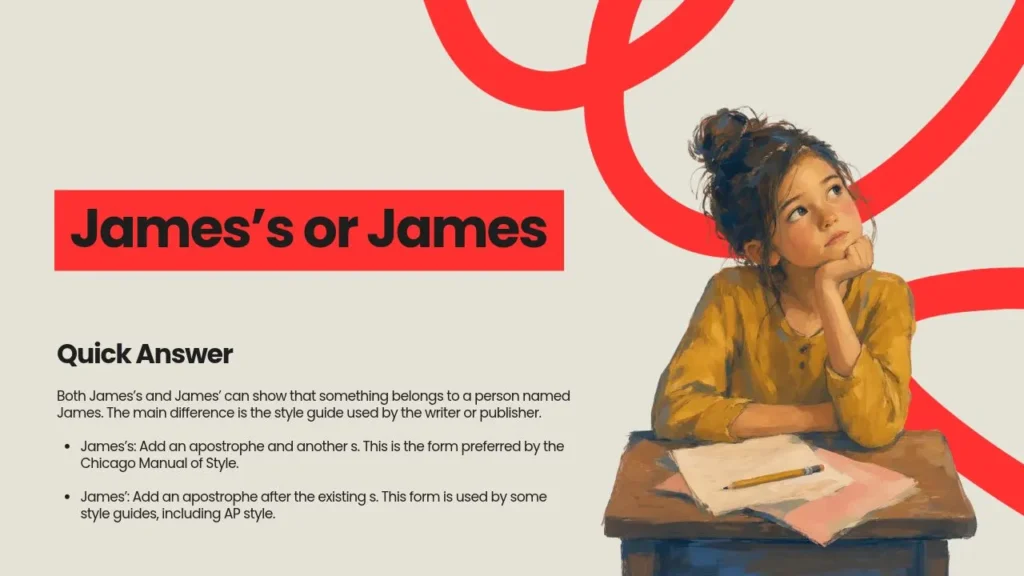
Both James’s and James’ can show that something belongs to a person named James. The main difference is the style guide used by the writer or publisher.
- James’s: Add an apostrophe and another s. This is the form preferred by the Chicago Manual of Style.
- James’: Add an apostrophe after the existing s. This form is used by some style guides, including AP style.
For example, both “James’s car is outside” and “James’ car is outside” can be correct under their respective conventions.
If your teacher, employer, or publisher requires a specific style guide, follow its rules. If no guide is specified, choose one accepted form and use it consistently throughout your writing.
Why Are Both James’s and James’ Used?
The confusion comes from a common English grammar rule. To show possession, writers usually add an apostrophe and s to a singular noun. However, when a name already ends in s, some style guides recommend adding another s, while others use only an apostrophe.
Neither spelling automatically indicates poor grammar. The choice depends on the convention being followed.
The Rule for James’s
The Chicago Manual of Style recommends adding an apostrophe and s to singular names ending in s. This means the possessive form of James is James’s.
Examples:
- James’s bicycle is parked outside.
- I borrowed James’s notebook.
- James’s advice helped me.
- We attended James’s presentation.
This spelling follows the broader convention of forming singular possessives with ’s, even when the noun already ends in s.
The Rule for James’
Some style guides use only an apostrophe after a singular proper name that ends in s. Under this convention, the possessive form is James’.
Examples:
- James’ bicycle is parked outside.
- I borrowed James’ notebook.
- James’ advice helped me.
- We attended James’ presentation.
The meaning is the same as in the James’s examples. The spelling changes because the style convention is different.
James’s vs. James’: Main Differences
The easiest way to understand the difference is to compare the spelling, meaning, and writing context.
| Feature | James’s | James’ |
| Purpose | Shows possession | Shows possession |
| Spelling | Adds apostrophe + s | Adds an apostrophe only |
| Chicago style | Preferred | Generally not preferred for this case |
| AP style | Generally not preferred | Preferred for singular proper names ending in s |
| Meaning | Belonging to James | Belonging to James |
The important point is that the two forms generally communicate the same relationship. The difference is in the punctuation convention, not in who owns the object.
Examples of James’s and James’ in Sentences
Consider these examples to see how the two spellings work in context.
| Using James’s | Using James’ |
| James’s phone is ringing. | James’ phone is ringing. |
| James’s sister lives nearby. | James’ sister lives nearby. |
| James’s report needs editing. | James’ report needs editing. |
| James’s birthday is tomorrow. | James’ birthday is tomorrow. |
| James’s idea solved the problem. | James’ idea solved the problem. |
Each pair communicates the same basic meaning. Choose the form that matches the style required for your writing.
Which Form Should You Use?
Your choice should depend on the purpose of your writing and any style requirements you need to follow. You do not need to memorize a different rule for every situation. Start by checking whether your school, publisher, or workplace has a preferred style guide.
For School Assignments
If your teacher has provided grammar rules or a style guide, use the required form. Many academic writing conventions use James’s for a singular name ending in s.
For example:
“James’s argument supports the main point of the essay.”
If no specific instructions are given, James’s is a reasonable choice because it follows a widely used possessive convention. However, consistency matters more than switching between forms.
For Newspapers and Online Publications
Publications may have their own editorial rules. AP style generally uses James’, while Chicago style prefers James’s.
For example, a publication following AP style would generally write:
“James’ statement was released on Monday.”
A publication following Chicago style would write:
“James’s statement was released on Monday.”
If you’re writing for a website, check its editorial guidelines before deciding which form to use.
For Emails and Everyday Writing
Both forms can work in everyday messages. If you are writing to a friend, sending a casual email, or posting online, the most important thing is to use the possessive form correctly and avoid confusing your reader.
Examples:
- I left James’s book on your desk.
- I left James’ book on your desk.
Either sentence can be appropriate under a recognized style convention.
For Business and Professional Documents
Reports, proposals, presentations, and formal documents should follow a consistent writing style. If your organization has an editorial guide, use it.
If no guide exists, choose a recognized convention and apply it throughout the document. Consistency helps your writing look polished and makes editing easier.
James’s, Jameses, and Jameses’: What Is the Difference?
These three forms look similar, but they serve different purposes. Understanding them will help you avoid confusing singular possession with a plural name.
James’s Means Possession by One Person
James’s is a singular possessive form. It indicates that something belongs to or is associated with one person named James.
Examples:
- James’s car is blue.
- James’s teacher praised his work.
- James’s office is on the second floor.
The name refers to one person, and the apostrophe marks the possessive relationship.
Jameses Means More Than One Person Named James
Jameses is the plural form of the name James. It refers to two or more people who share that name.
Examples:
- The two Jameses are classmates.
- Three Jameses attended the reunion.
- The Jameses in our group have different last names.
No apostrophe is needed simply to make the name plural. Apostrophes generally show possession or omitted letters, not ordinary plurals.
Jameses’ Means Possession by Multiple People Named James
Jameses’ is the plural possessive form. It indicates that something belongs to more than one person named James.
For example:
“The Jameses’ house is near the park.”
This sentence means that the house belongs to the people referred to as the Jameses.
Compare the three forms:
- James: One person’s name.
- James’s: Something belonging to one James, under the ’s convention.
- Jameses’: Something belonging to multiple people named James.
Remember that James’ is also used as a singular possessive under certain style conventions. Context and spelling rules help you determine which meaning is intended.
Common Mistakes When Using James’s or James’
Even a simple apostrophe rule can cause confusion. These common mistakes are easy to avoid once you understand the difference between possession and plural forms.
Adding an Apostrophe Incorrectly
Incorrect: James,s notebook is missing.
Correct: James’s notebook is missing.
The apostrophe must be placed correctly. A comma cannot replace it.
Using Jameses to Show Singular Possession
Incorrect: Jameses car is outside.
Correct: James’s car is outside.
Also accepted under some style conventions: James’ car is outside.
Jameses is normally the plural form of the name, not the standard singular possessive.
Using James’s and James’ Inconsistently
Switching between James’s and James’ in the same article can make the writing look inconsistent when you mean the same possessive form.
Choose the style required by your publisher or institution. If there is no requirement, select one accepted convention and use it throughout your document.
Assuming James’ Is Always Wrong
James’ is not automatically a grammar mistake. Some style guides prefer it for singular names ending in s.
Similarly, James’s is not wrong simply because the name already ends in s. The correct choice depends on the writing convention you follow.
Confusing Possession With a Contraction
The spelling James’s can also represent a contraction of “James is” or “James has” in certain sentences.
Compare these examples:
- “James’s phone is ringing.” Here, James’s shows possession.
- “James’s going home now.” Here, James’s means “James is.”
- “James’s finished his homework.” Here, James’s can mean “James has.”
The sentence determines the meaning. If a contraction makes the sentence unclear, write out “James is” or “James has” instead.
Frequently Asked Questions
Is James’s or James’ birthday correct?
Both forms can be correct. James’s birthday follows the Chicago style convention, while James’ birthday follows the AP style convention for singular proper names ending in s. Use the version required by your style guide.
Is James’ correct in American English?
Yes. James’ is accepted in American English, particularly in AP style. Other American writing conventions, including Chicago style, generally prefer James’s for a singular name ending in s. The style guide matters more than the country alone.
Is James’s correct in British English?
Yes. James’s is used in British English, and some British style guides also accept or recommend this form. Preferences can vary by publication, so check the relevant style guide rather than relying only on regional differences.
How do you make James plural?
The usual plural form is Jameses. For example, “Two Jameses attended the meeting.” Do not add an apostrophe simply to make the name plural.
What is the plural possessive of James?
The plural possessive is Jameses’. For example, “The Jameses’ house is large.” The plural name identifies multiple people, and the final apostrophe indicates that the house belongs to them.
Is James’s ever a contraction?
Yes. Depending on the sentence, James’s can mean “James is” or “James has.” For example, “James’s arriving soon” can mean “James is arriving soon.” In “James’s book,” however, the word shows possession.
Should I use James’s or James’ in formal writing?
Follow the style guide required by your school, employer, or publisher. Chicago style prefers James’s, while AP style generally uses James’. If no specific convention is required, choose one accepted form and use it consistently.
Conclusion
When deciding between James’s or James’, remember that both forms can be correct under different writing conventions. The Chicago Manual of Style prefers James’s, while AP style generally uses James’ for singular proper names ending in s.
For schoolwork, professional documents, and published articles, check the relevant style guide first. For everyday writing, either form can work when used consistently. Also, remember the difference between James’s as a singular possessive, Jameses as a plural name, and Jameses’ as a plural possessive.
Once you understand these distinctions, choosing the correct apostrophe placement becomes much easier.

Ava Collins is a passionate writer who enjoys turning everyday ideas into clear, engaging, and helpful content. She loves exploring language, culture and meaningful stories that connect with readers. Ava is also the fictional author of Beneath the Silver Maple and The Last Lantern of Willow Cove. When she’s not writing, she enjoys reading, traveling and finding inspiration in ordinary moments.
 Nicholas Turner
 Daniel Foster