
Have you ever wondered whether to write like or as in a sentence? You’re not alone. These two words often confuse English learners because they can express similar ideas, yet they are not always interchangeable.
Understanding like or as can help you write more clearly, avoid common grammar mistakes, and choose the right words in everyday conversations, school assignments, and professional writing.
The easiest way to start is to remember that like often expresses similarity, while as frequently describes a role, function, manner, or relationship between clauses. However, both words have several uses, and context matters.
Let’s explore the differences with simple rules, clear examples, common mistakes and a quick practice quiz.
Quick Answer: Like vs. As
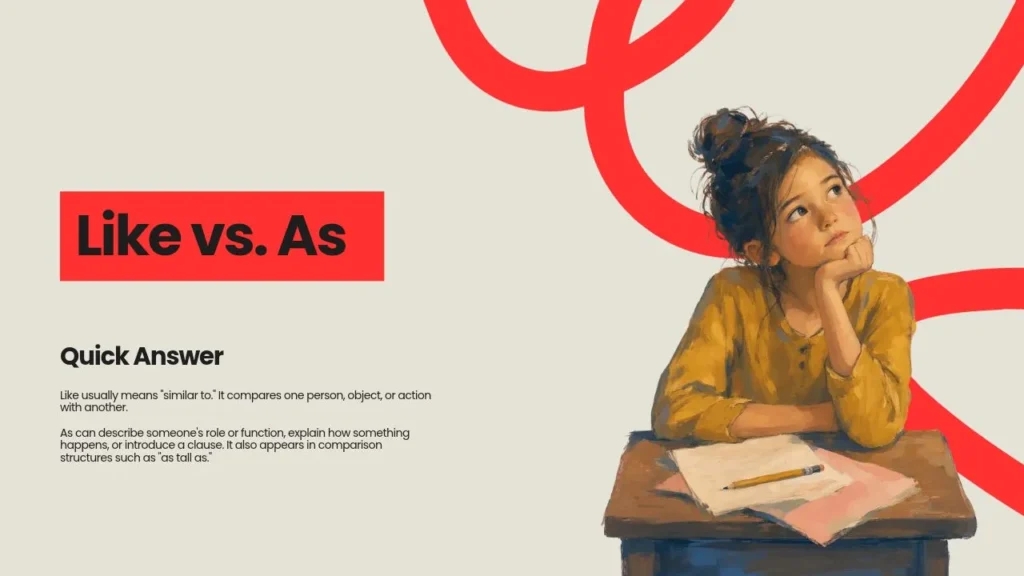
Like usually means “similar to.” It compares one person, object, or action with another.
As can describe someone’s role or function, explain how something happens, or introduce a clause. It also appears in comparison structures such as “as tall as.”
Consider these examples:
- Like: She sings like a professional.
- As: She works as a professional singer.
- As: Please arrange the books as I showed you.
- As … as: He is as tall as his brother.
In the first sentence, like compares her singing with the way a professional might sing. In the second, as describes her job. In the third, as explains how to arrange the books. In the fourth, as … as compares the height of two people.
A simple rule to remember is this: use like for similarity, as for roles and many clause-based meanings, and as … as to compare the degree of a quality. There are exceptions, especially in everyday English, so the examples below will help you understand when each form works best.
What Is the Difference Between Like and As?
The difference between like and as depends on the meaning and structure of your sentence. Although both words can connect ideas, they often perform different grammatical jobs.
When to Use Like
Use like to show that someone or something resembles another person or thing.
Examples:
- Your voice sounds like mine.
- This fabric feels like silk.
- He runs like a professional athlete.
- The clouds look like cotton.
- She behaves like her older sister.
In these sentences, like introduces something that helps the reader understand a similarity. The comparison might involve appearance, sound, behavior, texture, or another quality.
In standard grammar, like commonly works as a preposition followed by a noun, pronoun, or noun phrase. For example, “She looks like her mother” compares her appearance with her mother’s.
When to Use As
Use as when describing a role or function, explaining the manner in which something happens, or introducing clauses that express time or reason.
Examples:
- She works as a nurse.
- We used a blanket as a picnic mat.
- Do the exercise as I explained.
- As I was leaving, the phone rang.
- As it was getting late, we went home.
Here, as does more than compare two things. It identifies a role, describes a function, explains how to do something, or connects related events.
Notice the difference between these two sentences:
- He works like a manager.
- He works as a manager.
The first sentence suggests that his working style resembles a manager’s. It does not necessarily mean he holds that position. The second sentence identifies his actual role as a manager.
Can Like and As Be Used Interchangeably?
Sometimes they can express similar ideas, but they are not interchangeable in every sentence.
For example:
- She looks like a teacher.
- She works as a teacher.
The first sentence compares her appearance or behavior with what you might expect from a teacher. The second says that teaching is her job.
However, both words can appear in sentences about similarity or manner, depending on the construction.
For example:
- Do it as I showed you.
- Do it like I showed you.
The first version follows traditional formal grammar more closely. The second is common in everyday English. Both communicate the idea that you should follow the demonstrated method.
Always consider what you mean before choosing the word.
When to Use Like
The word like has several useful applications in English. Learning its main uses will help you choose it naturally in conversations and writing.
Use Like to Show Similarity
This is the most common use of like. It allows you to compare two things without saying they are exactly the same.
Examples:
- Her smile shines like the sun.
- He swims like a fish.
- This dessert tastes like chocolate.
- My brother looks like my father.
- The room smells like fresh flowers.
Each example highlights a resemblance. The person swimming is not a fish, and a smile is not literally the sun. These comparisons help readers imagine a quality or experience.
You can also use like to compare someone’s behavior with another person’s behavior.
For example, “She speaks like her mother” means that her way of speaking resembles her mother’s. It does not necessarily mean that she has the same voice or personality in every respect.
Use Like Before a Noun or Pronoun
When like means “similar to,” it is commonly followed by a noun, pronoun, or noun phrase.
Examples:
- He looks like his brother.
- This feels like a dream.
- Nobody understands me like you.
- She runs like an athlete.
- That sounds like a good idea.
The word after like gives you the person or thing used for comparison.
Be careful not to confuse this construction with as when describing a role. Compare “He dresses like a doctor” with “He works as a doctor.” The first describes how he dresses; the second identifies his profession.
Use Like to Give Examples
In everyday English, like can introduce examples of a larger category.
Examples:
- I enjoy outdoor activities like hiking and cycling.
- Fruits like apples and oranges are easy to pack.
- We studied subjects like history and geography.
- She enjoys creative hobbies like painting and photography.
In these sentences, like introduces examples that help explain the category.
You can also use such as for this purpose:
- I enjoy outdoor activities such as hiking and cycling.
- We studied subjects such as history and geography.
Both like and such as are common when giving examples. In formal writing, some style guides prefer such as when introducing specific examples. If precision matters, choose the wording that makes your intended meaning clearest.
Can Like Introduce a Complete Clause?
Yes. Although traditional grammar guidance often recommends as before a clause, modern English commonly uses like in this way, especially in conversation.
Examples:
- It looks like we’re going to be late.
- She talks like she knows everything.
- It sounds like you need a break.
- He acts like nothing happened.
These sentences are natural in everyday English. You do not need to treat every use of like before a clause as a mistake.
In formal writing, you may prefer as if or as though when describing an appearance, impression, or unreal situation.
For example:
- Everyday: He acts like he owns the place.
- More formal: He acts as if he owns the place.
Both communicate a similar idea. The second may sound more suitable in formal or academic writing.
When to Use As
The word as has several grammatical uses. It can identify a role, describe a function, connect clauses, and form comparisons.
Use As for Jobs, Roles, and Functions
Use as when someone holds a particular position or when something serves a particular purpose.
Examples:
- My sister works as a teacher.
- He served as the team captain.
- She joined the company as a designer.
- We used a box as a small table.
- They appointed him as the project manager.
In these examples, as explains the role or function of a person or object.
Compare these sentences:
- She sings like a professional.
- She works as a professional singer.
The first describes the quality of her singing by comparing it with a professional’s performance. The second identifies her work.
Another example makes the difference even clearer:
- He speaks like a lawyer.
- He works as a lawyer.
The first sentence describes his speaking style. The second identifies his profession.
Use As to Explain How Something Is Done
Use as when you want to explain the manner in which an action should be performed or how something happened.
Examples:
- Please write your name as it appears on your passport.
- Arrange the chairs as I instructed.
- Everything happened as we expected.
- Follow the recipe as the chef demonstrated.
- The team completed the task as planned.
In these examples, as introduces information about the way an action is carried out or the way an event unfolds.
This use is particularly helpful when giving instructions. For instance, “Prepare the report as your manager requested” means that you should follow the manager’s instructions.
Use As to Express Time
The word as can mean “while” when two actions happen at the same time or when one event occurs during another.
Examples:
- As I walked home, it started to rain.
- She smiled as she opened the gift.
- As the sun rose, the birds began to sing.
- He listened carefully as the teacher explained the lesson.
In each sentence, as connects events that happen at the same time or during the same period.
You can often replace as with while without changing the main idea.
For example:
“As I was leaving, the phone rang” can also be written as “While I was leaving, the phone rang.”
However, as can have other meanings too, so check the context before replacing it.
Use As to Express Reason
You can use as to introduce a reason for something. In this context, it often means “because” or “since.”
Examples:
- As it was getting dark, we returned home.
- As she was feeling tired, she went to bed early.
- As the roads were flooded, the school closed.
- As everyone was ready, the meeting began.
The clause beginning with as explains why the other event happened.
For example, “As it was raining, we stayed indoors” tells the reader that rain was the reason for staying inside.
This use is common in written English. When the reason needs strong emphasis or could be misunderstood, because may be clearer.
Use As If and As Though
Use as if or as though when describing how someone or something appears, behaves, or seems.
Examples:
- He talks as if he knows everything.
- She looked as though she had seen a ghost.
- It sounds as if someone is at the door.
- They acted as if nothing had happened.
These expressions describe an impression rather than necessarily confirming that the impression is true.
For example, “He talks as if he owns the company” does not prove that he owns it. It describes the way he speaks.
In everyday English, like can often express a similar meaning:
“He talks like he owns the company.”
Both forms are common, but as if and as though may be preferred in more formal writing.
How to Use As … As in Comparisons
One of the most important uses of as is the comparison structure as + adjective or adverb + as. It compares the degree of a quality or action between two people, things, or situations.
Use As … As to Compare Equal Qualities
Use this structure when two things have the same or a similar degree of a quality.
Examples:
- My sister is as tall as I am.
- This book is as interesting as that one.
- The new phone is as expensive as the old model.
- He runs as quickly as his brother does.
- The room is as bright as the kitchen.
In each sentence, the first person or thing is compared with the second.
The pattern is:
Subject + verb + as + adjective or adverb + as + comparison.
For example, “The test was as difficult as the previous one.”
This means that the two tests had the same or a similar level of difficulty.
Use Not As … As to Show a Difference
Use not as … as to say that something does not reach the same degree as another thing.
Examples:
- This bag is not as expensive as that one.
- He is not as tall as his brother.
- Today’s weather is not as warm as yesterday’s.
- The second lesson was not as difficult as the first.
- I do not run as quickly as my friend.
These sentences show that the first person or thing has a lower degree of the quality being discussed.
For example, “This book is not as long as that one” means that the first book is shorter than the second.
Use As Much As and As Many As
Use as much as with uncountable nouns or to compare amounts, and as many as with countable plural nouns.
Examples:
- I do not have as much time as you.
- She earns as much money as her colleague.
- We have as many books as they do.
- He invited as many guests as his sister.
- You can take as much water as you need.
Remember this simple distinction:
- As much as: water, time, money, information.
- As many as: books, guests, people, questions.
These expressions can also have other meanings in context, but the countable and uncountable distinction is a useful starting point.
Understand the Difference Between Like and As … As
These structures may look similar because both can compare things, but they work differently.
Compare:
- She sings like a professional.
- She sings as well as a professional.
The first sentence says that her singing resembles a professional’s singing. The second compares the quality of her singing with a professional’s.
Another example:
- He looks like his father.
- He is as tall as his father.
The first compares appearance in a general way. The second compares a specific quality, height.
Use like for a general resemblance and as … as when comparing the degree of a quality or action.
Like or As in Example Sentences
Comparing sentences side by side is one of the easiest ways to learn the difference. Each pair below highlights a different grammatical purpose.
| Sentence with Like | Sentence with As | Difference |
| She looks like her mother. | She works as a nurse. | Similarity versus role |
| He talks like a leader. | He served as a leader. | Resembling a leader versus holding the role |
| This feels like silk. | Use this cloth as a curtain. | Similarity versus function |
| She sings like a professional. | She sings as well as a professional. | General resemblance versus degree of ability |
| It looks like rain is coming. | As the rain began, we went inside. | Everyday clause usage versus time |
| He acts like he is angry. | He behaves as I expected. | Informal comparison versus manner |
| Activities like hiking are enjoyable. | As I explained, hiking requires preparation. | Giving examples versus introducing a clause |
These examples show why it is important to consider the whole sentence rather than choosing a word based on one memorized rule.
More Examples of Like in Everyday English
Here are additional examples that show how like appears in normal conversations and writing.
- You look like you need some sleep.
- This song sounds like an old favorite.
- She has a smile like her grandmother’s.
- The weather feels like spring.
- He eats like a hungry athlete.
- I enjoy books like mystery novels and biographies.
In these sentences, like helps describe a resemblance, an impression, or examples of a category.
More Examples of As in Everyday English
The following sentences demonstrate different meanings of as.
- She works as an editor.
- Use the chair as a step stool.
- Do it as I showed you.
- As I entered the room, everyone looked up.
- As the store was closed, we returned later.
- The results were as good as we expected.
The word as does not have just one meaning. Its function depends on the words around it and the relationship between the ideas in the sentence.
Like or As in Formal and Informal English
Both like and as are correct English words. The important question is whether the construction fits your meaning, audience, and writing style.
When Like Is Natural
In everyday conversations, like often introduces a comparison or a complete clause.
Examples:
- Like I said, we need more time.
- It looks like we’re going to be late.
- She acts like she knows everyone.
- It sounds like you have a good plan.
These expressions are widely used in modern English. They are generally suitable for conversations, casual emails, messages, and many forms of informal writing.
Do not assume that like is always informal. It is entirely appropriate in many formal constructions, such as “The results were like those recorded last year.”
When As May Be Preferable
In formal or academic writing, as can be a better choice when introducing a clause that explains manner or when describing a role.
Examples:
- As I mentioned earlier, the results need further review.
- Please complete the task as instructed.
- She was appointed as the department head.
- As the evidence shows, the situation has changed.
If you are writing an academic paper, professional report, or formal letter, choose the construction that communicates your meaning precisely.
For example:
- Casual: Do it like I showed you.
- More formal: Do it as I showed you.
Both versions are understandable. The second is often preferred in traditional formal grammar.
Is Like or As More Correct?
Neither word is automatically more correct than the other. They have different grammatical functions, and the right choice depends on the sentence.
For example, “She works as a doctor” is appropriate for describing a profession. Replacing as with like changes the meaning.
Similarly, “She looks like her mother” is the natural choice for comparing appearance. Replacing like with as would not preserve the intended construction.
The best approach is to learn the patterns instead of treating one word as more formal or more correct in every situation.
Common Mistakes With Like and As
Even experienced English users sometimes confuse these words. The following mistakes show how to recognize and correct the most common problems.
Mistake 1: Using Like to Describe a Job
Incorrect for the intended meaning: She works like a doctor.
Correct: She works as a doctor.
The first sentence compares the way she works with the way a doctor works. The second identifies her profession.
If you mean that someone holds a particular position, use as.
Mistake 2: Using As for a Simple Similarity
Incorrect: He looks as his brother.
Correct: He looks like his brother.
When comparing appearance, like is the natural choice. You could also say, “He looks the same as his brother,” but that uses a different grammatical structure.
Mistake 3: Forgetting the Second As in a Comparison
Incorrect: She is as tall her sister.
Correct: She is as tall as her sister.
The standard comparison structure requires as before the adjective and again before the comparison.
Remember the pattern: as + adjective + as.
Mistake 4: Treating Like Before a Clause as Always Wrong
Incorrect assumption: “It looks like it will rain” is always grammatically incorrect.
Better understanding: This sentence is common and acceptable in modern English. In formal writing, “It looks as if it will rain” is also a good option.
Traditional grammar recommendations and everyday usage do not always follow exactly the same preferences. Choose the form appropriate for your context.
Mistake 5: Confusing As With As If
Compare these sentences:
- She works as a manager.
- She talks as if she were the manager.
The first sentence identifies her role. The second describes how she speaks, suggesting that she behaves as though she holds that role.
Use as if when you want to describe an appearance, impression, or hypothetical situation.
Mistake 6: Using As Much and As Many Incorrectly
Incorrect: I have as many time as you.
Correct: I have as much time as you.
Time is uncountable in this meaning, so as much as is appropriate.
Compare:
- As much water as you need.
- As many bottles as you need.
Use much for uncountable quantities and many for countable plural items.
How to Remember the Difference Between Like and As
If you still find these words confusing, use the following checks before choosing one.
Ask Whether You Mean Similarity
If your intended meaning is “similar to,” like is often the right choice.
Examples:
- This tastes like honey.
- She looks like her aunt.
- He runs like a professional athlete.
Ask Whether You Mean a Role or Function
If you are explaining someone’s job, position, or the purpose of an object, as is usually the right choice.
Examples:
- She works as a nurse.
- He acted as the group leader.
- We used the basket as a storage container.
Check Whether You Are Comparing a Degree
If you are comparing height, speed, age, quality, or another measurable characteristic, consider the as … as structure.
Examples:
- He is as tall as his father.
- She works as carefully as her colleague.
- This route is not as long as the other one.
Check the Meaning of the Clause
If a clause follows the word, ask whether you are expressing manner, time, reason, or an impression.
Examples:
- Do it as I explained. (Manner)
- As I arrived, the meeting began. (Time)
- As it was late, we left. (Reason)
- He looks as if he is tired. (Impression)
This method is more reliable than trying to remember one rule that supposedly applies to every sentence.
Like or As Practice Quiz
Now test your understanding. Choose like or as for each blank. Some questions test similarity, while others test roles, comparisons, and clauses.
- She works ___ a graphic designer.
- He looks ___ his older brother.
- Please arrange the chairs ___ I showed you.
- The baby sleeps ___ an angel.
- This bag is not ___ expensive ___ that one.
- We used the old box ___ a storage container.
- It sounds ___ you’re feeling tired.
- ___ it was raining, we stayed inside.
- She runs ___ quickly ___ her sister.
- I enjoy outdoor activities ___ hiking and cycling.
- He talks ___ if he knows everything.
- Write your name ___ it appears on your passport.
Quiz Answers and Explanations
- As: It identifies her job or professional role.
- Like: It compares his appearance with his brother’s.
- As: It introduces a clause explaining how to arrange the chairs.
- Like: It compares the baby’s sleeping with the peaceful image of an angel.
- As, as: The correct pattern is not as + adjective + as.
- As: The box serves the function of a storage container.
- Like: This is a common conversational construction. “It sounds as if you’re feeling tired” is another option.
- As: Here, as introduces a reason and means approximately “because.”
- As, as: The structure as quickly as compares the speed of two people.
- Like: It introduces examples of outdoor activities. “Such as hiking and cycling” also works.
- As: The complete expression is as if, which describes an impression or hypothetical situation. In casual English, “He talks like he knows everything” is also common.
- As: It introduces a clause explaining how your name should appear.
If you answered most questions correctly, you understand the main patterns. If you missed a few, review the examples for that particular use rather than memorizing the entire article again.
Frequently Asked Questions
What Is the Main Difference Between Like and As?
Like usually expresses similarity, while as can describe a role or function, explain how something happens, and introduce clauses expressing time or reason. The expression as … as also compares the degree of a quality or action.
Should I Say Like I Said or As I Said?
Both expressions are used, but they suit different contexts. “Like I said” is common in everyday English, while “as I said” is often preferred in formal writing. You can also use “as I mentioned earlier” for a polished professional tone.
Can Like Be Used Before a Complete Sentence?
Yes. Modern English commonly uses like before a clause, as in “It looks like we are late.” This construction is especially common in conversation. In formal writing, as if or as though may be preferable in sentences describing an impression.
When Should I Use As … As?
Use as … as to compare the degree of a quality or action. For example, “My room is as large as yours” compares the size of two rooms. Use not as … as when one thing does not reach the same degree as another.
What Is the Difference Between Like a Teacher and As a Teacher?
“Like a teacher” means that someone resembles a teacher in appearance, behavior, or another quality. “As a teacher” identifies the person’s role or function. For example, “He speaks like a teacher” describes his speaking style, while “He works as a teacher” describes his profession.
Conclusion
Choosing between like and as becomes much easier when you focus on what your sentence means. Use like to express similarity or introduce examples. Use as to describe a role or function, explain how something happens, or connect clauses that express time and reason. When comparing the degree of a quality, remember the structure as … as.
Also, keep in mind that everyday English sometimes uses like before a complete clause, even when traditional grammar guidance prefers as or as if in formal writing. Context matters more than memorizing a single rule. The next time you hesitate between these two words, check whether you are describing a similarity, a role, a manner, or a comparison. That simple habit will help you write more naturally and confidently.

Daniel Foster is a writer who enjoys breaking down complex topics into simple, engaging and easy-to-understand content. He has a passion for research, storytelling, and creating articles that help readers find clear answers. Daniel is also the fictional author of Beyond the Quiet Compass and Shadows of the Forgotten Tide. When he’s away from the keyboard, he enjoys hiking, reading, and exploring new ideas. His goal is to create content that is informative, trustworthy and enjoyable to read.
 Nicholas Turner
 Ava Collins