
If you are unsure whether recieve or receive is the correct spelling, you should use receive. Receive is the standard and correct English spelling, while recieve is a misspelling.
The confusion usually comes from the order of the letters i and e. Many English words contain ie, so it is easy to accidentally write recieve instead of receive. The correct spelling has ei after the letter c:
Receive ✅
Recieve ❌
For example, you can say, “I hope to receive your message soon.” You should not write, “I hope to recieve your message soon.”
The same spelling pattern continues in related forms such as received, receiving, and receives. Learning these forms together can make the correct spelling much easier to remember.
Recieve or Receive: Quick Answer
Receive Is Correct
Receive is the correct spelling in standard English.
It is a verb that commonly means to get, be given, or accept something. You can receive an email, receive a gift, receive information, receive payment, or receive an award.
Examples:
- I will receive the package tomorrow.
- Did you receive my email?
- She hopes to receive a scholarship.
- We expect to receive the results soon.
Recieve Is Incorrect
Recieve is not the standard spelling of the word.
The mistake happens because the letters e and i are placed in the wrong order. Compare the two:
- receive → correct
- recieve → incorrect
The important part to remember is cei, not cie.
| Spelling | Correct? | Example |
| receive | Yes | I will receive the letter. |
| recieve | No | I will recieve the letter. |
If you are writing a school assignment, email, application, report, or professional message, always use receive.
What Does Receive Mean?
Receive Means to Get Something
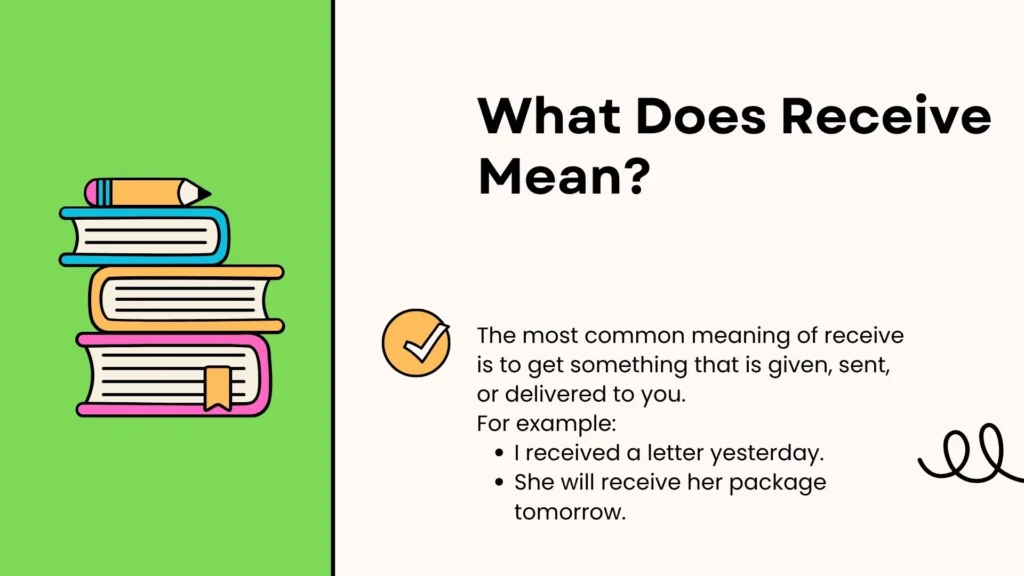
The most common meaning of receive is to get something that is given, sent, or delivered to you.
For example:
- I received a letter yesterday.
- She will receive her package tomorrow.
- We received an invitation to the event.
- Did you receive the information?
In these sentences, something comes to a person, and that person receives it.
Receive Can Have Other Meanings
The word receive can be used in several different situations.
You can receive a signal, message, payment, award, visitor, or reaction.
For example:
- The radio can receive a signal.
- The company received payment.
- He received an award.
- The hotel can receive guests.
- Her suggestion was well received.
This makes receive a useful everyday word that appears in personal, academic, business, and technical writing.
Why Do People Confuse Recieve and Receive?
The IE and EI Problem
The main problem is the order of two vowels.
The incorrect spelling is:
recieve
The correct spelling is:
receive
Look closely at the middle:
receive
recieve
The correct spelling contains ei after c.
This type of confusion is common because English contains many words with different ie and ei patterns.
Similar Words Can Cause Confusion
Words such as believe, piece, and friend contain ie, so writers may naturally expect receive to follow the same pattern.
For example:
- believe
- piece
- friend
- field
But receive uses ei:
- receive
- received
- receiving
The safest approach is to remember the spelling of receive itself rather than assuming every word follows the same vowel pattern.
The “I Before E” Rule Can Be Misleading
Many people learn the phrase “i before e except after c.” This can help you remember words such as receive, because the letters after c are ei.
However, English spelling has many exceptions, so this rhyme should not be treated as a perfect rule for every word.
For receive, the useful memory point is simple:
After C, remember EI in receive.
Receive vs. Recieve Examples
Everyday Examples
Here are some natural examples using receive:
- I hope you receive this letter.
- Did you receive my text?
- She will receive a gift on her birthday.
- We received the package this morning.
- He receives several emails every day.
Each sentence uses the correct spelling receive or one of its correct forms.
Formal and Professional Examples
Receive is also common in professional communication.
Examples include:
- We have received your application.
- You will receive a confirmation email.
- Please let us know when you receive the documents.
- The customer will receive an invoice shortly.
- Employees will receive further instructions by email.
These situations are especially important because a spelling mistake can make formal writing look less polished.
Email and Message Examples
Because receive is frequently used when talking about communication, these are useful sentences to remember:
- Did you receive my email?
- I have received your message.
- You should receive a confirmation shortly.
- We did not receive your reply.
- She is receiving messages from the team.
Notice that none of these sentences uses recieve.
Received or Recieved: Which Is Correct?
Received Is the Correct Past Form
The correct past tense and past participle is received.
Received = correct
Recieved = incorrect
Examples:
- I received your email yesterday.
- She received a package this morning.
- We received your application.
- He received an award for his work.
The easiest way to remember it is to start with the correct base word:
receive → received
Do not change the ei sequence when adding -d.
Common Received Mistake
A frequent spelling error is:
We recieved your application.
The correct sentence is:
We received your application.
The difference is only the order of e and i, but it changes a correct spelling into an error.
Receiving or Recieving: Which Is Correct?
Receiving Is Correct
The correct -ing form is receiving.
Receiving = correct
Recieving = incorrect
Examples:
- We are receiving new applications.
- She is receiving emails from customers.
- The store is receiving new stock.
- They are receiving payments online.
When -ing is added to receive, the final e is removed:
receive → receiving
The ei sequence remains unchanged.
Remember the Three Main Forms
Learning the three forms together can prevent repeated mistakes:
| Form | Correct Spelling | Example |
| Base form | receive | I receive emails. |
| Past form | received | I received an email. |
| -ing form | receiving | I am receiving emails. |
This is much easier to remember than treating each spelling as a separate word.
Receives or Recieves: Which Is Correct?
Receives Is Correct
The third-person singular form is receives.
Examples:
- She receives many emails.
- He receives a monthly payment.
- The school receives applications throughout the year.
- The company receives hundreds of orders.
Recieves is incorrect.
The spelling follows:
receive → receives
The final e remains before the s.
Common Uses of Receive
Receive an Email
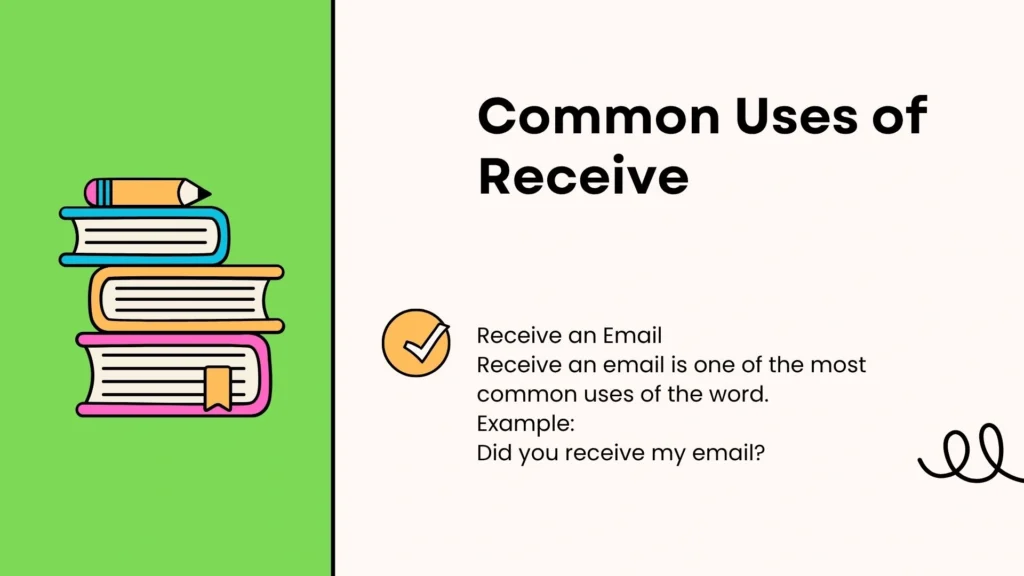
Receive an email is one of the most common uses of the word.
Example:
Did you receive my email?
You can also say:
I received your email this morning.
Receive a Package
When something is delivered to you, you can say that you receive it.
Example:
I expect to receive my package tomorrow.
Receive Payment
Businesses and individuals can receive payment.
Example:
The company received payment from the customer.
Receive an Award
Someone can receive an award, prize, certificate, or honor.
Example:
She received an award for her research.
Receive Information
Information can also be received.
Example:
Students will receive more information next week.
Receive Feedback
In school or at work, people often receive feedback.
Example:
The writer received helpful feedback from her editor.
Receive vs. Accept: What Is the Difference?
Receive and accept can sometimes appear in similar situations, but they do not mean exactly the same thing.
Receive generally focuses on getting something.
Accept focuses on agreeing to take or approve something.
Compare these sentences:
I received the invitation.
This means the invitation came to me.
I accepted the invitation.
This means I agreed to attend.
You can therefore receive something without necessarily accepting it.
For example:
I received the job offer, but I did not accept it.
This distinction is useful when learning how to use receive correctly.
Receive, Receipt, and Receiver
Receive
Receive is a verb.
Example:
I will receive the payment tomorrow.
Receipt
Receipt is a noun that can refer to written proof of a purchase or payment.
Example:
Please keep your receipt.
Although receive and receipt look similar, they have different meanings and pronunciations.
Receiver
Receiver is a noun referring to someone or something that receives something.
Example:
The radio receiver picked up the signal.
Learning these related words can help prevent confusion between them.
Is Receive Different in British and American English?
Receive Has the Same Spelling
There is no recieve vs. receive regional spelling difference between British and American English.
The standard spelling is:
receive
This is true in both varieties.
So you should not use recieve simply because you are writing in British English or American English.
Other English words sometimes have different regional spellings, but receive is not one of those words.
How to Remember the Spelling of Receive
Use the CEI Memory Trick
A simple way to remember receive is to focus on the middle:
re + cei + ve
The key sequence is:
CEI
Not:
CIE
So when you are unsure, write:
re-cei-ve
That gives you:
receive
Remember Receive, Received, and Receiving Together
Another useful technique is to learn the word family:
receive
receives
received
receiving
Seeing the same spelling pattern in different forms makes it easier to recognize the correct version.
For example:
I receive emails.
She receives emails.
I received an email.
I am receiving emails.
The incorrect versions recieve, recieves, recieved, and recieving should not be used.
Common Mistakes With Receive
Mistake 1: Recieve
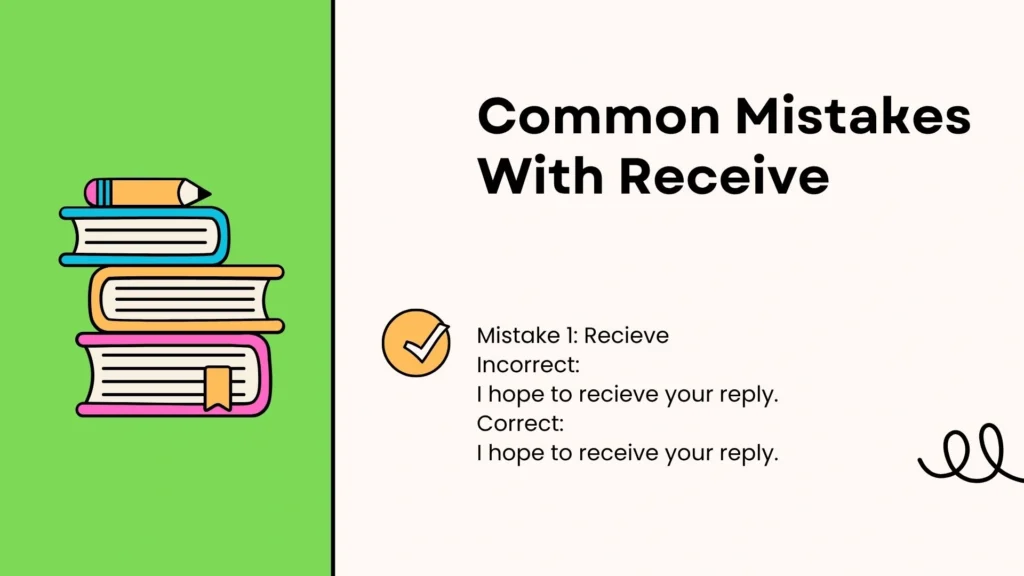
Incorrect:
I hope to recieve your reply.
Correct:
I hope to receive your reply.
Mistake 2: Recieved
Incorrect:
We recieved your message.
Correct:
We received your message.
Mistake 3: Recieving
Incorrect:
She is recieving emails.
Correct:
She is receiving emails.
Mistake 4: Recieves
Incorrect:
He recieves several letters every week.
Correct:
He receives several letters every week.
Mistake 5: Recive
Another variation is leaving out the second e:
I will recive the package tomorrow.
The correct form is:
I will receive the package tomorrow.
When checking your writing, look carefully at the sequence cei.
Receive in Different Writing Situations
In School Writing
Students may use receive when discussing grades, awards, information, or assignments.
Students will receive their results next week.
In Workplace Writing
Employees often use the word in emails and reports.
We have received your request.
In Customer Service
Businesses commonly use receive when discussing orders, payments, and deliveries.
You will receive a confirmation after your order is processed.
In Personal Messages
The word is also natural in everyday conversation.
Did you receive my message?
This wide range of uses makes learning the correct spelling especially worthwhile.
Quick Receive Spelling Quiz
Choose the correct word in each sentence.
- Did you (receive / recieve) my email?
- I (received / recieved) your letter yesterday.
- She is (receiving / recieving) a package today.
- He (receives / recieves) regular updates.
- We hope to (receive / recieve) your reply soon.
- The company has (received / recieved) your application.
Quiz Answers
- receive
- received
- receiving
- receives
- receive
- received
If you got all six correct, you have a good grasp of the spelling pattern.
Frequently Asked Questions
Is recieve a correct spelling?
No. Recieve is a misspelling. The correct spelling is receive.
Is it receive or recieve an email?
The correct phrase is receive an email.
For example:
Did you receive my email?
Is it received or recieved?
Received is correct. Recieved is incorrect.
Example:
I received your message yesterday.
Is it receiving or recieving?
Receiving is correct. Recieving is incorrect.
Example:
We are receiving new applications.
Why is receive spelled with ei?
The standard spelling of the word is receive, with ei after c. The incorrect form recieve switches the order of these two vowels.
How do I remember receive?
Remember the middle of the word as CEI:
re + cei + ve = receive
You can also learn the word family together: receive, receives, received, receiving.
Conclusion
When choosing between recieve or receive, the correct spelling is receive. The incorrect form recieve comes from switching the order of e and i. Remember the middle sequence cei, and keep that pattern when using related forms such as receives and received. For the -ing form, remember receiving, not recieving. Whether you are writing an email, school assignment, business message, or everyday sentence, receive is the spelling to use.

Daniel Foster is a writer who enjoys breaking down complex topics into simple, engaging and easy-to-understand content. He has a passion for research, storytelling, and creating articles that help readers find clear answers. Daniel is also the fictional author of Beyond the Quiet Compass and Shadows of the Forgotten Tide. When he’s away from the keyboard, he enjoys hiking, reading, and exploring new ideas. His goal is to create content that is informative, trustworthy and enjoyable to read.
 Ava Collins