

Have you ever paused while writing an email because you weren’t sure whether to type recieved or received?
This is a common spelling confusion, especially when you’re writing quickly or trying to finish a message. The two words look almost identical, but only one is correct in standard English.
Received is the correct spelling. Recieved is a misspelling. The correct word means to get, obtain, or be given something. You might receive an email, a package, a payment, or good news.
Learning the correct spelling and a simple way to remember it can help you avoid this mistake in schoolwork, professional documents, and everyday messages.
Recieved or Received: Which One Is Correct?
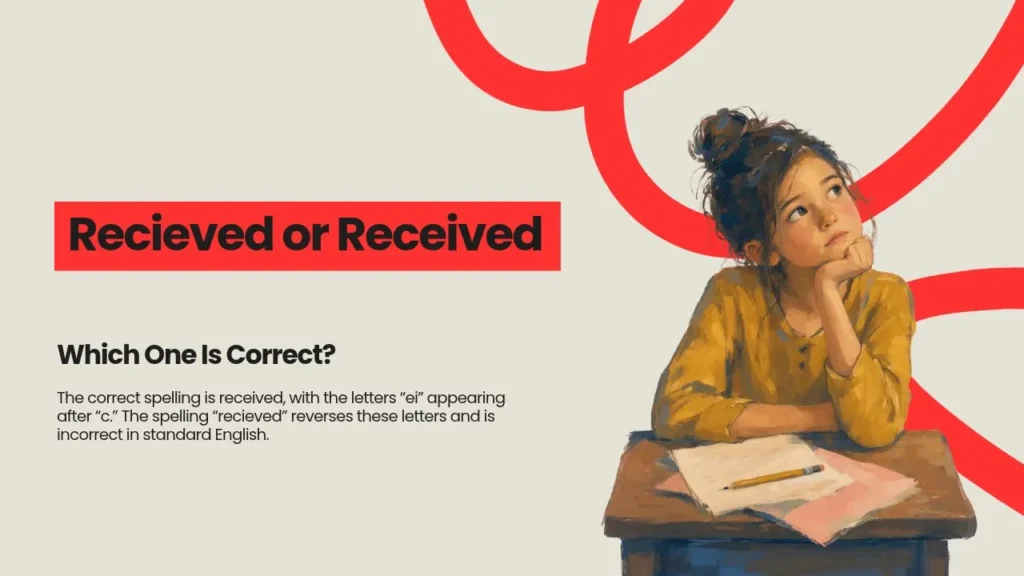
The correct spelling is received, with the letters “ei” appearing after “c.” The spelling “recieved” reverses these letters and is incorrect in standard English.
Here is a quick comparison:
| Spelling | Status | Example |
| Received | Correct | I received your message yesterday. |
| Recieved | Incorrect | I recieved your message yesterday. |
If you’re writing a job application, school assignment, business email, or personal message, always use received.
The mistake usually happens because people remember the sound of a word but not its exact letter order. Since received contains several vowels, it’s easy to type the letters incorrectly when you’re in a hurry. The best solution is to remember the spelling of the base word, receive, and use it as a guide.
What Does Received Mean?
Received is the past tense and past participle of the verb receive. It means that someone got, obtained, accepted, or was given something.
The word can describe many everyday situations. For example, you can receive a message from a friend, receive money from a customer, or receive an award for your work.
Here are some examples:
- I received your email this morning.
- She received a gift from her brother.
- We received the payment before the deadline.
- He received a certificate for completing the course.
- They received good news about their application.
Received can also describe how people respond to something. For example, “The presentation was well received” means that the audience reacted positively to it.
Understanding the meaning helps you recognize when the word fits a sentence. However, knowing the meaning alone isn’t enough. You also need to remember its correct spelling.
Why Is Received Spelled With “Ei”?
The spelling of received comes from its base word, receive. When you form the simple past tense or past participle, you keep the original spelling and add “d.”
Receive + d = Received
Notice that the letters “ei” remain in the same order. You don’t switch them to “ie” when changing receive into received.
A familiar spelling mnemonic says, “I before E, except after C.” This can help you remember why received contains “ei” after “c.” However, English has exceptions to this mnemonic, so it’s best to treat it as a memory aid rather than a rule that works for every word.
The easiest approach is to learn the base word first:
- Receive: I receive several emails every day.
- Receives: She receives updates from her manager.
- Received: I received your email yesterday.
- Receiving: We are receiving new orders this week.
- Receiver: The receiver signed for the delivery.
These words belong to the same word family, but they have different grammatical roles. Learning them together can help you spell each form correctly.
Receive vs. Received: Meaning and Grammar
Receive and received have related meanings, but they are used differently depending on the sentence.
| Word or Form | How It Is Used | Example |
| Receive | Base form of the verb | I receive a weekly newsletter. |
| Receives | Present tense with he, she, or it | She receives customer requests. |
| Received | Simple past tense | I received the parcel yesterday. |
| Have received | Present perfect | We have received your application. |
| Had received | Past perfect | She had received the documents before the meeting. |
| Receiving | Present participle or gerund | He is receiving training this month. |
These forms help you describe actions at different times. The spelling received stays the same when it functions as the simple past tense or past participle.
Should You Use “Received” or “Have Received”?
Both forms are correct, but they serve different purposes.
Use received when describing a completed action in the past, especially when mentioning a specific past time.
Example: “I received your message yesterday.”
Use have received when you want to connect a past action with the present or report that something has arrived without focusing on when it happened.
Example: “I have received your message and will respond soon.”
You can also use had received when one past action happened before another.
Example: “I had received the instructions before the meeting began.”
The best choice depends on what you want to communicate. Regardless of the tense, remember to spell the word received correctly.
Examples of Received in Everyday Sentences

Examples make it easier to recognize how received works in different situations. Instead of memorizing a spelling rule alone, pay attention to how the word fits into a complete sentence.
Examples in Emails and Professional Writing
- I have received your email and will reply shortly.
- We received your application before the deadline.
- This message confirms that your payment was received.
- The office received the documents on Monday.
These examples are useful for work messages, customer service replies, and formal communication.
Examples in School and Daily Life
- I received my exam results yesterday.
- She received an award for her hard work.
- We received an invitation to the wedding.
- He received a package from his online order.
Examples of Common Grammar Patterns
- Simple past: I received the file last night.
- Present perfect: I have received the file.
- Past perfect: I had received the file before the meeting.
- Passive voice: The file was received by the manager.
Notice that received remains correctly spelled in every example. The surrounding words change to express the intended meaning, but the spelling does not change.
Common Spelling Mistakes Related to Received
The most common mistake is writing recieved instead of received. However, people sometimes misspell other words in the same family, especially when they are unsure of the original word.
| Incorrect Spelling | Correct Spelling |
| Recieved | Received |
| Recieve | Receive |
| Recieving | Receiving |
| Reciever | Receiver |
One useful habit is to check the base word before adding an ending. If you know that receive is correct, you can use it to remember received, receiving, and receiver.
Be careful not to confuse receive with receipt. Both words contain a similar sequence of letters, but receipt has a silent “p” and is a different word.
For example:
- Correct: I received the package and kept the receipt.
- Incorrect: I recieved the package and kept the reciept.
Spell-check tools can catch many of these mistakes, but they shouldn’t replace your own proofreading. A quick review before sending a message can prevent small errors from appearing in important documents.
Is Received Correct in American and British English?
Yes. Received is the standard spelling in both American and British English. The spelling does not change based on your country or the type of English you use.
For example:
- American English: I received your email this morning.
- British English: I received your email this morning.
Both sentences use the same spelling. Recieved is not a standard alternative in either variety.
This makes the choice simple. Whether you’re writing for a school in the United States, a company in the United Kingdom, or an international audience, use received.
Frequently Asked Questions
Is it recieved or received?
Received is correct. Recieved is a misspelling caused by putting “i” before “e” in the wrong position. Always use received in standard English.
How do you spell received correctly?
The correct spelling is R-E-C-E-I-V-E-D. Start with receive, keep the letters “ei” in their original order, and add “d.”
Why do people misspell received?
People often misspell received because they reverse the letters “i” and “e” or rely on memory rather than checking the word. Learning the spelling of receive can make the correct form easier to remember.
Is received the past tense of receive?
Yes. Received is the simple past tense and past participle of receive. For example, “I received your letter yesterday” uses the simple past, while “I have received your letter” uses the present perfect.
Is “I have recieved your email” correct?
No. The correct sentence is “I have received your email.” The grammar pattern is correct, but recieved must be replaced with received.
Is recieved ever acceptable in English?
Recieved is not an accepted alternative spelling in standard English. You might see it in informal online messages or documents containing typing errors, but it should be corrected in professional and academic writing.
Conclusion
When deciding between recieved or received, always choose received. It is the correct spelling of the past tense and past participle of receive, while recieved is a common spelling mistake.
The easiest way to remember the correct form is to learn receive first and keep the letters “ei” in the same order when adding “d.” Use received in emails, assignments, work documents, and everyday messages to communicate clearly and confidently. A quick spelling check can help you catch this small but common mistake before you share your writing.

Daniel Foster is a writer who enjoys breaking down complex topics into simple, engaging and easy-to-understand content. He has a passion for research, storytelling, and creating articles that help readers find clear answers. Daniel is also the fictional author of Beyond the Quiet Compass and Shadows of the Forgotten Tide. When he’s away from the keyboard, he enjoys hiking, reading, and exploring new ideas. His goal is to create content that is informative, trustworthy and enjoyable to read.
 Nicholas Turner
 Ava Collins