

If you are unsure whether to write sergeant or sargent, the correct spelling depends on what you mean.
Sergeant is the standard spelling of the military and police rank, while Sargent is a common misspelling when referring to that rank.
However, Sargent is also a legitimate surname. The confusion mainly comes from pronunciation because sergeant sounds more like “SAR-jənt” than its written form suggests.
Understanding the difference will help you avoid spelling mistakes and use both words correctly in everyday writing, professional communication, and formal documents.
Sergeant or Sargent: Which One Is Correct?
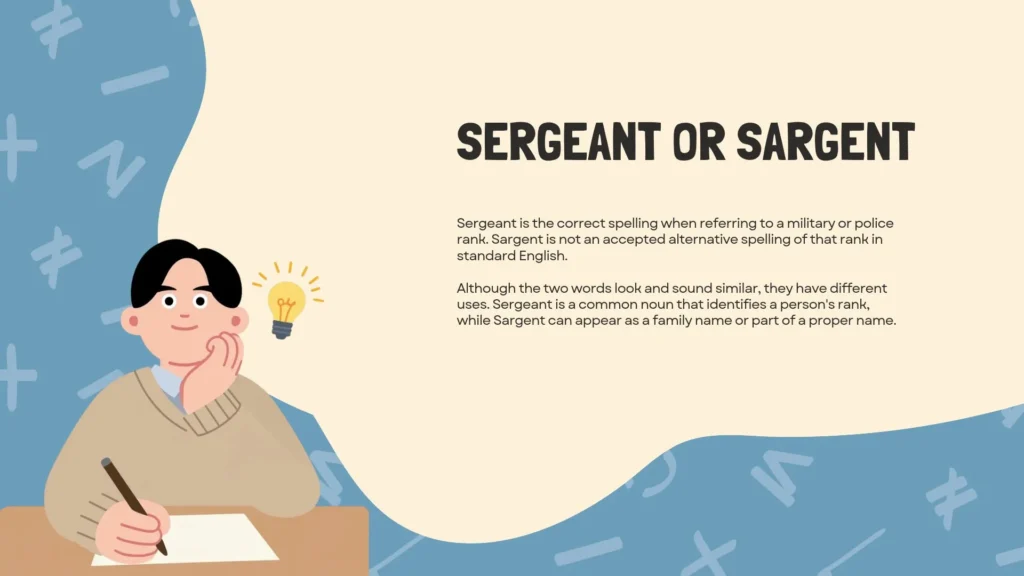
Sergeant is the correct spelling when referring to a military or police rank. Sargent is not an accepted alternative spelling of that rank in standard English.
Although the two words look and sound similar, they have different uses. Sergeant is a common noun that identifies a person’s rank, while Sargent can appear as a family name or part of a proper name.
| Word | Correct Usage | Meaning |
| Sergeant | Correct | A military or police rank |
| Sargent | Incorrect for the rank | A surname or proper name |
| Sargeant | Incorrect for the rank | Common spelling mistake |
| Sergent | Incorrect for the rank | Common spelling mistake |
| Sergant | Incorrect for the rank | Common spelling mistake |
For example:
- Correct: The sergeant instructed the new officers.
- Incorrect: The sargent instructed the new officers.
- Correct: Mr. Sargent attended the meeting.
The easiest way to remember the difference is that sergeant is always the standard spelling of the rank, while Sargent can be correct as a person’s name.
What Does Sergeant Mean?
A sergeant is a person who holds a particular rank in a military organization or police department. The position usually involves experience, responsibility, and some level of leadership or supervision.
The exact duties and authority of a sergeant depend on the country and organization. However, the role commonly involves guiding other personnel, maintaining discipline, providing instructions, and helping manage daily operations.
Sergeant in the Military
In the military, a sergeant is generally a noncommissioned officer (NCO). Sergeants often supervise soldiers, organize training activities, communicate orders, and help maintain discipline within their units.
They also serve as an important connection between senior leadership and the personnel they supervise.
For example:
- The sergeant checked the soldiers before the morning exercise.
- A senior sergeant helped train the new recruits.
- She was promoted to sergeant after years of dedicated service.
Military rank structures differ between countries and branches, so a sergeant’s exact position and responsibilities are not identical everywhere.
Sergeant in the Police
In many police departments, a sergeant is an experienced officer who holds a supervisory rank. Police sergeants may oversee teams of officers, review reports, coordinate daily assignments, and provide guidance during investigations or emergency situations.
Their responsibilities can vary depending on the department and its organizational structure.
For example:
- The police sergeant arrived at the scene to assess the situation.
- A sergeant supervised the officers during the investigation.
- The department appointed a new sergeant to lead the patrol team.
In both military and police contexts, the correct spelling remains sergeant.
How Do You Pronounce Sergeant?
The word sergeant is pronounced approximately as SAR-jənt. Its pronunciation is one of the main reasons people mistakenly write it as sargent.
The first syllable sounds similar to “sar,” while the second syllable has a soft “j” sound followed by a short vowel and an ending similar to “nt.”
Here is a simple pronunciation breakdown:
| Part | Pronunciation |
| First syllable | SAR |
| Second syllable | jənt |
| Full pronunciation | SAR-jənt |
| IPA (American English) | /ˈsɑːrdʒənt/ |
| IPA (British English) | /ˈsɑːdʒənt/ |
The exact vowel quality can vary by accent, but the general pronunciation is similar in both varieties of English.
Why Does Sergeant Sound Like Sargent?
English pronunciation does not always match spelling. Some words retain historical spellings even when their sounds change over time.
In the case of sergeant, the written letters do not provide an obvious guide to its modern pronunciation. When people hear the word without seeing it written, they may naturally assume that it should be spelled sargent.
This is why the mistake is understandable, especially for people learning English or encountering the word for the first time.
The important thing to remember is that pronunciation and spelling are not always identical. Even though sergeant sounds like “sargent,” the standard written form remains sergeant.
Why Is Sergeant Spelled This Way?
The spelling of sergeant has a historical background. The word entered English through Old French, where forms such as sergent were used. Its earlier history is connected to Latin serviens, meaning “serving” or “one who serves.”
Over time, the word developed into its modern English form, sergeant. Its pronunciation also changed, but the traditional spelling remained.
This historical development helps explain why the word contains letters that may seem unusual when compared with the way it is spoken today.
English has many words whose spelling reflects older forms rather than their modern pronunciation. Sergeant is one example of why it is important to learn established spellings instead of relying entirely on sound.
Is Sargent Ever a Correct Word?
Yes. Sargent is a legitimate surname and can also appear in established proper names. It is not simply a meaningless collection of letters or an incorrect word in every situation.
The important distinction is how the word is being used. When someone writes about a military or police rank, the correct spelling is sergeant. When someone uses Sargent as a person’s actual family name, that spelling should be respected.
For example, John Singer Sargent was a well-known American artist celebrated for his portrait paintings.
Consider these examples:
- Correct: The sergeant inspected the training area.
- Correct: John Singer Sargent was known for his portraits.
- Correct: Mr. Sargent joined the discussion.
- Incorrect: The sargent inspected the training area.
A person’s surname should not be changed to match the spelling of a different word. Always consider the context before deciding whether a spelling is correct.
Sergeant vs. Sargent: Examples in Sentences
The easiest way to understand the difference between these words is to see how they work in actual sentences. The following examples demonstrate correct usage in military, police, and everyday contexts.
Correct Examples With Sergeant
- The sergeant gave instructions before the training exercise.
- My uncle served as a sergeant in the military.
- The police sergeant spoke with the witnesses.
- She worked hard to earn her promotion to sergeant.
- The staff sergeant supervised the training session.
- A drill sergeant taught the recruits basic military skills.
- The sergeant reviewed the officers’ daily reports.
- The commanding officer congratulated him on becoming a sergeant.
Incorrect and Correct Sentence Examples
| Incorrect | Correct |
| He became a sargent last year. | He became a sergeant last year. |
| The sargeant led the team. | The sergeant led the team. |
| She spoke to the army sergent. | She spoke to the army sergeant. |
| The police sargent arrived early. | The police sergeant arrived early. |
| My friend was promoted to sergant. | My friend was promoted to sergeant. |
Remember that the correct spelling is sergeant, regardless of whether the sentence refers to a military officer or a police officer.
Common Misspellings of Sergeant
Because the pronunciation of sergeant is different from what its spelling suggests, several incorrect variations appear in everyday writing.
Here are some common mistakes and their correct forms.
| Common Misspelling | Correct Spelling |
| Sargent | Sergeant |
| Sargeant | Sergeant |
| Sergent | Sergeant |
| Sergant | Sergeant |
These variations may seem reasonable when someone tries to spell the word according to its pronunciation. However, none of them is the standard spelling of the military or police rank.
If you are writing an email, school assignment, professional document, or official report, always use sergeant.
How to Remember the Correct Spelling of Sergeant
If you frequently confuse sergeant with sargent, a few simple techniques can make the correct spelling easier to remember.
Remember the Letter E
The most important difference is the letter e after the first letter.
The correct spelling is:
S-E-R-G-E-A-N-T
Try breaking the word into smaller parts when practicing it. Writing it a few times can help you remember the correct letter order.
Connect the Word With Its Meaning
Think about the military or police rank whenever you encounter the word. Associating the spelling with its meaning can make it easier to recall.
For example:
- The sergeant trained the soldiers.
- The police sergeant supervised the team.
- The officer was promoted to sergeant.
Do Not Spell It Only by Sound
One of the biggest mistakes is assuming that every English word should be written exactly as it sounds.
Sergeant is a good example of why this approach does not always work. Even though it sounds similar to “sargent,” its standard spelling contains the letters e-r after the initial s.
Learning the written form rather than guessing from pronunciation is the safest approach.
Is Sergeant Spelled Differently in American and British English?
No. Sergeant is the standard spelling in both American and British English.
Unlike certain words that have different regional spellings, such as color and colour, this word does not have a standard American and British spelling variation.
| English Variety | Correct Spelling |
| American English | Sergeant |
| British English | Sergeant |
| Canadian English | Sergeant |
| Australian English | Sergeant |
Pronunciation may differ slightly between accents, but the standard spelling remains the same.
Therefore, you should not use sargent simply because you are writing for an American or British audience.
Sergeant Abbreviation and Capitalization
Understanding the abbreviation and capitalization of sergeant can also help you use the word correctly in formal and professional writing.
What Is the Abbreviation for Sergeant?
The commonly used abbreviation for sergeant is Sgt.
It is frequently used in military records, police documents, formal references, and before a person’s name when the title is appropriate.
Examples:
- Sergeant Miller → Sgt. Miller
- Sergeant Johnson → Sgt. Johnson
- Sergeant Davis → Sgt. Davis
Abbreviation conventions can vary between organizations and style guides, so follow the official format when preparing formal documents.
Should Sergeant Be Capitalized?
The word sergeant is generally lowercase when used as an ordinary rank rather than a formal title before a name.
Use lowercase:
- The sergeant arrived at the station.
- She was promoted to sergeant.
- A sergeant supervised the officers.
Use uppercase when part of a formal title before a name:
- Sergeant Miller attended the meeting.
- Sergeant Johnson led the team.
The same general distinction applies to many professional titles and ranks. Always follow the relevant organization’s capitalization rules for official writing.
Frequently Asked Questions
Is It Sergeant or Sargent?
Sergeant is the correct spelling when referring to a military or police rank. Sargent is a common misspelling in this context, although it is a legitimate surname.
Is Sargent a Real Surname?
Yes. Sargent is an established family name. For example, John Singer Sargent was a famous American portrait artist. The spelling is correct when it represents someone’s actual name.
What Is the Abbreviation for Sergeant?
The commonly used abbreviation is Sgt. For example, Sergeant Miller can be written as Sgt. Miller when the abbreviation is appropriate for the document or style being used.
Is It Staff Sergeant or Staff Sargent?
The correct spelling is staff sergeant. It is a military rank used in several armed forces, although its exact position differs between countries and military branches.
What Is the Plural of Sergeant?
The plural of sergeant is sergeants. You simply add an “s” to the singular form.
Example: The sergeants attended a meeting with their commanding officer.
Is Sergeant Capitalized in a Sentence?
Sergeant is generally lowercase when used as a general rank, such as “the sergeant arrived.” It is capitalized when used as a formal title directly before a person’s name, such as “Sergeant Miller.”
Conclusion
When deciding between sergeant or sargent, remember that sergeant is the correct spelling for a military or police rank. Although its pronunciation makes sargent seem like a reasonable alternative, it is not the standard written form. Sargent is still correct as a surname or proper name, so context matters. Remember the letter E in sergeant, and you will be less likely to make this common spelling mistake.

Nicholas Turner is a dedicated writer who enjoys creating clear, engaging and well-researched content for readers around the world. He has a passion for exploring language, culture and everyday topics that spark curiosity. Nicholas is also the fictional author of The Silent Ember Road and Where Morning Echoes Rest, two original story concepts created exclusively for his author profile. Outside of writing, he enjoys traveling, reading, and discovering new perspectives. His goal is to make every article informative, approachable, and genuinely useful.
 Ava Collins