
Spicy is the correct spelling. Spicey is a common misspelling and is not considered a standard English word.
Many people get confused because the word comes from spice, making it seem like spicey should be correct. However, English spelling does not follow that pattern in this case.
In this article, you’ll learn the difference between spicey and spicy, when to use the correct spelling, common mistakes to avoid, and an easy trick to remember the right form.
Quick Answer
Spicy is the only correct spelling in standard English.
Spicey is incorrect and should be avoided in school, work, emails, and everyday writing.
Examples:
- ✅ I love spicy food.
- ❌ I love spicey food.
Spicey vs Spicy: Main Difference
| Word/Phrase | Meaning | Correct? | Best Used For | Example |
| Spicey | Intended to mean “full of spice,” but not a standard English spelling | ❌ No | Avoid using it | ❌ This curry is spicey. |
| Spicy | Full of spice or having a strong, hot flavor; can also mean exciting or bold | ✅ Yes | All writing and conversation | ✅ This curry is spicy. |
What Does Spicey Mean?
Spicey is not a standard English word. People often write it by mistake because they think it should match the noun spice.
Although you may occasionally see spicey online or in informal writing, it is considered a spelling error.
Examples of incorrect usage:
- ❌ This soup is spicey.
- ❌ I enjoy spicey snacks.
- ❌ The salsa is too spicey for me.
- ❌ She ordered a spicey chicken sandwich.
- ❌ That was a spicey debate.
In all of these examples, spicy is the correct spelling.
What Does Spicy Mean?
Spicy is the correct adjective. It usually describes food with a hot or strong flavor from spices or chili peppers. It can also describe something exciting, bold, dramatic, or slightly shocking.
Examples:
- I enjoy spicy noodles.
- This soup is too spicy for my taste.
- They served spicy chicken at dinner.
- She shared a spicy story with her friends.
- The movie has a spicy sense of humor.
How to Use Spicey or Spicy
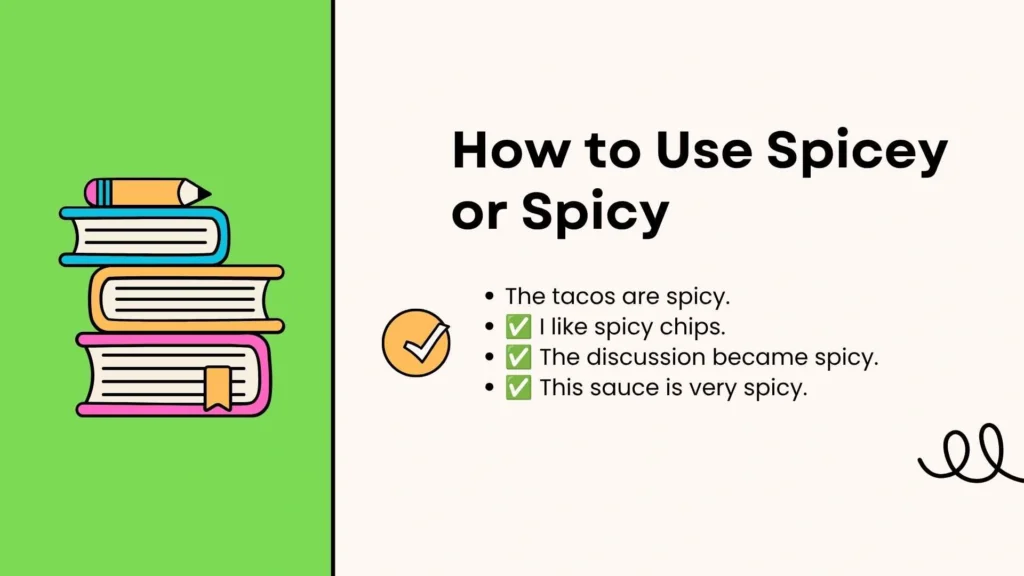
Always use spicy when describing food, flavors, conversations, stories, opinions, or anything that is exciting or bold.
Avoid using spicey because it is not the accepted spelling.
Correct
- ✅ The tacos are spicy.
- ✅ I like spicy chips.
- ✅ The discussion became spicy.
- ✅ This sauce is very spicy.
Incorrect
- ❌ The tacos are spicey.
- ❌ I like spicey chips.
- ❌ The discussion became spicey.
Where to Use Spicy
Use spicy in every type of writing and conversation.
School Writing
- The recipe includes several spicy ingredients.
Formal Writing
- The restaurant is known for its spicy dishes.
Emails
- I prefer the spicy option on the menu.
Everyday Conversation
- Do you like spicy food?
Messages
- Let’s order something spicy tonight.
Professional Communication
- Customers can choose between mild and spicy flavors.
American English
Spicy is the correct spelling.
British English
Spicy is also the correct spelling.
Other English-Speaking Regions
Countries such as Canada, Australia, New Zealand, India, and Pakistan also use spicy as the standard spelling.
There is no regional spelling difference between spicy and spicey.
Why People Get Confused
People often confuse these spellings because the adjective comes from the noun spice.
Many English words keep the original spelling when adding a suffix, so it feels natural to write spicey. However, English changes the spelling here, and spicy became the accepted form.
Typing quickly, autocorrect mistakes, and seeing the wrong spelling online can also cause confusion.
Common Mistakes to Avoid
Wrong:
This pasta is spicey.
Correct:
This pasta is spicy.
Explanation: Spicy is the correct spelling.
Wrong:
She likes spicey food.
Correct:
She likes spicy food.
Explanation: Always use spicy when talking about food.
Wrong:
The conversation became spicey.
Correct:
The conversation became spicy.
Explanation: Spicy can describe exciting or bold conversations.
Wrong:
I ordered a spicey pizza.
Correct:
I ordered a spicy pizza.
Explanation: Spicy is the only standard spelling.
Real-Life Examples
Meeting
“The discussion became a little spicy after the budget review.”
School
“Our teacher asked us to describe our favorite spicy food.”
Travel
“We tried spicy street food during our trip.”
Work
“The restaurant now offers a new spicy chicken sandwich.”
Message
“Let’s order something spicy for dinner.”
Conversation
“I can’t eat very spicy food.”
Restaurant Order
“I’d like the spicy version, please.”
Social Situation
“Everyone laughed at his spicy joke.”
Easy Trick to Remember
Think of icy at the end of spicy.
Spicy ends with “icy,” not “icey.”
If you remember spicy, you’ll never need to write spicey.
Mini Quiz
1. Which spelling is correct?
Answer: Spicy
2. Is “spicey” a standard English word?
Answer: No.
3. Which sentence is correct?
A. I love spicey wings.
B. I love spicy wings.
Answer: B
4. Can “spicy” describe a conversation?
Answer: Yes.
5. Do American and British English spell it differently?
Answer: No. Both use spicy.
6. Which spelling should you use in formal writing?
Answer: Spicy
Related Confusing Words
- gray or grey
- canceled or cancelled
- traveling or travelling
- its or it’s
- your or you’re
- affect or effect
- bear with me or bare with me
- then or than
FAQs About Spicey or Spicy
Is spicey correct?
No. Spicey is a common misspelling and should be avoided.
Is spicy correct?
Yes. Spicy is the correct spelling in standard English.
What is the difference between spicey and spicy?
Spicy is the correct word. Spicey is simply a spelling mistake.
Which one should I use?
Always use spicy in writing and speech.
Is spicy formal or informal?
Spicy is appropriate in both formal and informal English.
Conclusion
Spicy is the correct spelling in all forms of English. Spicey is a common mistake that should be avoided.
Whether you’re writing for school, work, emails, or everyday conversations, always choose spicy. Remember: spicy is the standard spelling, and there is no regional variation.

Daniel Foster is a writer who enjoys breaking down complex topics into simple, engaging and easy-to-understand content. He has a passion for research, storytelling, and creating articles that help readers find clear answers. Daniel is also the fictional author of Beyond the Quiet Compass and Shadows of the Forgotten Tide. When he’s away from the keyboard, he enjoys hiking, reading, and exploring new ideas. His goal is to create content that is informative, trustworthy and enjoyable to read.
 Ava Collins