

Whose is correct, while whos is incorrect in standard English. Whose is used to ask who something belongs to or to show a relationship between a person, animal, or thing and something connected to them.
For example, “Whose jacket is this?” asks about the owner of the jacket. The confusion often comes from who’s, which means who is or who has.
Although whose, who’s, and whos look and sound similar, they serve different purposes.
Understanding their meanings, spelling rules and sentence usage can help you avoid common writing mistakes in emails, messages, school assignments and everyday conversations.
Whos or Whose: Which Is Correct?
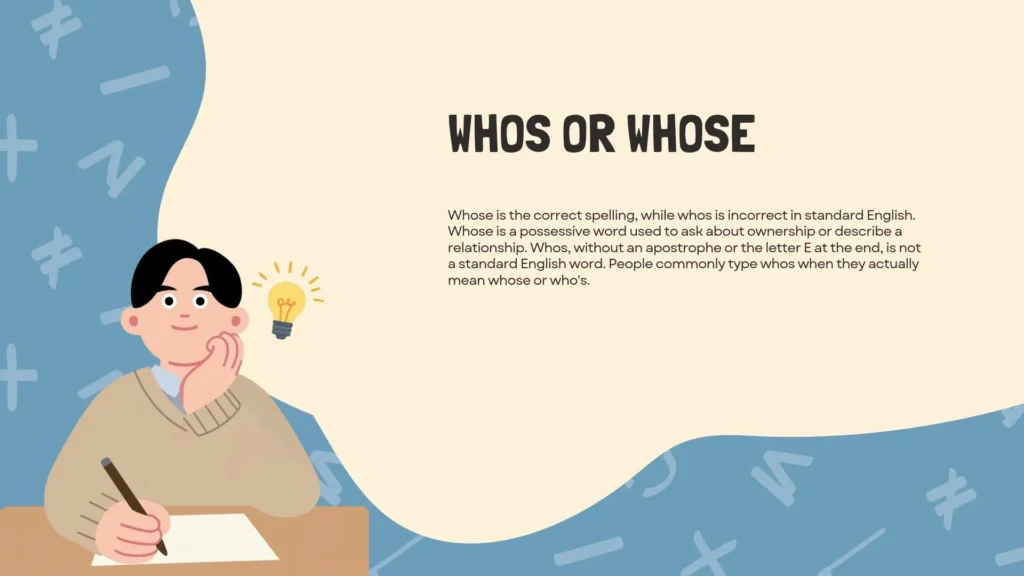
Whose is the correct spelling, while whos is incorrect in standard English.
Whose is a possessive word used to ask about ownership or describe a relationship. Whos, without an apostrophe or the letter E at the end, is not a standard English word. People commonly type whos when they actually mean whose or who’s.
| Word | Correct or Incorrect? | Meaning | Example |
| Whose | Correct | Shows ownership or a relationship | Whose keys are these? |
| Who’s | Correct | Short for who is or who has | Who’s coming tonight? |
| Whos | Incorrect | Not a standard English word | Whos coming tonight? |
The difference becomes easier to understand when you focus on the meaning of the sentence instead of how the words sound.
- Whose: Whose bicycle is parked outside?
- Who’s: Who’s waiting for the bus?
- Whos: Incorrect spelling in standard English.
If your sentence asks who owns something, use whose. If it means who is or who has, use who’s.
What Does Whose Mean?
Whose is a possessive word that helps identify the person, animal, or thing associated with something. It is commonly used in questions to ask about ownership, but it also appears in statements to connect a person or thing with another noun.
In simple English, whose helps you find out who something belongs to or tells you something about a person or thing.
Whose as a Possessive Word
Whose is used as a possessive determiner when it comes before a noun and identifies the owner or the person connected to that noun.
For example:
- Whose phone is ringing?
- Whose jacket did you borrow?
- Whose birthday are we celebrating?
- Whose house are we visiting this weekend?
In these sentences, whose comes before a noun such as phone, jacket, birthday, or house. It helps identify the person associated with that object or event.
Whose can also function as a possessive pronoun in certain constructions, particularly when the noun is understood from context.
For example:
- Whose is this?
- Whose are those?
In these questions, the noun is not stated, but the reader or listener understands what is being discussed.
Whose in Statements
Whose is not limited to questions. It can also connect two parts of a sentence and describe a relationship between a person or thing and something associated with them.
For example:
- I met a woman whose daughter works as a nurse.
- He is the teacher whose lessons are always interesting.
- They adopted a dog whose tail was injured.
- We visited a family whose house was damaged by the storm.
In these sentences, whose connects a person or animal with a related noun. It helps avoid repeating the same name or using an awkward sentence structure.
Whose vs. Who’s vs. Whos
Whose, who’s, and whos are frequently confused because they have similar pronunciations. However, their spelling and meanings are different.
| Word | Meaning | Example |
| Whose | Shows possession or a relationship | Whose coat is this? |
| Who’s | Means who is or who has | Who’s ready to leave? |
| Whos | Incorrect spelling | Whos ready to leave? |
Whose vs. Who’s
Whose and who’s are both correct English words, but they are used differently.
Whose asks about ownership or describes a relationship. Who’s is a contraction of who is or who has.
Examples of whose:
- Whose wallet is on the table?
- Whose turn is it to cook?
- She is the student whose project won the award.
Examples of who’s:
- Who’s at the door? (Who is at the door?)
- Who’s going to the concert? (Who is going to the concert?)
- Who’s finished the homework? (Who has finished the homework?)
The apostrophe in who’s indicates that letters have been omitted from who is or who has. It does not indicate ownership.
Whose vs. Whos
Whose is the correct spelling when expressing ownership or a relationship. Whos is generally a spelling mistake and should not be used in standard English writing.
| Incorrect | Correct | Explanation |
| Whos bag is this? | Whose bag is this? | Whose asks about ownership. |
| Whos shoes are by the door? | Whose shoes are by the door? | Whose identifies the owner of the shoes. |
| Whos idea was that? | Whose idea was that? | Whose asks who came up with the idea. |
| Whos car are we taking? | Whose car are we taking? | Whose identifies the person associated with the car. |
Remember that whose contains the letter E at the end. You don’t need an apostrophe when writing whose.
How to Use Whose in a Sentence
Whose can be used in different sentence structures depending on what you want to communicate. It commonly appears in questions about ownership, statements about relationships, and sentences involving responsibility or association.
Asking About Ownership
Use whose when you want to know who owns something or who something belongs to.
- Whose notebook is on my desk?
- Whose keys did you find?
- Whose car is parked near the entrance?
- Whose shoes are these?
These questions focus on identifying the owner of an object.
Showing a Relationship
Whose can connect a person, animal, or sometimes a thing with a noun that describes something related to them.
- She is the girl whose brother lives in Canada.
- I know a man whose business is growing quickly.
- The dog whose owner was missing stayed near the gate.
- They hired a writer whose articles were well researched.
Whose makes these sentences more natural by connecting the related information without unnecessary repetition.
Asking About Responsibility or an Idea
Whose can also be used to identify who is responsible for something, who created an idea, or who is associated with a decision.
- Whose responsibility is it to organize the meeting?
- Whose idea was it to start the project?
- Whose decision changed the schedule?
- Whose job is it to prepare the report?
These sentences do not always refer to physical ownership. Whose can also describe responsibility, authorship, decisions, or other relationships.
How to Remember Whose vs. Who’s
If you frequently confuse whose and who’s, a simple substitution trick can help you choose the correct word.
Use the Who Is or Who Has Test
Whenever you’re unsure whether to use who’s, replace it with who is or who has.
If the sentence still makes sense, who’s is probably correct.
- Who’s coming to dinner? = Who is coming to dinner?
- Who’s been calling you? = Who has been calling you?
- Who’s ready to begin? = Who is ready to begin?
If replacing who’s with who is or who has doesn’t make sense, you may need whose instead.
- Whose bag is this? = Who is bag is this? (Incorrect)
- Whose bag is this? = Asking who owns the bag. (Correct)
Remember That Whose Shows Possession
Whose is associated with ownership or a relationship. If you’re asking about the owner of a car, book, phone, or house, whose is usually the word you need.
- Whose book did you borrow?
- Whose phone is ringing?
- Whose room is this?
Quick reminder: Whose asks about ownership or relationships. Who’s means who is or who has. Whos is incorrect.
Common Mistakes With Whose and Who’s
People often make spelling mistakes because they focus on pronunciation rather than meaning. Since whose and who’s sound similar, it is easy to choose the wrong word when writing quickly.
| Incorrect Sentence | Correct Sentence | Why It Is Correct |
| Whos book is this? | Whose book is this? | Whose asks about ownership. |
| Whos coming over? | Who’s coming over? | Who’s means who is. |
| Whose going to help? | Who’s going to help? | Who’s means who is going to help. |
| Whos finished the assignment? | Who’s finished the assignment? | Who’s means who has finished. |
| Whos idea was that? | Whose idea was that? | Whose identifies who created the idea. |
| Whos dog is barking? | Whose dog is barking? | Whose identifies the dog’s owner. |
The easiest way to avoid these mistakes is to check the meaning of the sentence. If it asks about ownership, use whose. If it means who is or who has, use who’s.
Frequently Asked Questions
Is Whos Ever Correct?
No. Whos without an apostrophe or the letter E at the end is not a standard English word. It is usually a spelling mistake for whose or who’s. In formal writing, schoolwork, emails, and professional communication, use the correct spelling.
Is Whose a Possessive Word?
Yes. Whose is a possessive word that identifies who something belongs to or shows a relationship between a person, animal, or thing and something connected to them. For example, “Whose phone is this?” asks who owns the phone.
Can Whose Be Used Without a Noun?
Yes. Whose can appear without a noun when the noun is understood from the context. For example, “Whose is this?” is grammatically correct when the speaker is asking who owns an object.
Can Whose Refer to Animals or Things?
Yes. Whose can refer to animals and sometimes things, particularly when describing a relationship or associated feature. For example, “The dog whose collar was blue ran across the yard.” It can also be used with things in certain constructions, such as “A company whose reputation is strong.”
What Is the Difference Between Whose and Who’s?
Whose shows ownership or a relationship, while who’s is a contraction of who is or who has. For example, “Whose keys are these?” asks about ownership, while “Who’s waiting outside?” means “Who is waiting outside?”
How Do You Spell Whose?
Whose is spelled W-H-O-S-E. It has five letters and ends with the letter E. It does not need an apostrophe because it is not a contraction.
Conclusion
Whose is the correct spelling when asking about ownership or showing a relationship, while whos is not a standard English word. Who’s is also correct, but it is a contraction of who is or who has, so it cannot replace whose in every sentence.
The simplest way to remember the difference is to focus on meaning. Use whose when asking who something belongs to, and use who’s when you mean who is or who has. Once you understand this rule, choosing the correct word becomes much easier in everyday writing.

Ava Collins is a passionate writer who enjoys turning everyday ideas into clear, engaging, and helpful content. She loves exploring language, culture and meaningful stories that connect with readers. Ava is also the fictional author of Beneath the Silver Maple and The Last Lantern of Willow Cove. When she’s not writing, she enjoys reading, traveling and finding inspiration in ordinary moments.
 Nicholas Turner