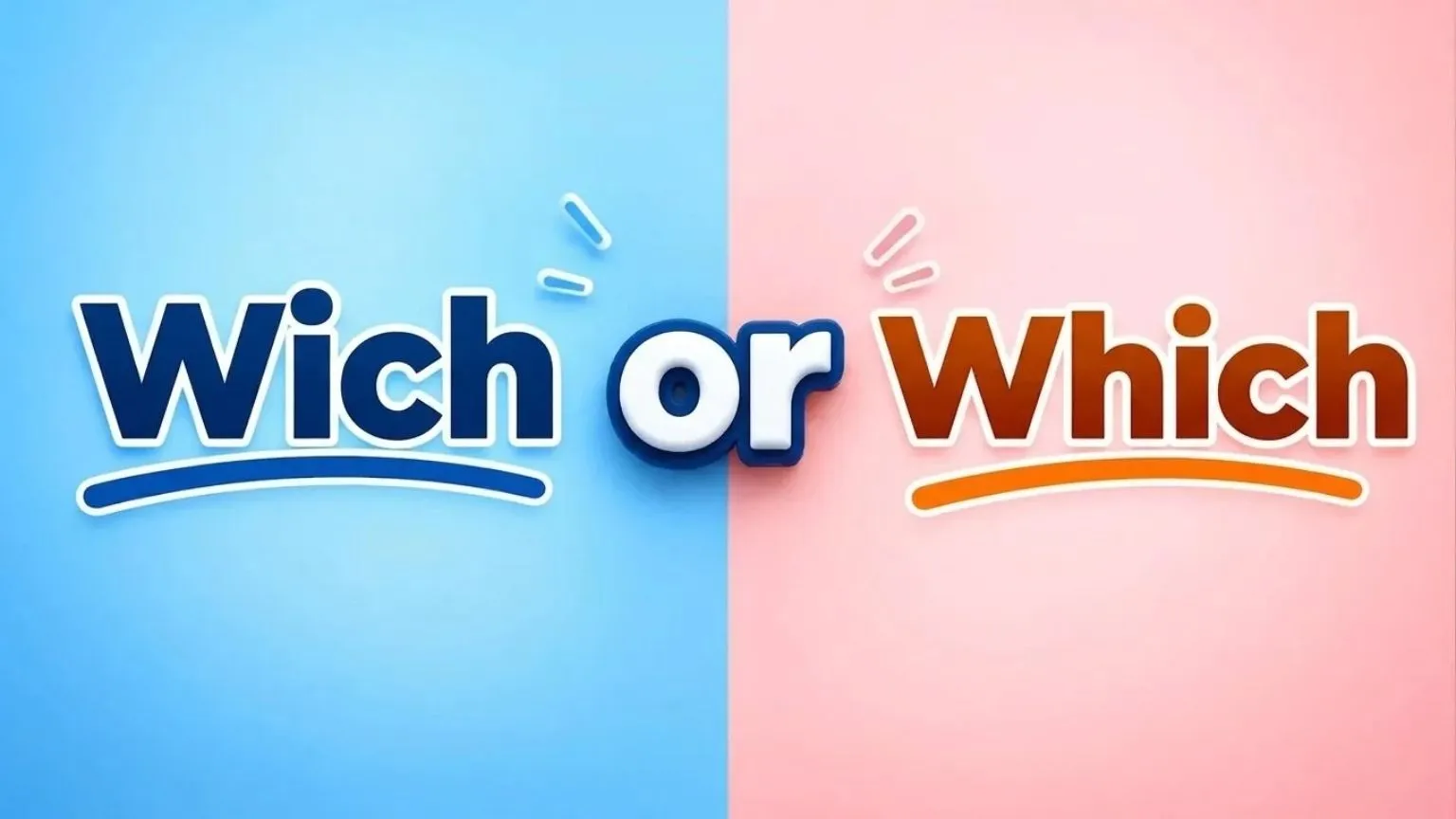
If you’re unsure whether to write wich or which, the correct spelling in standard modern English is which. The word wich is not a standard alternative spelling of which, although it appears in some historical forms and English place names.
Which is commonly used to ask questions, identify specific choices, and introduce additional information in sentences.
For example, “Which movie do you want to watch?” is correct, while “Wich movie do you want to watch?” is incorrect. The difference is just one letter, but leaving out the H changes a correctly spelled word into a spelling mistake.
Understanding its meaning, pronunciation, and common uses can help you avoid this error in everyday writing.
Wich or Which: Which Is Correct?
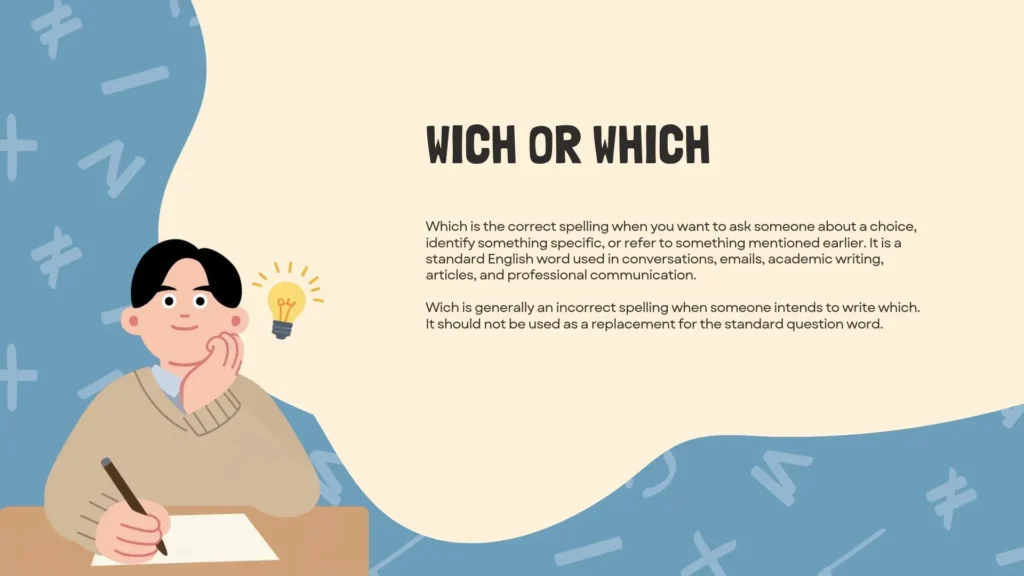
Which is the correct spelling when you want to ask someone about a choice, identify something specific, or refer to something mentioned earlier. It is a standard English word used in conversations, emails, academic writing, articles, and professional communication.
Wich is generally an incorrect spelling when someone intends to write which. It should not be used as a replacement for the standard question word.
Here is a quick comparison:
| Feature | Which | Wich |
| Standard modern spelling | Correct | Incorrect as a substitute for which |
| Used in questions | Yes | No |
| Used to identify choices | Yes | No |
| Used as a relative pronoun | Yes | No |
| Historical or specialized uses | Yes | Yes, in limited contexts |
| Used in everyday English writing | Yes | No, when meaning which |
Examples:
- Correct: Which subject do you enjoy the most?
- Incorrect: Wich subject do you enjoy the most?
- Correct: Which route should we take?
- Incorrect: Wich route should we take?
The easiest way to remember the difference is that which always contains the letter H when you use it as the English question word.
What Does Which Mean?
Which is a question word that helps identify a particular person, object, place, or choice. It is commonly used when someone needs to select something from a group of possibilities or find out specific information.
For example:
- Which color looks better with this outfit?
- Which student answered the question?
- Which restaurant serves Italian food?
- Which of these bags belongs to you?
- Which phone would you recommend?
In each example, which helps narrow down the answer. Instead of asking a completely open question, the speaker wants to identify a particular option or piece of information.
The word also has different grammatical functions depending on how it appears in a sentence.
Which as a Question Word
Which is frequently used at the beginning of direct questions. It helps someone ask about a particular choice or identify something from a known or understood group.
Examples:
- Which book are you reading?
- Which team won the final match?
- Which day is convenient for you?
- Which shoes should I buy?
- Which road leads to the airport?
You can also use which when the available choices are not directly mentioned but are clear from the conversation.
For example:
“Which one did you select?”
The speaker does not list the options, but both people may already know what choices are being discussed.
Which as a Pronoun
Which can work as a pronoun when it replaces a noun instead of appearing directly before one.
Examples:
- Which is your favorite?
- Which should we choose?
- Which belongs to your brother?
- Which of these is the cheapest?
- Which would you prefer?
In these sentences, which stands on its own and refers to something understood from the context.
Compare these two examples:
- Which dress do you like? Here, which comes before the noun dress.
- Which do you like? Here, which replaces the name of the thing being discussed.
Both sentences are grammatically correct.
Which in Indirect Questions
Which is also used in indirect questions. These are questions included within another sentence rather than asked directly.
Examples:
- I don’t know which dress she bought.
- Can you tell me which bus goes downtown?
- He asked which restaurant we preferred.
- She wants to know which answer is correct.
One important grammar rule applies here: indirect questions normally use statement word order rather than the word order of direct questions.
Direct question: Which phone do you want?
Indirect question: I don’t know which phone you want.
The following construction is incorrect in standard English:
“I don’t know which phone do you want.”
Remember this distinction when writing longer sentences with which.
Which as a Relative Pronoun
Which can also function as a relative pronoun. It introduces additional information about something already mentioned in a sentence.
Examples:
- I bought a new laptop, which has a powerful processor.
- We visited the museum, which was built many years ago.
- She received a promotion, which made her family proud.
- He missed the flight, which caused a delay in his plans.
In these examples, which connects the main statement with extra information.
It often appears after a comma when introducing nonessential information. However, its exact punctuation depends on the sentence structure.
What Does Wich Mean?
Wich is not the correct spelling of the everyday English question word which. However, saying that the spelling never appears in English would be too broad. It has historical and specialized uses, particularly in place names.
The important distinction is that these uses do not make wich an acceptable alternative to which in ordinary sentences.
Wich in Historical English
The element wich appears in some English place names and is historically associated with the Old English word wīc. Depending on the location and its history, this element can be connected with a dwelling, settlement, or specialized settlement or trading place.
Its historical meaning can vary, so it should not be treated as having exactly the same meaning in every place name.
Examples of English places containing this element include:
- Droitwich
- Middlewich
- Nantwich
- Northwich
- Ipswich
These are proper place names, not examples of wich being used as a question word.
For example:
“Droitwich is a town in Worcestershire, England.”
Here, Wich is part of a proper name. It is not replacing which in a sentence.
Why Wich Is Not a Replacement for Which
The spelling wich may appear in historical material, names, or specialized contexts, but it is not the standard spelling used when asking questions or identifying choices.
Consider these examples:
- Correct: Which city would you like to visit?
- Incorrect: Wich city would you like to visit?
- Correct: Which answer is correct?
- Incorrect: Wich answer is correct?
If you are writing an ordinary English sentence and want to ask which option someone prefers, always use which.
Which vs. Witch vs. Wich: What’s the Difference?
Which, witch, and wich may look similar, but they do not serve the same purpose. Understanding their differences can help you avoid another common spelling mistake.
| Word | Meaning | Example |
| Which | Used to ask about a choice or identify something | Which movie should we watch? |
| Witch | A person traditionally associated with witchcraft or magical powers | The witch appeared in the old story. |
| Wich | A rare historical or specialized spelling element | Ipswich is a place name. |
When to Use Which
Use which when asking about a particular choice or referring to something already mentioned.
Examples:
- Which bag belongs to you?
- Which answer did the teacher select?
- I bought a new car, which is very comfortable.
When to Use Witch
Witch is a noun that traditionally describes a person believed to practice witchcraft or use magic. It frequently appears in fairy tales, folklore, fantasy stories, and Halloween-related writing.
Examples:
- The witch lived in a small cottage.
- The children dressed as witches for Halloween.
- The story follows a young witch learning magic.
Although which and witch are pronounced the same in many English accents, their meanings and spellings are different.
When to Recognize Wich
Wich may appear in historical words, specialized references, and place names. It is not the spelling you should choose when writing a normal question.
For example, Ipswich is correctly spelled with wich because it is a proper geographical name. However, “Wich restaurant do you prefer?” is incorrect.
Which vs. What: What’s the Difference?
Which and what are both question words, but they are commonly used in slightly different situations.
Which generally asks someone to identify or select something from a known or limited set of possibilities. What usually asks for information more generally, without necessarily limiting the answer to a specific group.
Compare these examples:
| Which | What |
| Which dress do you want, the red one or the blue one? | What color do you like? |
| Which subject did you choose from the available options? | What subject do you enjoy studying? |
| Which restaurant should we visit tonight? | What type of food do you like? |
| Which phone is yours? | What phone do you use? |
When to Use Which
Use which when the choices are understood, identified, or limited by the situation.
Examples:
- Which movie should we watch tonight?
- Which of these two bags is yours?
- Which route is shorter?
The available choices may be stated directly or understood from the conversation.
When to Use What
Use what when you want general information or are asking about something without a clearly limited set of choices.
Examples:
- What is your favorite movie?
- What do you do for a living?
- What kind of music do you enjoy?
- What happened yesterday?
The distinction is a useful guideline rather than an absolute rule. What can also be used when options are limited, and which can be used when the options are not explicitly listed.
Common Mistakes With Which
Even people who know the correct spelling sometimes make mistakes when using which in longer sentences. Understanding these common errors can improve your writing.
Leaving Out the Letter H
This is the most common mistake associated with the keyword.
Incorrect: Wich color do you prefer?
Correct: Which color do you prefer?
Incorrect: Wich one is yours?
Correct: Which one is yours?
Always check that the H appears immediately after the W.
Using Incorrect Word Order in Indirect Questions
Indirect questions do not normally follow the same word order as direct questions.
Incorrect: I don’t know which book did she buy.
Correct: I don’t know which book she bought.
Incorrect: Can you tell me which bus does he take?
Correct: Can you tell me which bus he takes?
Use statement word order after which in these indirect question structures.
Confusing Which With Witch
These words sound identical in many accents, so it is easy to select the wrong one while typing.
Incorrect: Witch movie do you want to watch?
Correct: Which movie do you want to watch?
Incorrect: The which lives in the forest.
Correct: The witch lives in the forest.
Remember that which asks a question or refers to something, while witch refers to a person associated with witchcraft.
Using Which Without a Clear Reference
When using which in a statement, make sure the reader can understand what it refers to.
Unclear: She told him that she was leaving, which surprised.
Clear: She told him that she was leaving, which surprised him.
The second sentence gives the reader a complete idea.
How to Remember the Correct Spelling
If you regularly confuse wich and which, a few simple techniques can help you remember the correct spelling.
Remember the Five-Letter Spelling
The word which contains five letters:
W – H – I – C – H
Pay special attention to the H after W. This is the letter people most often forget when typing the word.
Connect Which With Making a Choice
Think of a question you ask when choosing between different options:
“Which one should I buy?”
Whenever you need to ask someone to identify or select something, remember to use which with the H.
Practice With Everyday Sentences
Using the word in natural sentences helps build better spelling habits.
Try these examples:
- Which shirt should I wear?
- Which road is the fastest?
- Which answer is correct?
- Which restaurant do you recommend?
- Which one would you choose?
The more frequently you use the correct spelling, the easier it becomes to remember.
Test Your Spelling Knowledge
Complete these sentences using the correct spelling.
- ___ movie would you like to watch?
- I don’t know ___ train she took.
- ___ of these two bags is yours?
- Can you tell me ___ road leads to the station?
- ___ answer did your teacher mark as correct?
Answers:
- Which
- Which
- Which
- Which
- Which
All five sentences require which because they ask about or identify a particular person, object, or choice.
Frequently Asked Questions
Is Wich Ever a Real Word?
Wich has historical and specialized uses, particularly as an element in certain English place names. However, it is not a standard substitute for which in modern everyday writing.
Why Does Which Have an H?
The H is part of the established spelling of which. Although it does not represent a separate pronounced sound in modern English, it must remain in the written word.
How Do You Pronounce Which?
Which is commonly pronounced /wɪtʃ/, with a short i sound. The H is not pronounced separately. In many English accents, which and witch sound identical, although some accents distinguish their initial sounds.
What Is the Difference Between Which and Witch?
Which is a question word used to identify choices or refer to something. Witch is a noun referring to a person traditionally associated with witchcraft or magic. They have different spellings and meanings, even though they sound alike in many accents.
Can Which Be Used in a Statement?
Yes. Which can appear in statements, particularly when introducing additional information about something already mentioned.
Example: “She bought a new phone, which has an excellent camera.”
Is Which Used for Two Choices or More?
Which can be used for two choices or several possibilities. For example, “Which do you prefer, tea or coffee?” is grammatically correct.
What Is the Difference Between Which and What?
Which generally asks someone to identify something from a known or limited group of choices. What usually asks for more general information. The exact choice depends on the context and intended meaning.
Conclusion
The correct spelling is which, not wich, when you want to ask a question, identify a choice, or introduce additional information in a sentence. Although wich appears in some historical forms and English place names, it is not a standard replacement for which.
Remember the five-letter spelling: W-H-I-C-H. Also, avoid confusing which with witch, which has a completely different meaning. The next time you write a question such as “Which one do you prefer?” make sure you include the H. This small spelling detail will help you communicate more clearly and avoid a common English writing mistake.

Nicholas Turner is a dedicated writer who enjoys creating clear, engaging and well-researched content for readers around the world. He has a passion for exploring language, culture and everyday topics that spark curiosity. Nicholas is also the fictional author of The Silent Ember Road and Where Morning Echoes Rest, two original story concepts created exclusively for his author profile. Outside of writing, he enjoys traveling, reading, and discovering new perspectives. His goal is to make every article informative, approachable, and genuinely useful.
 Ava Collins