
Advise and advice are both correct English words, but they have different grammatical roles. Advise is a verb, while advice is a noun.
People often confuse them because they look almost identical and have similar meanings. The final sound also differs, which can make the distinction harder for English learners.
The simple rule is: you advise someone, but you give someone advice.
This guide explains their meanings, pronunciation, sentence patterns, common mistakes, and easy ways to remember which one to use.
Quick Answer
Advise is a verb meaning “to suggest what someone should do.”
Advice is a noun meaning “a suggestion or guidance about what someone should do.”
- My teacher advised me to study harder.
- My teacher gave me some good advice.
So, use advise for the action and advice for the suggestion itself.
Advise vs Advice: Main Difference
| Word/Phrase | Meaning | Correct? | Best Used For | Example |
| advise | To suggest or tell someone what they should do | Yes | Verb/action | I advise you to wait. |
| advice | A suggestion or guidance | Yes | Noun/thing | She gave me good advice. |
A useful rule
Think of the difference this way:
Someone advises you. Someone gives you advice.
This simple pattern will prevent most mistakes.
What Does Advise Mean?
Advise is a verb. It means to give someone a suggestion, recommendation, or information about what they should do. It can also mean to officially inform someone about something.
Common patterns include:
- advise someone to do something
- advise someone against something
- advise someone on something
- advise someone that something is true
Examples
- I advise you to check your work before submitting it.
- The doctor advised him to get more rest.
- My parents advised me against making a quick decision.
- She advised us on how to prepare for the interview.
- The company advised customers that the office would be closed.
Notice that advise describes an action. You can change it into other verb forms, such as advised and advising.
What Does Advice Mean?
Advice is a noun. It means a suggestion, opinion, or guidance about what someone should do. It is normally an uncountable noun, so we usually do not say “an advice” or “advices.”
Examples
- She gave me some useful advice.
- I need your advice about this problem.
- His advice helped me make a better decision.
- You should listen to your teacher’s advice.
- We followed the lawyer’s advice.
When you need to count individual suggestions, use a piece of advice:
- She gave me a piece of advice.
- He gave me two pieces of advice.
Not:
- She gave me an advice.
- He gave me two advices.
How to Use Advise or Advice
The easiest way to choose the right word is to identify its job in the sentence.
Use advise when you need a verb
Correct: I advise you to save your money.
Here, advise describes what the speaker is doing.
Other useful structures include:
- I advise you to…
- She advised me to…
- They advised us against…
- He advises students on…
- We were advised to…
Use advice when you need a noun
Correct: I need some advice.
Here, advice is the thing the person wants.
You can also say:
- give advice
- get advice
- ask for advice
- seek advice
- follow advice
- take advice
- offer advice
- use someone’s advice
Compare these sentences
The teacher advised me to practice.
The teacher performed the action.
The teacher gave me some advice.
The suggestion itself is the noun.
Where to Use These Words
Both words are suitable in everyday and formal English. They are common in school, work, emails, professional communication, and ordinary conversation.
School writing
- My teacher advised me to revise the chapter.
- I followed my teacher’s advice.
Formal writing
- We advise applicants to submit the form early.
- Applicants should seek professional advice if necessary.
Emails
- Please advise me on the next step.
- Thank you for your advice.
Everyday conversation
- What do you advise me to do?
- Can I ask you for some advice?
Professional communication
Advise is especially common when someone is giving recommendations or official information:
- Customers are advised to arrive early.
- Employees were advised of the policy change.
Cambridge notes that advise can also mean formally informing someone about something, such as informing them of their rights or a decision.
Why People Get Confused
The main problem is that the words look almost the same:
adviSE
adviCE
Their meanings are closely related too. Someone who advises you gives you advice.
Pronunciation adds another clue. In standard pronunciation, advice ends with an /s/ sound, while advise ends with a /z/ sound.
That small spelling and sound difference is easy to miss, especially for people learning English.
A useful comparison is:
Advise = action
Advice = suggestion
Common Mistakes to Avoid
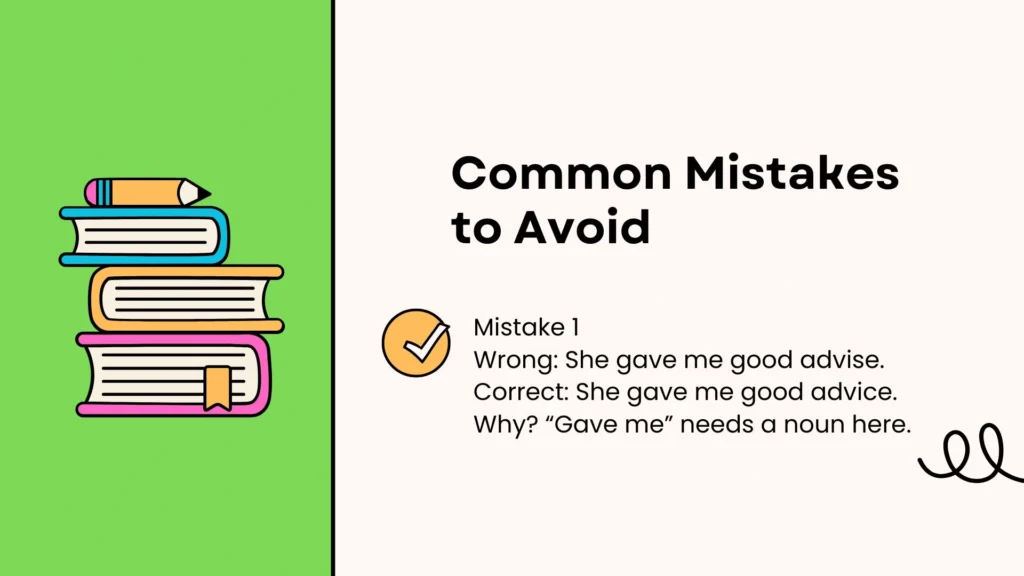
Mistake 1
Wrong: She gave me good advise.
Correct: She gave me good advice.
Why? “Gave me” needs a noun here.
Mistake 2
Wrong: I advice you to wait.
Correct: I advise you to wait.
Why? The word describes an action, so you need the verb.
Mistake 3
Wrong: He gave me an advice.
Correct: He gave me some advice.
Or:
He gave me a piece of advice.
Why? Advice is normally uncountable.
Mistake 4
Wrong: She gave me three advices.
Correct: She gave me three pieces of advice.
Mistake 5
Wrong: The doctor advice me to rest.
Correct: The doctor advised me to rest.
Why? The sentence describes an action that already happened, so the past-tense verb advised is needed.
Real-Life Examples
At a meeting
Manager: “I advise everyone to review the new policy.”
At school
Student: “Can you give me some advice about my essay?”
At work
The consultant advised the company to change its approach.
While traveling
The hotel staff advised us to book a taxi early.
In a message
Can you advise me when the meeting starts?
In a conversation
A: “Should I apply for the job?”
B: “I would advise you to apply.”
A: “Do you have any advice for my interview?”
B: “Yes. Prepare a few questions beforehand.”
Easy Trick to Remember
Use this two-word memory trick:
Advise = verb
Advice = noun
Or remember:
You adviSE someone.
You receive adviCE.
If you can replace the word with “suggest”, you probably need advise:
- I advise you to wait.
- I suggest that you wait.
If you can replace it with “suggestion”, you probably need advice:
- I need your advice.
- I need your suggestion.
Mini Quiz
Choose advise, advice, advised, or piece of advice.
- My father gave me some good ______.
- I would ______ you to leave early.
- The teacher ______ us to read the instructions.
- Can you give me a ______ of advice?
- She needs professional ______.
- We were ______ to arrive before noon.
Answers
- advice
- advise
- advised
- piece
- advice
- advised
Related Confusing Words
- affect or effect
- practice or practise
- principal or principle
- accept or except
- compliment or complement
- your or you’re
- its or it’s
- farther or further
FAQs About Advise or Advice
Is “advise” correct?
Yes. Advise is a correct verb meaning to suggest or recommend what someone should do.
Is “advice” correct?
Yes. Advice is a correct noun meaning a suggestion or guidance. It is normally uncountable.
What is the difference between advise and advice?
Advise is the verb; advice is the noun.
- She advised me to wait.
- She gave me advice.
Which one should I use in “Please ___ me”?
Use advise:
Please advise me about the next step.
Is “advice” formal or informal?
Advice works in both everyday and formal English. You can use it in conversations, school assignments, emails, and professional writing.
References
- Cambridge Dictionary — “Advise”
- Cambridge Dictionary — “Advice”
- Cambridge Grammar — “Advice or advise?”
- Cambridge Grammar — “Part of speech: advice or advise?”
Conclusion
Advise and advice are both correct, but they have different grammatical roles.
Use advise as a verb: “I advise you to wait.”
Use advice as a noun: “Thank you for your advice.”
Remember: you advise someone, but you give someone advice.

Ava Collins is a passionate writer who enjoys turning everyday ideas into clear, engaging, and helpful content. She loves exploring language, culture and meaningful stories that connect with readers. Ava is also the fictional author of Beneath the Silver Maple and The Last Lantern of Willow Cove. When she’s not writing, she enjoys reading, traveling and finding inspiration in ordinary moments.
 Daniel Foster