
If you are confused about bachelors or bachelor’s, you are not alone. The small apostrophe can completely change the meaning and grammatical role of the word.
The correct choice depends on what you are talking about. If you mean a university qualification, the standard expression is bachelor’s degree. If you mean more than one unmarried man, bachelors is the plural form of bachelor. If you are showing possession involving several bachelors, bachelors’ may be appropriate.
There is one more form worth knowing: bachelor’s can sometimes stand alone when the word degree is understood. For example, “She earned her bachelor’s last year.” Merriam-Webster lists this shortened use and gives examples such as “a bachelor’s in economics.”
Understanding these differences is useful when writing resumes, college applications, academic documents, professional profiles, and everyday English.
Bachelors or Bachelor’s? (Quick Answer)
Use the form that matches your meaning:
| Form | What it means | Example |
| bachelor | One bachelor | He is a bachelor. |
| bachelor’s | A degree or something associated with one bachelor | She earned a bachelor’s degree. |
| bachelors | More than one bachelor | Three bachelors attended the event. |
| bachelors’ | Something associated with multiple bachelors | The bachelors’ apartments were nearby. |
| bachelor’s degrees | More than one bachelor’s degree | She earned two bachelor’s degrees. |
The easiest rule
If you are talking about a university qualification, use:
bachelor’s degree ✅
If you are talking about several bachelors as people, use:
bachelors ✅
If you are talking about something belonging to several bachelors, use:
bachelors’ ✅
So:
- bachelor’s degree ✅
- bachelors degree ❌ in standard general usage
- two bachelor’s degrees ✅
- two bachelors ✅ when referring to people
A bachelor’s degree is a college or university degree, and both Cambridge and Merriam-Webster recognize bachelor’s degree as the standard term.
Bachelor’s vs Bachelors vs Bachelors’: What’s the Difference?
The apostrophe is the key to understanding these forms.
Bachelor
Bachelor is the singular form.
One common meaning is an unmarried man:
He remained a bachelor for many years.
The word also has an academic meaning related to a university degree. Merriam-Webster lists both the degree-related meaning and the meaning of an unmarried man.
Bachelor’s
Bachelor’s has the apostrophe before the s.
It is the standard form in:
bachelor’s degree
It can also be used as a shortened form when degree is already understood:
She earned her bachelor’s in biology.
Merriam-Webster specifically recognizes bachelor’s as a noun meaning a bachelor’s degree.
Bachelors
Bachelors is simply the plural of bachelor.
There is no apostrophe because you are only talking about more than one person.
The three bachelors rented a house together.
Here, bachelors means three or more individual bachelors.
Bachelors’
Bachelors’ is the plural possessive form.
It refers to something associated with or belonging to multiple bachelors.
The bachelors’ apartments were expensive.
The apostrophe comes after the s because the noun is already plural.
Is It Bachelor’s Degree or Bachelors Degree?
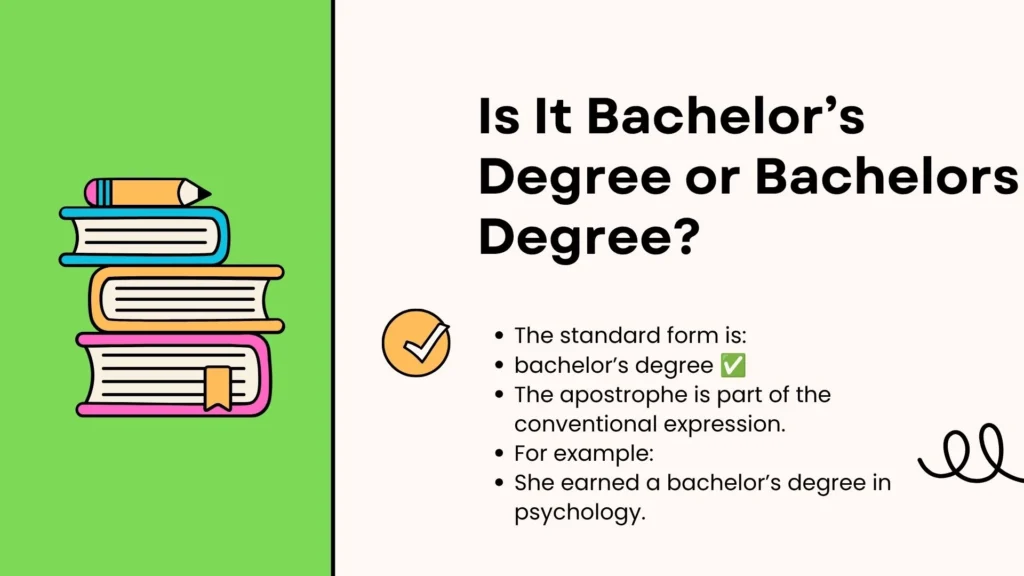
The standard form is:
bachelor’s degree ✅
The apostrophe is part of the conventional expression.
For example:
- She earned a bachelor’s degree in psychology.
- He is pursuing a bachelor’s degree in business.
- I completed my bachelor’s degree last year.
- A bachelor’s degree can be useful for many careers.
The form bachelors degree is not the standard choice in polished general English.
Why Is the Apostrophe There?
The apostrophe-s form comes from the established expression bachelor’s degree.
For everyday writing, you do not need to analyze the historical development of the phrase every time you use it. The practical rule is simply:
Write “bachelor’s degree” when you mean the academic qualification.
Merriam-Webster defines a bachelor’s degree as a degree awarded by a college or university, usually after a period of undergraduate study.
What Is the Plural of Bachelor’s Degree?
The plural is:
bachelor’s degrees
This is an important point because people often incorrectly remove the apostrophe when making the phrase plural.
Singular
She has a bachelor’s degree.
Plural
She has two bachelor’s degrees.
The word degrees becomes plural. The word bachelor’s does not change.
Think of it this way:
One: bachelor’s degree
Two: bachelor’s degrees
Several: bachelor’s degrees
Merriam-Webster’s usage examples also show bachelor’s degrees as the normal plural form.
Why “Bachelors Degrees” Is Confusing
A common mistake is:
She has two bachelors degrees.
The problem is that bachelors looks like the plural of bachelor, rather than the established degree expression.
Write:
She has two bachelor’s degrees.
This keeps the degree expression intact while making degree plural.
Bachelor’s Degree vs Bachelor of Science
Bachelor’s degree and Bachelor of Science are related, but they are not interchangeable in every sentence.
Bachelor’s degree is a general term
Use it when you are talking about the qualification generally.
She has a bachelor’s degree.
You do not need to specify the exact type.
Bachelor of Science is a specific degree title
Use it when you are naming a particular degree.
She earned a Bachelor of Science in Biology.
Other examples include:
- Bachelor of Arts
- Bachelor of Science
- Bachelor of Business Administration
- Bachelor of Engineering
The exact title can vary by institution and country, so when writing a resume or academic document, it is sensible to follow the official name provided by your university.
Compare the Two
| General wording | Specific wording |
| She has a bachelor’s degree. | She has a Bachelor of Science. |
| He earned a bachelor’s degree in biology. | He earned a Bachelor of Science in Biology. |
| She is completing her bachelor’s degree. | She is completing her Bachelor of Arts. |
This distinction also helps prevent a common mistake:
Incorrect: Bachelor’s of Science
Better: Bachelor of Science
When Bachelor of Science is the official degree title, Bachelor is not written as the possessive Bachelor’s.
Is It Bachelor’s Degree or Bachelor Degree?
For general English, bachelor’s degree is the safer and more standard choice.
For example:
I have a bachelor’s degree in marketing.
The shorter form bachelor degree may appear in institutional names, job listings, translated English, or other contexts, but it is not the best general-purpose choice when you are writing natural, polished English.
If you are writing for a university, employer, or professional organization, follow its official terminology when it provides a specific degree name.
How to Write Bachelor’s Degree on a Resume
If you are preparing a resume or CV, clarity matters more than trying to make the wording complicated.
General resume wording
You can write:
Bachelor’s Degree in Business Administration
University Name, 2026
Or:
Bachelor’s Degree in English
University Name, 2025
When You Know the Official Degree Title
If your university awarded a specific degree, using its official title can be even clearer:
Bachelor of Science in Computer Science
University Name, 2026
Or:
Bachelor of Arts in English
University Name, 2025
Avoid This Form
Bachelors Degree in Business
For a polished resume, use:
Bachelor’s Degree in Business
Or use the institution’s official title, such as:
Bachelor of Business Administration
The key is to distinguish the general term bachelor’s degree from the official title of a specific qualification.
Bachelor’s Degree Capitalization
Capitalization depends on whether you are using a general description or an official degree title.
General description
Use lowercase when the phrase is being used generally:
She earned a bachelor’s degree in history.
He is pursuing a bachelor’s degree in finance.
Official degree title
Capitalize the formal name when appropriate:
She earned a Bachelor of Arts in History.
He received a Bachelor of Science in Chemistry.
The safest approach for formal documents is to check the exact degree name used by your institution and follow its capitalization style.
Can Bachelor’s Be Used Without “Degree”?
Yes.
When the context is clear, bachelor’s can stand alone to mean bachelor’s degree.
For example:
She completed her bachelor’s last year.
He is working on his bachelor’s.
I earned a bachelor’s in economics.
Merriam-Webster lists bachelor’s as a noun meaning a bachelor’s degree and gives examples of this shortened use.
However, bachelor’s degree is usually clearer for formal documents, especially when there is any possibility of confusion.
For example:
Professional:
I earned a bachelor’s degree in economics.
More conversational:
I earned my bachelor’s in economics.
Both can work, but the first is more explicit.
When Should You Use Bachelors?

Use bachelors when you mean more than one bachelor.
For example:
Three bachelors shared the apartment.
The story follows a group of young bachelors.
Several bachelors attended the event.
Here, bachelors is a normal plural noun.
Bachelors Does Not Mean Multiple Degrees
This distinction is especially important:
She has two bachelors.
This can mean two bachelors as people, depending on context.
But if you mean two university degrees, write:
She has two bachelor’s degrees.
The difference is clear once you identify what is being counted.
People: bachelors
Degrees: bachelor’s degrees
When Should You Use Bachelors’?
Use bachelors’ when something belongs to, relates to, or is associated with multiple bachelors.
For example:
The bachelors’ apartments were located downtown.
The bachelors’ opinions were different.
The bachelors’ club held a meeting.
Compare the three forms:
- bachelor’s → one bachelor / degree expression
- bachelors → multiple bachelors
- bachelors’ → something associated with multiple bachelors
The apostrophe after the s signals the plural possessive form.
Bachelor’s, Bachelors, and Bachelors’ Examples
A few side-by-side examples make the distinction easier to remember.
| Sentence | Correct form | Why |
| She earned a ___ degree. | bachelor’s | Academic degree |
| Three ___ attended. | bachelors | More than one bachelor |
| The ___ apartments were renovated. | bachelors’ | Belonging to multiple bachelors |
| She earned two ___ degrees. | bachelor’s | Multiple academic degrees |
| He has a ___ in economics. | bachelor’s | Short for bachelor’s degree |
| He is a confirmed ___. | bachelor | One unmarried man |
Common Mistakes With Bachelor’s and Bachelors
Mistake 1: Bachelors degree
Incorrect:
She earned a bachelors degree.
Correct:
She earned a bachelor’s degree.
Mistake 2: Bachelors degrees
Incorrect:
The university offers several bachelors degrees.
Correct:
The university offers several bachelor’s degrees.
The word degrees carries the plural.
Mistake 3: Two bachelors degrees
Incorrect:
He has two bachelors degrees.
Correct:
He has two bachelor’s degrees.
Mistake 4: Using bachelor’s for several people
Incorrect:
Three bachelor’s attended the event.
If you mean three unmarried men, write:
Three bachelors attended the event.
Mistake 5: Using bachelors’ for the degree
Incorrect:
She earned a bachelors’ degree.
Correct:
She earned a bachelor’s degree.
Bachelors’ is a plural possessive form, not the standard academic degree expression.
Mistake 6: Bachelor’s of Science
Incorrect:
He earned a Bachelor’s of Science.
Correct:
He earned a Bachelor of Science.
When naming the formal degree title, use the institution’s official wording.
Is “Bachelors” Ever Correct for Education?
Yes, but context matters.
In casual speech, someone may say:
I got my bachelors.
However, in formal writing, it is better to make the intended meaning explicit:
I earned my bachelor’s degree.
There is also an important distinction between bachelors and bachelor’s.
Bachelors without an apostrophe is the plural of the noun bachelor.
Bachelor’s with an apostrophe can mean a bachelor’s degree when degree is understood.
So if you are writing a resume, application, academic paper, or professional profile, bachelor’s degree is usually the clearest choice.
A Simple Rule to Remember
You can remember the difference with three questions.
Are you talking about a university degree?
Use:
bachelor’s degree
Example:
I earned a bachelor’s degree in journalism.
Are you talking about several bachelors?
Use:
bachelors
Example:
The three bachelors lived together.
Are you talking about something belonging to several bachelors?
Use:
bachelors’
Example:
The bachelors’ apartments were recently renovated.
And when you have more than one university degree:
bachelor’s degrees
This is the most useful rule:
Bachelor’s = degree
Bachelors = people
Bachelors’ = possession involving multiple bachelors
Bachelor’s or Bachelors: Quick Comparison
| Word or phrase | Correct? | Meaning |
| bachelor | Yes | One bachelor |
| bachelor’s | Yes | Degree/shortened degree term or singular possessive |
| bachelors | Yes | More than one bachelor |
| bachelors’ | Yes | Plural possessive |
| bachelor’s degree | Yes | University degree |
| bachelor’s degrees | Yes | More than one university degree |
| bachelors degree | No in standard general usage | Missing apostrophe in the standard degree expression |
| bachelors degrees | No in standard general usage | Incorrect form for multiple bachelor’s degrees |
| bachelors’ degree | No for the standard degree name | Incorrect possessive form for this expression |
| Bachelor of Science | Yes | Specific degree title |
| Bachelor’s of Science | No as the standard degree title | Unnecessary possessive |
Frequently Asked Questions
Is it bachelors or bachelor’s?
Both forms can be correct, but they have different meanings. Bachelor’s is used in bachelor’s degree, while bachelors is the plural of bachelor when referring to multiple people.
Is “bachelors degree” correct?
The standard form is bachelor’s degree with an apostrophe.
What is the plural of bachelor’s degree?
The plural is bachelor’s degrees.
For example:
She earned two bachelor’s degrees.
Is it two bachelors degrees or two bachelor’s degrees?
Use two bachelor’s degrees.
The word degrees becomes plural, while bachelor’s remains part of the established degree expression.
What is the difference between bachelor’s and bachelors’?
Bachelor’s can refer to a bachelor’s degree or something associated with one bachelor. Bachelors’ is the plural possessive form, referring to something associated with multiple bachelors.
Should I write bachelor’s degree on my resume?
Yes. Bachelor’s degree is a clear general term. If your institution gives you a specific degree title, such as Bachelor of Science, you can use that official title instead.
Is “bachelors” a real word?
Yes. Bachelors is the plural of bachelor.
Two bachelors attended the dinner.
Can bachelor’s be used without degree?
Yes. When the meaning is obvious, bachelor’s can be used as a shortened form of bachelor’s degree.
She earned her bachelor’s last year.
Is Bachelor of Science the same as bachelor’s degree?
A Bachelor of Science is one specific type of bachelor’s degree. Bachelor’s degree is the broader term.
Is “Bachelor’s of Science” correct?
The standard degree title is Bachelor of Science, not Bachelor’s of Science.
Is bachelors’ degree correct?
No, not when you mean the standard university qualification. Use bachelor’s degree.
What is the difference between bachelor and bachelor’s?
Bachelor is the base noun. Bachelor’s is used in the standard expression bachelor’s degree and can also be a singular possessive form.
Conclusion
The choice between bachelors or bachelor’s becomes simple once you identify what you mean. Use bachelor’s degree when referring to a university qualification, bachelors when referring to more than one bachelor, and bachelors’ when showing possession involving multiple bachelors.
For multiple academic degrees, write bachelor’s degrees, not bachelors degrees. If you are naming a specific qualification, use its official title, such as Bachelor of Science or Bachelor of Arts.
The easiest memory rule is: bachelor’s = degree, bachelors = multiple people, bachelors’ = multiple-person possession. Keeping this distinction in mind will help you write more accurately in resumes, academic work, applications, and everyday English.

Ava Collins is a passionate writer who enjoys turning everyday ideas into clear, engaging, and helpful content. She loves exploring language, culture and meaningful stories that connect with readers. Ava is also the fictional author of Beneath the Silver Maple and The Last Lantern of Willow Cove. When she’s not writing, she enjoys reading, traveling and finding inspiration in ordinary moments.
 Daniel Foster