
The short answer is both breathe and breath are correct, but they have different meanings. Breathe is a verb (an action), while breath is a noun (a thing).
Many people confuse these words because they look almost the same and are closely related. The difference is small in spelling but important in meaning.
In this article, you’ll learn the difference between breathe and breath, how to use each one correctly, common mistakes to avoid, and an easy trick to remember them.
Quick Answer
Breathe means to take air into and out of your lungs. It is a verb.
Breath means the air you inhale or exhale. It is a noun.
Examples:
- Please breathe slowly.
- Take a deep breath before you begin.
Breathe vs Breath: Main Difference
| Word | Meaning | Correct? | Best Used For | Example |
| Breathe | To inhale and exhale air | ✅ Yes | Actions | Please breathe deeply. |
| Breath | The air taken in or out of the lungs | ✅ Yes | Things or ideas | She took a deep breath. |
What Does Breathe Mean?
Breathe is a verb. It describes the action of taking air into your lungs and letting it out.
You can also use it in a figurative way, such as “to relax” or “to pause.”
Examples
- Please breathe slowly during the exercise.
- It’s hard to breathe when you have a cold.
- Take a moment to breathe and relax.
- The doctor asked him to breathe deeply.
- Fresh mountain air makes it easier to breathe.
What Does Breath Mean?
Breath is a noun. It refers to the air that goes into or comes out of your lungs.
People often confuse breath with breathe because the words are very similar in spelling and pronunciation.
Examples
- She took a deep breath before speaking.
- His breath smelled like mint.
- I lost my breath after running.
- Hold your breath for a few seconds.
- You could see your breath in the cold air.
How to Use Breathe or Breath
The easiest rule is:
- Use breathe when talking about doing the action.
- Use breath when talking about the air itself.
Correct Examples
- Remember to breathe normally.
- Take a deep breath before diving.
- I couldn’t breathe because of the smoke.
- Her breath was warm.
Incorrect Examples
Wrong:
- Take a deep breathe.
Correct:
- Take a deep breath.
Wrong:
- I can’t breath through my nose.
Correct:
- I can’t breathe through my nose.
Where to Use Breathe or Breath
Both words are used in many types of communication.
School Writing
Use the correct form based on whether you need a noun or a verb.
- The runner struggled to breathe.
- She caught her breath after the race.
Formal Writing
Both words are common in reports, essays, and medical writing.
Emails
Use whichever word matches your sentence.
- Please breathe slowly during the test.
- Take a deep breath before your presentation.
Everyday Conversation
Both words are used naturally in daily speech.
Messages
Simple reminders often use breathe.
- Just breathe. Everything will be okay.
Professional Communication
Medical professionals, teachers, coaches, and trainers regularly use both words correctly.
American and British English
There is no spelling difference between American and British English.
- Breathe and breath are spelled the same in the United States, the United Kingdom, Canada, Australia, New Zealand, India, Pakistan, and other English-speaking regions.
Why People Get Confused
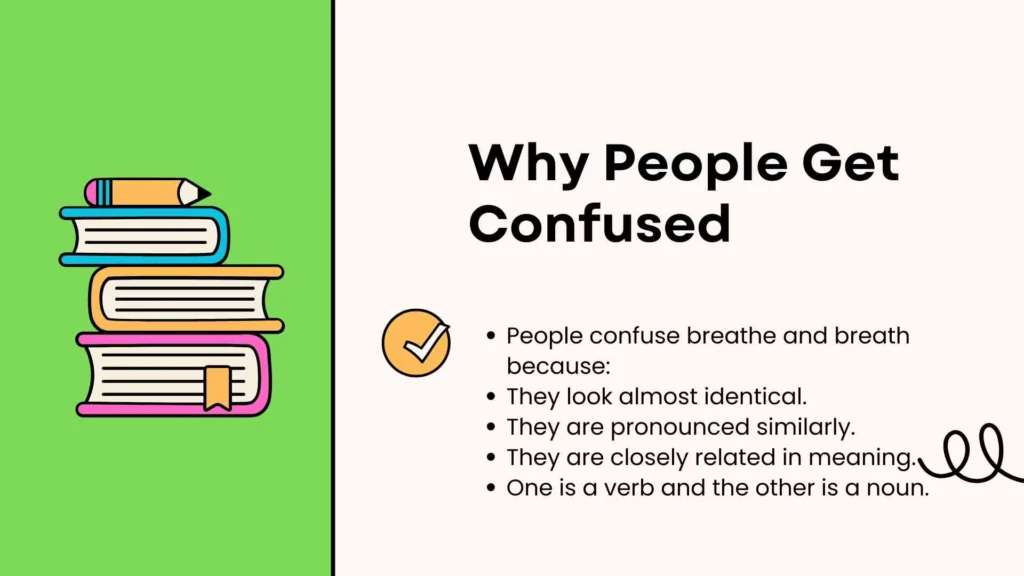
People confuse breathe and breath because:
- They look almost identical.
- They are pronounced similarly.
- They are closely related in meaning.
- One is a verb and the other is a noun.
- The extra “e” at the end changes both the pronunciation and the grammar.
Common Mistakes to Avoid
Wrong:
I need to catch my breathe.
Correct:
I need to catch my breath.
Explanation: Use the noun breath.
Wrong:
Please breath slowly.
Correct:
Please breathe slowly.
Explanation: Use the verb breathe for the action.
Wrong:
She took a deep breathe.
Correct:
She took a deep breath.
Explanation: You are talking about the air, not the action.
Wrong:
It’s difficult to breath after running.
Correct:
It’s difficult to breathe after running.
Explanation: The sentence needs the verb.
Real-Life Examples
Meeting
- Take a deep breath before your presentation.
- Try to breathe slowly if you’re nervous.
School
- The teacher asked everyone to breathe quietly during meditation.
- She took a deep breath before reading aloud.
Travel
- The fresh sea air helped us breathe more comfortably.
- I finally caught my breath after climbing the hill.
Work
- Remember to breathe and stay calm during interviews.
- He paused to catch his breath after carrying heavy boxes.
Message
- Just breathe. You’ve got this!
Conversation
- I was so surprised that I lost my breath for a moment.
Sports
- Athletes learn how to breathe properly while exercising.
- Take a deep breath before you start the race.
Easy Trick to Remember
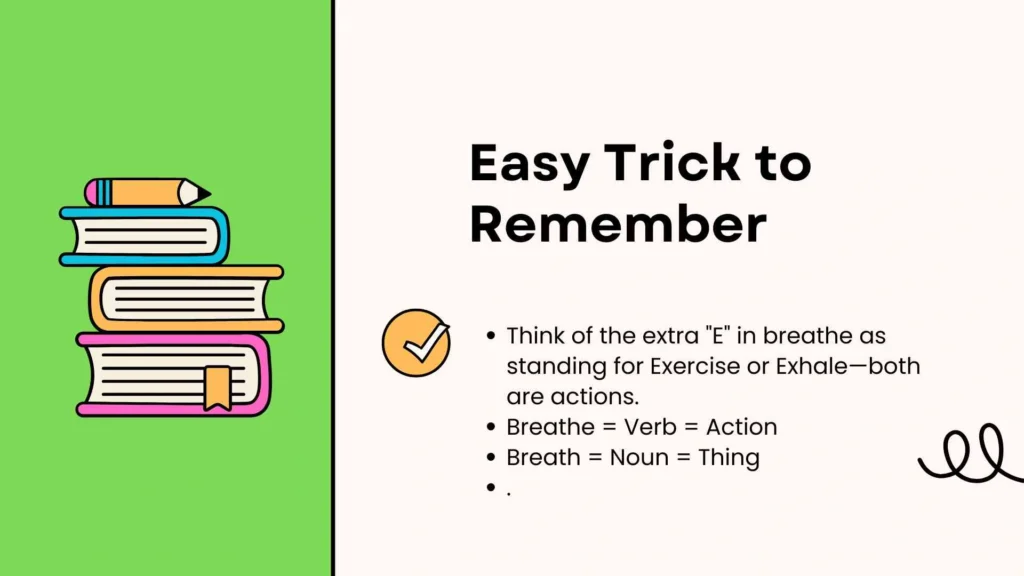
Think of the extra “E” in breathe as standing for Exercise or Exhale—both are actions.
- Breathe = Verb = Action
- Breath = Noun = Thing
Mini Quiz
1. Which word is a verb?
Answer: Breathe
2. Which sentence is correct?
A. Take a deep breathe.
B. Take a deep breath.
Answer: B
3. Fill in the blank:
I couldn’t after running.
Answer: breathe
4. Fill in the blank:
Take a deep before speaking.
Answer: breath
5. Which word means the air you inhale or exhale?
Answer: Breath
6. Which sentence is correct?
A. Please breath slowly.
B. Please breathe slowly.
Answer: B
Related Confusing Words
- its or it’s
- your or you’re
- there or their
- affect or effect
- accept or except
- than or then
- lose or loose
- advice or advise
FAQs About Breathe or Breath
Is breathe correct?
Yes. Breathe is the correct verb meaning to inhale and exhale air.
Is breath correct?
Yes. Breath is the correct noun referring to the air you breathe.
What is the difference between breathe and breath?
Breathe is a verb (an action). Breath is a noun (a thing).
Which one should I use?
Use breathe when describing the action. Use breath when referring to the air itself.
Are breathe and breath formal or informal?
Both words are standard English and are appropriate in formal and informal writing and speech.
Conclusion
Both breathe and breath are correct, but they are used differently. Breathe is the verb that describes the action of taking air in and out. Breath is the noun that refers to the air itself. Remember this simple rule, and you’ll choose the right word every time.

Daniel Foster is a writer who enjoys breaking down complex topics into simple, engaging and easy-to-understand content. He has a passion for research, storytelling, and creating articles that help readers find clear answers. Daniel is also the fictional author of Beyond the Quiet Compass and Shadows of the Forgotten Tide. When he’s away from the keyboard, he enjoys hiking, reading, and exploring new ideas. His goal is to create content that is informative, trustworthy and enjoyable to read.
 Ava Collins