Check or cheque? Both spellings are correct, but the right choice depends on what you mean and which variety of English you are using.
Check is the standard American spelling for a bank payment document, while cheque is preferred in British, Canadian, Australian, and New Zealand English.
However, both American and British English use check when referring to examining or verifying something.
Understanding this simple difference will help you choose the correct spelling in everyday conversations, emails, and formal writing.
Check vs. Cheque: What Is the Difference?
The main difference between check and cheque is their use as a banking term. Both words refer to the same type of payment document, but their spellings vary between English-speaking countries.
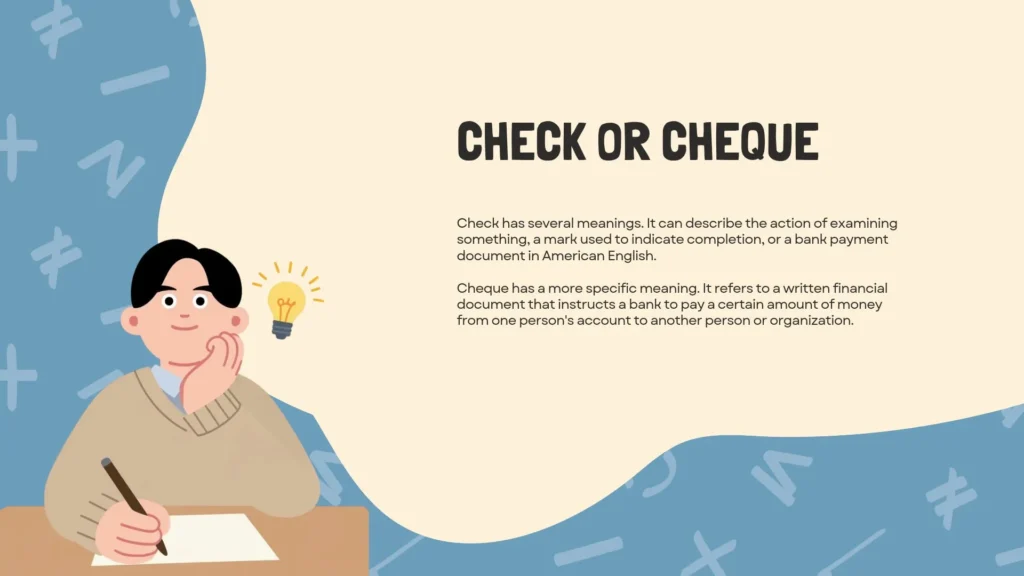
Check has several meanings. It can describe the action of examining something, a mark used to indicate completion, or a bank payment document in American English.
Cheque has a more specific meaning. It refers to a written financial document that instructs a bank to pay a certain amount of money from one person’s account to another person or organization.
Here is a quick comparison:
| Check | Cheque |
| American spelling for a bank payment | British-style spelling for a bank payment |
| Used as a verb meaning to examine or verify | Not used as a verb with this meaning |
| Can mean a restaurant bill in American English | Does not mean a restaurant bill |
| Used in expressions such as check out and double-check | Used in banking expressions such as cheque book |
Check and Cheque in American and British English
English spelling varies between countries, and check and cheque are good examples of this difference.
In American English, check is used for both the action of examining something and a bank payment document. Americans generally write check, checkbook, and paycheck.
British English uses check for examining or verifying something but prefers cheque for a bank payment document. The related spellings include chequebook and, in some contexts, paycheque.
For example:
American English:
- I wrote a check for $300.
- My paycheck arrives every Friday.
- I need to buy a new checkbook.
British English:
- I wrote a cheque for £300.
- My paycheque arrives every Friday.
- I need to buy a new chequebook.
The meaning remains the same. Only the spelling changes according to regional conventions.
What Does Check Mean?
The word check has several meanings in English. It can function as both a verb and a noun, making it useful in everyday communication, education, business, banking, and travel.
As a verb, check means to examine, inspect, confirm, or verify something. As a noun, it can refer to an inspection, a mark, a restaurant bill, or a banking document in American English.
Understanding these different meanings will help you recognize when check is the correct word.
Check as a Verb
When check is used as a verb, it means to look at something carefully to make sure it is correct, accurate, safe, or in good condition.
It is commonly used when checking information, reviewing documents, inspecting objects, or confirming details.
Examples:
- Please check your answers before submitting the test.
- I always check the weather before planning a trip.
- She checked the door to make sure it was locked.
- Can you check whether the payment has arrived?
- The manager asked me to check the figures in the report.
- You should check your flight details before leaving home.
In all these sentences, check means to examine or verify something.
It does not matter whether you are writing in American, British, Canadian, or Australian English. Check is the correct spelling when used this way.
Check as a Noun
Check can also function as a noun. Its meaning depends on the situation in which it appears.
Here are some common uses:
1. A Checkmark or Tick
A check can refer to a mark used to indicate that something is correct, selected, or completed. In American English, a checkmark is often called a check.
Examples:
- Put a check next to the correct answer.
- She placed a check beside every completed task.
- There was a check in the box next to his name.
In British English, people commonly call this mark a tick.
2. An Inspection or Examination
Check can describe an examination performed to make sure something is working properly or meets certain requirements.
Examples:
- The mechanic performed a safety check on the car.
- The doctor ordered a routine health check.
- The company completed a background check before hiring him.
3. A Bank Payment Document
In American English, a check is a written financial document used to instruct a bank to pay money from the writer’s account to another person or organization.
Examples:
- She wrote a check to pay the electricity bill.
- I received a check from my employer.
- He deposited the check into his bank account.
In British English, the same document is called a cheque.
4. A Restaurant Bill
In American English, check can also mean the bill a restaurant gives customers after a meal.
Examples:
- Could we have the check, please?
- The waiter brought the check after dinner.
- I offered to pay the check for everyone.
British English generally uses the word bill instead.
For example, a British customer would commonly say, “Could we have the bill, please?”
This is an important distinction because check can refer to both a restaurant bill and a bank payment document in American English, depending on the context.
What Does Cheque Mean?
A cheque is a written financial document that instructs a bank to pay a specific amount of money from the account of the person who writes it to the individual or organization named on the document.
It is the standard spelling for this banking term in British English and is also used in countries such as Canada, Australia, and New Zealand.
A cheque normally contains important information, including:
- The name of the person or organization receiving the payment.
- The amount of money being paid.
- The date the cheque is written.
- The account holder’s details.
- The signature of the person issuing it.
For example, if someone needs to pay a school, business, or service provider using a traditional paper payment document, they may write a cheque.
Although electronic transfers and digital payment methods are common today, cheques are still used in certain personal, business, and financial situations.
Examples of Cheque in Sentences
Here are some natural examples showing how to use cheque correctly:
- My father wrote a cheque to pay the school fees.
- The company sent me a cheque for my work.
- She deposited the cheque into her bank account.
- Please sign the cheque before handing it to the cashier.
- He received a cheque as a birthday gift.
- The bank processed the cheque the following day.
- I found an old cheque in my desk drawer.
- They issued a cheque to cover the remaining expenses.
In each example, cheque refers to a banking document rather than the action of checking something.
Remember that cheque is a noun. You cannot use it as a replacement for check in sentences such as “Check your email” or “Check the results.”
Check or Cheque in Different Countries
The correct spelling of a bank payment document depends on the English conventions followed in your country.
Although American and British English are the two main spelling systems, other English-speaking countries have their own established preferences.
Here is how check and cheque are generally used in different countries.
American English
In the United States, check is the standard spelling for a bank payment document.
Americans also use check when referring to examining or verifying something.
Common American spellings include:
- Check
- Checkbook
- Paycheck
- Check writer
- Check stub
Examples:
- I wrote a check for the monthly rent.
- My paycheck arrived this morning.
- She ordered a new checkbook from the bank.
Using cheque in American writing would generally look unusual unless you are quoting or referring to a specific foreign spelling.
British English
In the United Kingdom, cheque is the standard spelling for a bank payment document.
However, check remains correct when it means to examine, inspect, or verify something.
Common British spellings include:
- Cheque
- Chequebook
- Paycheque
- Check
- Check-in
Examples:
- I paid the bill by cheque.
- She received her paycheque at the end of the month.
- Please check the information before submitting the form.
British English also uses check in expressions such as check-in, check out, and double-check.
Canadian English
Canada generally follows British-style spelling for the banking term, so cheque is the standard Canadian spelling.
However, Canadian English also includes many American spelling conventions, which can sometimes confuse English learners.
Examples:
- She wrote a cheque to pay the contractor.
- I deposited my cheque at the bank.
- Please check your account balance.
Canadian English uses cheque for the banking document and check for the action of verifying something.
Australian and New Zealand English
Australian and New Zealand English generally follow British spelling conventions for traditional banking terminology.
Therefore, cheque is the preferred spelling when referring to a paper bank payment document.
Examples:
- He received a cheque from his employer.
- She deposited the cheque into her bank account.
- Please check the payment details before sending the document.
These countries also use check as a verb meaning to inspect or verify something.
Quick Country Comparison
| Country | Banking Document | Meaning to Examine |
| United States | Check | Check |
| United Kingdom | Cheque | Check |
| Canada | Cheque | Check |
| Australia | Cheque | Check |
| New Zealand | Cheque | Check |
These are the standard regional preferences. Individual organizations, financial institutions, and writing contexts may have their own style requirements.
Paycheck or Paycheque: Which Spelling Is Correct?
Both paycheck and paycheque are correct, but the spelling depends on the variety of English you are using.
Paycheck is the American English spelling, while paycheque is commonly used in British-style English, particularly in Canada.
A paycheck or paycheque refers to the money an employee receives for their work. Traditionally, it could refer to a physical cheque, although the term is also used for wages paid through electronic methods.
American English examples:
- I received my paycheck on Friday.
- His paycheck covers his monthly expenses.
- She deposited her paycheck into her bank account.
British and Canadian English examples:
- I received my paycheque at the end of the month.
- Her paycheque was higher than expected.
- He uses his paycheque to cover his monthly bills.
In everyday British English, people may also use terms such as salary or wages, depending on the payment arrangement.
Checkbook or Chequebook: Which One Is Correct?
Checkbook and chequebook are both correct spellings. They refer to a small book containing blank checks or cheques that an account holder can use to make payments.
The difference is regional:
- Checkbook: American English.
- Chequebook: British English and commonly used in Canada and other British-style English contexts.
Examples:
- I ordered a new checkbook from my bank. (American English)
- She keeps her chequebook in a safe place. (British English)
- My grandfather still uses a checkbook for certain payments. (American English)
- He found an old chequebook in his desk. (British English)
The spelling follows the same pattern as check and cheque. American English uses check, while British-style English uses cheque for the banking term.
Are Check and Cheque Pronounced the Same?

Yes. Check and cheque have exactly the same pronunciation, even though their spellings and meanings differ.
Both words are pronounced /tʃek/.
The first sound is the same as the beginning of words such as chair, cheese, and chocolate.
Check and cheque are examples of homophones. Homophones are words that sound alike but have different spellings or meanings.
Other examples of English homophones include:
- Their and there
- Write and right
- Sea and see
- Pair and pear
- Break and brake
Because check and cheque sound identical, you usually understand which word someone means from the context of the conversation.
For example:
- “Check your email” means to examine your email.
- “Write me a cheque” means to prepare a bank payment document.
Their pronunciation does not change between American and British English in this distinction.
Why Do Check and Cheque Have Different Spellings?
The different spellings of check and cheque developed through the history of the English language and regional differences in spelling.
Both forms have historical connections to older French terminology associated with the word eschec, which was related to chess and the idea of checking or controlling something.
Over time, the word check developed different uses in English. When it became associated with banking, British English adopted the spelling cheque for the financial document.
American English retained the shorter spelling check for both the banking meaning and the general meaning of examining something.
As English developed in different countries, these spelling preferences became established in everyday writing, dictionaries, and financial terminology.
Today, the difference is mainly a matter of regional convention rather than pronunciation or a difference in the basic banking function.
Common Mistakes When Using Check and Cheque
Even though the distinction is simple, English learners sometimes confuse these words, particularly when writing about banking or everyday activities.
Here are some common mistakes and their corrections.
Mistake 1: Using Cheque as a Verb
Incorrect: Please cheque your email before the meeting.
Correct: Please check your email before the meeting.
Cheque refers to a bank payment document. When you mean to examine or verify something, use check.
Mistake 2: Using Check in British Banking Contexts
Less appropriate in standard British English: I received a check from the company.
Preferred British spelling: I received a cheque from the company.
American English uses check for the same banking document.
Mistake 3: Assuming Cheque Is Always More Correct
Incorrect assumption: Cheque is the proper spelling everywhere.
Correct explanation: Both spellings are correct, but their use depends on the regional variety of English. American English uses check, while British-style English generally uses cheque for the banking meaning.
Mistake 4: Confusing a Restaurant Check With a Bank Cheque
Incorrect: Could we have the cheque, please? (When following standard American restaurant terminology.)
Correct: Could we have the check, please?
In American English, check means a restaurant bill. British English generally uses bill.
Mistake 5: Mixing Regional Spellings
If you are writing for a British audience, using a mixture of checkbook, cheque, and paycheck can make your writing inconsistent.
Choose the spelling system that matches your intended audience and apply it throughout your document.
For American readers, use checkbook and paycheck. For British readers, use chequebook and paycheque.
Common Expressions With Check
Check appears in many everyday English expressions. These expressions are used in different situations and have meanings that are not directly related to bank payments.
Learning them can help you understand conversations, emails, instructions, and written English more easily.
| Expression | Meaning | Example |
| Check out | Look at or examine something | Check out this new website. |
| Check in | Register your arrival | We need to check in at the hotel. |
| Double-check | Examine something again | Double-check the figures before submitting them. |
| Check off | Mark something as completed | Check off each task on your list. |
| Check up on | Find out how someone is doing | I will check up on my friend tomorrow. |
| Background check | An investigation into someone’s history | The company performed a background check. |
| Check-in | Registration or arrival procedure | Our hotel check-in starts at 2 p.m. |
Notice that these expressions always use check, not cheque.
Check or Cheque: Examples in Everyday Sentences
The best way to understand the difference is to see how both spellings work in real-life situations.
Here are examples from education, banking, employment, shopping, restaurants, and travel.
| Situation | Example | Correct Usage |
| Education | Check your answers before submitting the test. | Check |
| Banking (US) | She wrote a check for $500. | Check |
| Banking (UK) | He paid the company by cheque. | Cheque |
| Employment (US) | My paycheck arrives on Friday. | Paycheck |
| Employment (UK) | Her paycheque arrived yesterday. | Paycheque |
| Shopping | Please check the receipt before leaving. | Check |
| Restaurant (US) | Could we have the check, please? | Check |
| Travel | Check your flight details before departure. | Check |
| Forms | Put a check beside your preferred option. | Check |
Test Your Understanding
Try choosing the correct word in each sentence. These examples will help you remember the difference.
- Please _____ the spelling before submitting your assignment.
- She wrote a _____ to pay the electricity bill. (British English)
- I received my _____ on Friday. (American English)
- Could we have the _____, please? (American restaurant)
- He deposited the _____ into his bank account. (British English)
Answers:
- Check
- Cheque
- Paycheck
- Check
- Cheque
Remember that the meaning and regional spelling conventions determine which word is appropriate.
Frequently Asked Questions
Is It Check or Cheque?
Both spellings are correct. Check is the American spelling for a bank payment document, while cheque is the standard British spelling. However, check is used in both American and British English when it means to examine or verify something.
Is Cheque British or American English?
Cheque is primarily associated with British English. It is also the standard spelling for a bank payment document in countries such as Canada, Australia, and New Zealand. American English uses check instead.
Is Check Correct in British English?
Yes. Check is completely correct in British English when it means to inspect, examine, or verify something. However, when referring to a bank payment document, the preferred British spelling is cheque.
Can Cheque Be Used as a Verb?
No. Cheque is used as a noun for a traditional bank payment document. If you want to describe examining, inspecting, or verifying something, use check.
Is It Paycheck or Paycheque?
Both are correct. Paycheck is the standard American spelling, while paycheque is commonly used in British-style English, particularly in Canada.
Is It Checkbook or Chequebook?
Checkbook is the American spelling, while chequebook is the standard British spelling and is also used in Canada. Both words refer to a book containing blank bank payment documents.
Conclusion
The difference between check and cheque comes down to meaning and regional spelling conventions. Check is used in both American and British English when referring to examining or verifying something. However, Americans use check for a bank payment document, while British, Canadian, Australian, and New Zealand English generally prefer cheque.
Remember the simple rule: use check when you mean to examine something, and choose check or cheque for a bank payment according to your audience. Once you understand this distinction, you can use both spellings confidently in everyday conversations, emails, and professional writing.

Daniel Foster is a writer who enjoys breaking down complex topics into simple, engaging and easy-to-understand content. He has a passion for research, storytelling, and creating articles that help readers find clear answers. Daniel is also the fictional author of Beyond the Quiet Compass and Shadows of the Forgotten Tide. When he’s away from the keyboard, he enjoys hiking, reading, and exploring new ideas. His goal is to create content that is informative, trustworthy and enjoyable to read.
 Nicholas Turner
 Ava Collins