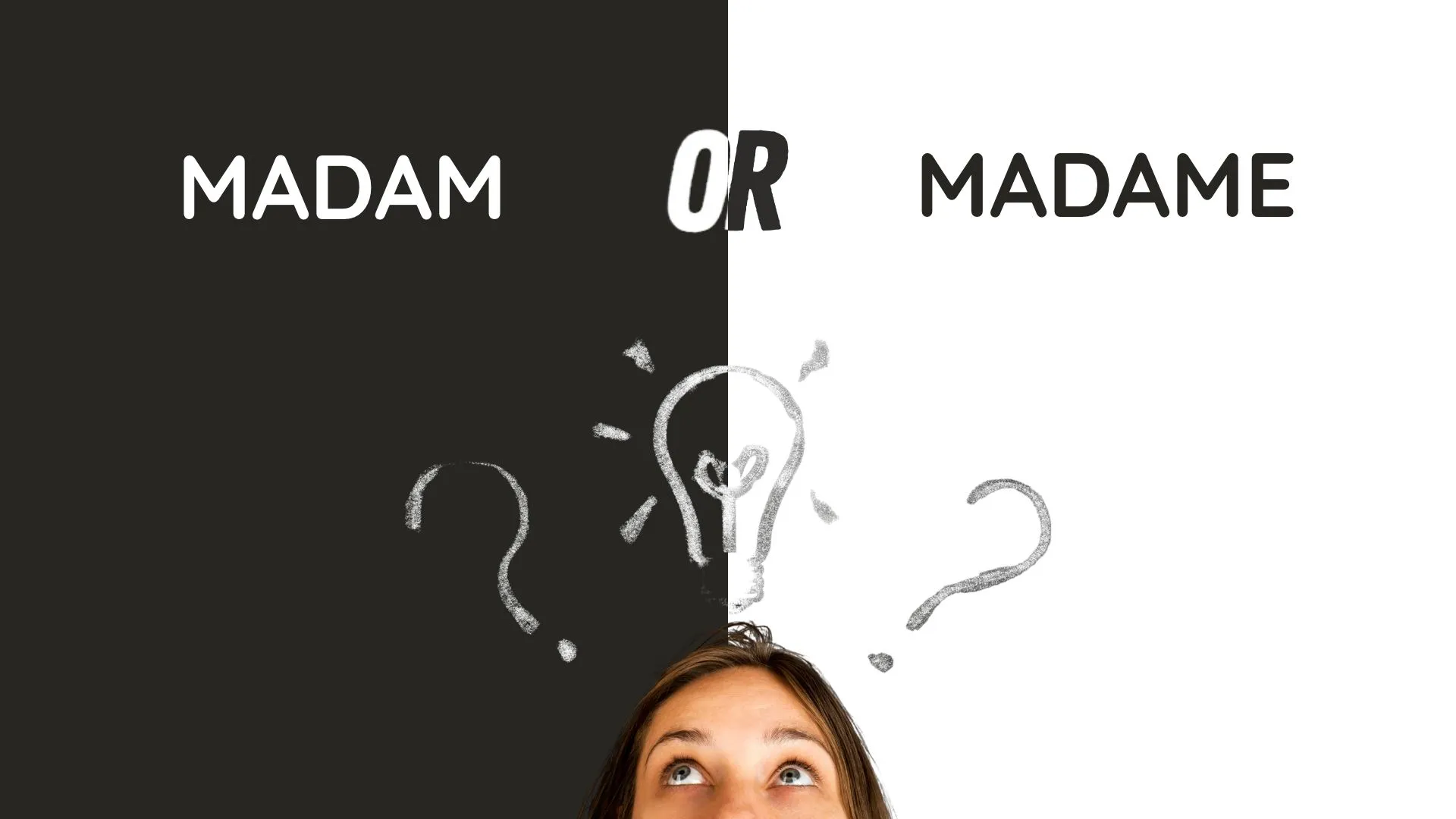
Madam and madame are both correct words, but they have different meanings and uses.
Madam is the standard English form of polite address for a woman, while madame is the French title commonly used before a woman’s name or when speaking in French.
For example, you would write “Dear Madam” in a traditional English letter but “Madame Curie” when referring to the famous scientist.
Knowing the difference helps you choose the right spelling in formal writing, conversations, and everyday situations.
Madam vs Madame: Quick Difference

The main difference between madam and madame is their language context and how people use them. Although the words are historically related, they serve different purposes in modern English.
| Feature | Madam | Madame |
| Origin | Entered English through Old French | French |
| Meaning | A respectful or formal way to address a woman | A French title used to address or refer to a woman |
| Main language | English | French, also used in English |
| Common use | Formal conversations, letters, and official titles | French names, titles, and French-speaking situations |
| Pronunciation | MAD-uhm | muh-DAM (common English pronunciation) |
| Example | Thank you for your help, madam. | Madame Curie was a famous scientist. |
| Related form | Ma’am | Mesdames (French plural) |
The simple rule: Use madam when addressing a woman in ordinary formal English. Use madame when referring to a woman by her French title or following French language conventions.
What Does Madam Mean?
Madam is a formal English noun used to address a woman politely or respectfully. It is especially common in professional environments, customer service, official conversations, and traditional business correspondence.
People often use madam when they do not know a woman’s name or want to maintain a respectful tone. For example, a receptionist might say, “Good morning, madam. How may I help you?”
The word can also appear before certain official positions, such as Madam President or Madam Secretary. In these expressions, it functions as part of a formal title rather than simply being a general greeting.
Examples of Madam in Sentences
Understanding madam becomes easier when you see how it works in everyday and professional situations.
- Excuse me, madam. You dropped your phone.
- Good afternoon, madam. Your appointment is ready.
- Dear Madam, I am writing to ask about your available services.
- May I help you with your luggage, madam?
- Madam President will address the audience this evening.
- Thank you for your patience, madam.
- The receptionist asked the visitor, “Would you like some assistance, madam?”
- Yes, madam. I will send the documents shortly.
- The employee politely welcomed the customer.
- Madam Secretary announced the new regulations.
These examples show that madam is useful when addressing someone respectfully, especially in situations where a person’s name or preferred title is unknown.
When Should You Use Madam?
Madam is appropriate in several situations, particularly when you want to sound formal and respectful.
1. Formal Conversations
Use madam when speaking politely to a woman you do not know, especially in a professional or service-related situation.
Example: “Excuse me, madam. Is this seat available?”
2. Business Communication
Madam can be used when addressing a woman in a formal business interaction.
Example: “Thank you for contacting our customer support team, madam.”
3. Formal Letters and Emails
When writing to a woman whose name is unknown, “Dear Madam” is a traditional formal greeting.
Example: “Dear Madam, I am contacting you regarding your recent application.”
4. Official Positions
Madam is used before certain official titles, particularly in formal political and administrative contexts.
Examples include Madam President and Madam Secretary.
5. Respectful Customer Service
Employees may use madam to address customers politely, particularly in formal service environments.
However, madam is not always the most natural choice in casual conversation. Some people prefer their name, professional title, or a simple greeting without a formal form of address.
Other Meanings of Madam
Madam does not always have a polite meaning. Its interpretation can change depending on the context.
In British English, the expression “a little madam” can describe a girl or woman who behaves in a bossy, demanding, or self-important way.
Madam can also refer to a woman who manages a brothel. This is a separate dictionary meaning and is generally associated with a specific context.
Therefore, although madam is commonly used as a respectful title, it is important to understand the sentence and situation in which it appears.
What Does Madame Mean?
Madame is a French title used as a respectful form of address for a woman. It is similar in function to English titles such as Mrs. and Ms., although its exact use depends on the language and cultural setting.
In modern French, Madame is a general courtesy title for an adult woman. It is not limited to married women, so you should not assume that someone using this title has a husband.
The word is also used in English, particularly when referring to French women, historical figures, cultural references, and established titles.
For example, Marie Curie is commonly referred to as Madame Curie in English-language writing. The title reflects the French form of address associated with her name.
Examples of Madame in Sentences
Here are some examples that show how madame is used in French-related contexts and English writing.
- Madame Curie made important contributions to science.
- Madame Bovary is a famous character in French literature.
- The invitation was addressed to Madame Dupont.
- Bonjour, Madame! Comment allez-vous?
- Madame Tussaud became associated with the famous wax museum.
- The student greeted her French teacher by saying, “Bonjour, Madame.”
- Madame Laurent welcomed the guests into her home.
- We read a biography about Madame Curie in class.
- The letter began with the French greeting “Chère Madame.”
- Madame was invited to attend the official ceremony.
These examples demonstrate that madame is not simply an alternative spelling of madam. It has a distinct role in French language and culture.
When Should You Use Madame?
Use madame when the French title is intended or when referring to a woman by a recognized French form of address.
1. Before French Women’s Names
Madame is commonly placed before the name or surname of a French woman.
Example: “Madame Curie is remembered for her scientific achievements.”
2. In French Conversations
When speaking French, Madame is a standard respectful way to address an adult woman.
Example: “Bonjour, Madame!”
3. In French Letters
Madame is used in formal French correspondence. For example, “Madame,” or “Chère Madame,” may be used depending on the relationship and type of letter.
4. In Cultural and Historical References
The word appears in books, biographies, historical accounts, and discussions involving French people and traditions.
Example: “Madame de Pompadour was an influential figure in French history.”
Is Madame Only Used for Married Women?
No. In modern French, Madame is not restricted to married women.
Traditionally, French forms of address sometimes distinguished women based on marital status. However, modern usage treats Madame as a general respectful title for an adult woman, regardless of whether she is married.
This is an important difference for English speakers who assume that Madame always means Mrs.
For comparison:
- Madame: A French courtesy title for an adult woman.
- Mrs.: An English title traditionally associated with a married woman.
- Ms.: An English title that does not specify marital status.
Madam vs Madame: Key Differences Explained
Although madam and madame look similar, understanding their practical differences makes it easier to choose the right word.
English and French Usage
The most important difference is the language context.
Madam is the usual English spelling when formally addressing a woman. Madame is the standard French form and is also used in English when referring to French titles and names.
For example:
- English: “May I help you, madam?”
- French: “Bonjour, Madame!”
- English historical reference: “Madame Curie changed the history of science.”
Notice that madame can appear in an English sentence without making the entire sentence French. The title itself is being used in its French form.
Madam or Madame Before a Name?
When using a title before a woman’s name, the appropriate spelling depends on the context.
| Expression | Appropriate use |
| Madam President | Formal English official title |
| Madam Secretary | Formal English official title |
| Madame Curie | French-style title before a recognized name |
| Madame Bovary | Title used for a French literary character |
| Madame Dupont | French form of address before a surname |
For ordinary English professional titles, madam is generally the appropriate spelling. For French names and titles, madame is generally preferred.
Madam or Madame in Everyday Conversations?
The words also differ in how natural they sound in everyday speech.
In formal English conversations, madam can be appropriate when addressing a woman respectfully. However, it may sound overly formal or old-fashioned in some casual situations.
Madame is less common as an ordinary English greeting. It is more likely to appear when someone is speaking French, referring to a French woman, or using a French cultural title.
For example:
- “Excuse me, madam. Is this your bag?” is a formal English greeting.
- “Bonjour, Madame!” is a natural French greeting.
- “Good morning, Madame” may sound unusual in ordinary English unless a French title is intended.
The best choice depends on the language, relationship, and setting.
Madam or Madame in a Formal Letter?

When writing a formal English letter or email to a woman whose name you do not know, “Dear Madam” is the traditional choice.
Using “Dear Madame” in an ordinary English letter is generally not appropriate because madame is the French form.
However, if you know the recipient’s name, using her name or professional title is often more natural and personal.
Dear Madam vs Dear Madame
Compare these examples:
Correct for traditional English correspondence:
Dear Madam,
I am writing to request further information about your services. I would appreciate it if you could provide the relevant details at your earliest convenience.
Thank you for your time.
Not the standard choice for an ordinary English letter:
Dear Madame,
I am writing to request further information about your services.
The second example uses the French spelling where standard English correspondence normally requires madam.
What If You Know the Recipient’s Name?
If you know the recipient’s name, you usually do not need to use madam.
Consider these examples:
| Situation | Suggested greeting |
| Recipient’s name is unknown | Dear Madam, |
| Recipient’s surname is known | Dear Ms. Smith, |
| Recipient has a professional title | Dear Dr. Smith, |
| Recipient’s position is known | Dear Hiring Manager, |
| French correspondence | Madame or Chère Madame, depending on context |
In modern professional communication, using a person’s preferred name or title is often more suitable than relying on a generic greeting.
Also, “Dear Sir or Madam” is a traditional greeting when the recipient’s gender and identity are unknown. However, a role-based greeting such as “Dear Hiring Manager” may be more specific and inclusive.
Madam vs Madame vs Ma’am
Madam, madame, and ma’am are related expressions, but they are not interchangeable in every situation.
Ma’am is a shortened form of madam. It is commonly used as a polite form of address, particularly in American English.
Madame, on the other hand, is the French form of address.
| Word | Meaning | Common use | Example |
| Madam | Formal English title or address | Formal conversations and letters | May I help you, madam? |
| Madame | French title for a woman | French names and conversations | Madame Curie was a scientist. |
| Ma’am | Shortened form of madam | Everyday polite conversations | Yes, ma’am. |
What Does Ma’am Mean?
Ma’am is a contraction of madam. It is generally used to address a woman respectfully without saying the full word.
For example:
- Yes, ma’am. I understand.
- Excuse me, ma’am. You dropped your wallet.
- Thank you, ma’am.
- No, ma’am. I have not received the message.
Ma’am is especially familiar in American English, although its use and frequency vary by region and social setting.
When Should You Use Ma’am Instead of Madam?
Ma’am is often more natural than madam in everyday American conversations.
For example:
- Everyday conversation: “Yes, ma’am.”
- Formal customer service: “How may I help you, madam?”
- Formal letter: “Dear Madam,”
- French title: “Madame Dupont”
The choice depends on the situation. Ma’am is generally conversational, madam is often more formal, and madame is associated with French usage.
Madam vs Madame: Pronunciation Differences
Madam and madame are not usually pronounced the same way in English. Their syllable stress and ending sounds help distinguish them.
How to Pronounce Madam
Madam is commonly pronounced:
MAD-uhm
IPA: /ˈmæd.əm/
The word has two syllables:
- MAD: The first syllable receives the stress.
- UHM: The second syllable is shorter and less emphasized.
You can hear the pronunciation in a sentence such as:
“Good morning, madam.”
How to Pronounce Madame
Madame is commonly pronounced:
muh-DAM
IPA: /məˈdæm/
The common English pronunciation has two syllables:
- MUH: The first syllable is unstressed.
- DAM: The second syllable receives the stress.
Some English speakers also use a pronunciation closer to the French form, so pronunciation can vary.
What Is the Main Pronunciation Difference?
The easiest way to remember the difference is to focus on the stressed syllable.
| Word | Pronunciation | Stress |
| Madam | MAD-uhm | First syllable |
| Madame | muh-DAM | Second syllable |
In madam, the emphasis is on the beginning of the word. In the common English pronunciation of madame, the emphasis falls toward the end.
Is Calling Someone Madam Rude or Disrespectful?
Calling someone madam is not automatically rude. It is generally intended as a respectful or formal way to address a woman. However, the way it sounds can depend on the situation, tone, country, and personal preference.
A word that sounds polite in one situation may feel unnecessarily formal in another.
When Does Madam Sound Polite?
Madam is usually suitable in formal or professional interactions.
For example:
- A hotel employee addressing a guest.
- A receptionist speaking to a visitor.
- A customer service representative assisting a customer.
- A person politely getting the attention of an unfamiliar woman.
In these situations, madam can communicate courtesy and respect.
When Can Madam Sound Unnatural?
In casual conversations, madam may sound distant, stiff, or old-fashioned.
For example, saying “Good morning, madam” to a close friend may sound unusual because the relationship does not require such a formal title.
Some women may also dislike being addressed as madam because it can make them feel uncomfortable or unnecessarily formal.
If you are unsure, a simple greeting or the person’s preferred name is often a better option.
Is Ma’am More Polite Than Madam?
Neither word is automatically more polite. Both can communicate respect, but their naturalness depends on the setting.
In many American conversations, ma’am sounds more familiar and conversational. Madam may sound more formal or official.
The important thing is to consider the person’s preference rather than assuming that a particular title is always welcome.
Common Mistakes to Avoid When Using Madam and Madame
Because the two words look similar, it is easy to confuse their spelling and meaning. Here are some mistakes to avoid.
1. Using Madame in an Ordinary English Greeting
Incorrect: Good afternoon, madame. How can I help you?
Better: Good afternoon, madam. How can I help you?
Use madam when you intend an ordinary formal English greeting.
2. Using Madam When Referring to a French Title
Incorrect: Madam Curie was a famous scientist.
Better: Madame Curie was a famous scientist.
Use madame when referring to Marie Curie by her established French title.
3. Confusing Ma’am With Madame
Incorrect: Ma’am is another spelling of madame.
Correct: Ma’am is a shortened form of madam.
Madame is the French form of address, while ma’am is an English contraction.
4. Assuming Madame Always Means Mrs.
Madame does not necessarily indicate that a woman is married.
In modern French, it is a respectful title for an adult woman, regardless of marital status.
5. Using Formal Titles in Every Conversation
Madam is not necessary every time you speak to a woman. Repeating it in casual conversations can sound unnatural.
Use titles when they suit the relationship and situation.
6. Forgetting Capitalization
Capitalization depends on how the word is used.
Examples:
- “Good morning, madam.” (General form of address)
- “Madam President will speak today.” (Part of an official title)
- “Dear Madam,” (Beginning of a formal letter)
- “The customer was addressed as madam.” (Common noun)
When madame is used as a title before a person’s name, it is commonly capitalized.
Frequently Asked Questions
Is Madam or Madame Correct in English?
Both are correct English words, but they have different uses. Madam is the standard form for politely addressing a woman in English, while madame is the French title used in French names, cultural references, and appropriate formal contexts.
Should I Write Dear Madam or Dear Madame?
Write “Dear Madam” in traditional formal English correspondence when you do not know the woman’s name. Use “Madame” when following French language conventions or addressing someone by a French title.
Is Madame Only Used for Married Women?
No. In modern French, Madame is a general respectful title for an adult woman. It does not necessarily indicate that she is married.
Is Madam the Same as Ma’am?
They are closely related, but their forms differ. Ma’am is the shortened form of madam and is frequently used in everyday polite conversations, particularly in American English.
Is Calling a Woman Madam Rude?
Not necessarily. Madam is traditionally a respectful form of address, especially in formal settings. However, some people may find it too formal or prefer to be addressed by their names. Tone and context matter.
What Is the Plural of Madam and Madame?
The regular English plural of madam is madams. The French plural of Madame is mesdames, which is also used in English in appropriate contexts. For example, “The two madams attended the meeting” and “Mesdames Dupont and Laurent attended the ceremony.”
Conclusion
The difference between madam and madame comes down to language, context, and usage. Madam is the usual English form for respectfully addressing a woman in formal conversations, letters, and official titles. Madame is the French title commonly used before a woman’s name and in French-speaking situations. Remember that ma’am is a shortened form of madam, not another spelling of madame
Also, Madame does not necessarily mean a married woman. If you are writing an English business letter or politely addressing a customer, madam is generally the appropriate choice. If you are referring to a French woman by her title, madame is the correct form.
The easiest rule to remember: Madam for ordinary formal English, Madame for the French title, and Ma’am for a shorter conversational form.

Nicholas Turner is a dedicated writer who enjoys creating clear, engaging and well-researched content for readers around the world. He has a passion for exploring language, culture and everyday topics that spark curiosity. Nicholas is also the fictional author of The Silent Ember Road and Where Morning Echoes Rest, two original story concepts created exclusively for his author profile. Outside of writing, he enjoys traveling, reading, and discovering new perspectives. His goal is to make every article informative, approachable, and genuinely useful.
 Ava Collins