
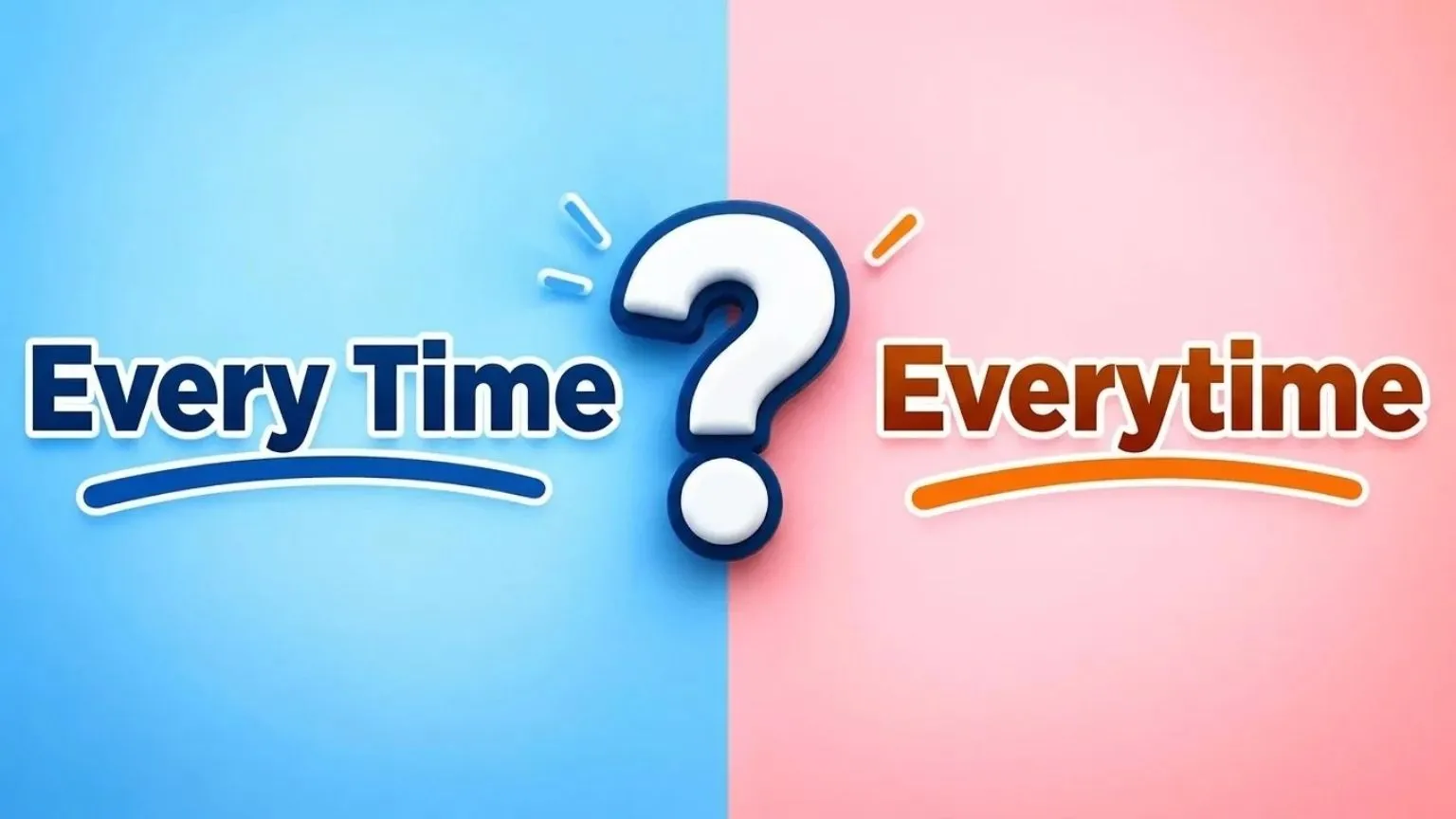
Have you ever wondered whether to write every time or everytime? You are not alone. These two spellings look almost identical, so it is easy to assume they are both correct. However, standard English recognizes only one spelling: every time, written as two separate words.
Every time means “each time” or “on every occasion.” It describes something that happens whenever a particular situation occurs. The spelling everytime is a common mistake and is not accepted as the standard form of this expression.
For example:
- Correct: Every time I hear this song, I remember my childhood.
- Incorrect: Everytime I hear this song, I remember my childhood.
The confusion often comes from familiar English words such as everyone, everything, and everywhere, which are written as single words. However, every time follows a different spelling pattern.
Let’s look at the meaning, grammar, sentence examples, and differences between similar expressions so you can use every time correctly in everyday and professional writing.
Every Time vs. Everytime: Quick Difference
The main difference is simple: every time is correct, while everytime is a nonstandard spelling.
| Spelling | Correct or Incorrect? | Meaning |
| Every time | Correct | Each time or on every occasion |
| Everytime | Incorrect in standard English | Nonstandard spelling of every time |
Every time contains two separate words. Every is a determiner, and time is a singular noun. Together, they refer to each individual occasion when something happens.
For example:
- Every time I visit my grandparents, they prepare my favorite meal.
- She smiles every time someone compliments her work.
- Every time we travel, we discover something interesting.
In all three examples, the expression describes something that happens on each occasion.
On the other hand, writing everytime as one word is a spelling mistake in standard English. You may see it in social media posts, text messages, or informal online writing, but that does not make it an accepted spelling.
Remember: Whenever you mean “each time” or “on every occasion,” always write every time as two words. This rule applies to American, British, Canadian, and Australian English.
What Does Every Time Mean?
Every time means each time, whenever, or on every occasion that something happens. It describes repeated actions, habits, experiences, or situations that occur whenever a particular event takes place.
The expression is commonly used in everyday conversations and writing because it helps explain how one event is connected to another.
Consider these examples:
- Every time it rains, the roads become slippery.
- I feel relaxed every time I listen to music.
- He forgets his keys every time he leaves the house.
- Every time she visits us, she brings something special.
- My little brother laughs every time he watches cartoons.
In each sentence, every time introduces a situation that happens repeatedly.
Why Is Every Time Written as Two Words?
Every time is written as two words because it functions as a combination of a determiner and a noun rather than an established single-word compound.
To understand this, look at its two parts:
- Every: A determiner that refers to all individual members or occasions in a group.
- Time: A singular noun referring to an occasion, instance, or event.
When these words appear together, they refer to each individual occasion.
English also contains several words beginning with every that are written as one word. This is one reason people become confused.
Compare these examples:
| Word or Expression | Correct Spelling | Meaning |
| Everyone | One word | Every person |
| Everything | One word | All things |
| Everywhere | One word | In all places |
| Every day | Two words | Each day |
| Every time | Two words | On each occasion |
| Everyday | One word | Ordinary or usual |
Notice that English does not follow one universal rule for combining every with another word. Some expressions have established single-word forms, while others remain separate.
For this reason, you should learn the standard spelling of each expression rather than assuming that all words beginning with every follow the same pattern.
Is Everytime Ever Acceptable?
You may occasionally encounter everytime in informal writing, online conversations, comments, or social media captions. People sometimes combine the words because they sound like a single expression when spoken.
However, everytime is not the standard spelling recognized in edited English.
If you are writing an email, school assignment, article, business document, or professional message, use every time.
For example:
- Informal spelling: I miss you everytime you leave.
- Standard spelling: I miss you every time you leave.
The second version is the correct choice. Even in casual communication, using the standard spelling helps make your writing clearer.
How to Use Every Time in a Sentence
You can use every time in different parts of a sentence to describe repeated situations and actions. It commonly introduces a time clause that explains when something happens.
Here are some practical ways to use it.
Every Time at the Beginning of a Sentence
You can begin a sentence with every time when you want to introduce a repeated event or situation.
Examples:
- Every time I visit my hometown, I remember my childhood.
- Every time she opens her laptop, she checks her emails.
- Every time it snows, the children go outside to play.
- Every time we work together, we learn something new.
- Every time he hears that song, he starts dancing.
When every time begins a sentence and introduces the opening clause, place a comma before the main clause.
For example:
Every time I see my best friend, I feel happy.
The opening part explains when the feeling occurs, while the second part tells the reader what happens.
Every Time in the Middle or at the End of a Sentence
Every time can also appear after the main clause. This is a natural construction in everyday English.
Examples:
- I drink coffee every time I visit this café.
- She checks her answers every time she finishes a test.
- He makes the same mistake every time.
- My parents encourage me every time I face a challenge.
- I remember our conversations every time I hear that song.
You generally do not need a comma when the every time clause follows the main clause naturally.
Every Single Time: Meaning and Usage
Every single time is another correct expression. It has the same basic meaning as every time, but the word single adds emphasis.
It highlights that something happens on absolutely every occasion, without an exception.
Examples:
- You make me laugh every single time.
- She arrives late every single time we arrange a meeting.
- I get excited every single time I visit the beach.
- He forgets his password every single time he logs in.
Compare:
- She calls me every time she needs help.
- She calls me every single time she needs help.
Both sentences are correct. The second one places stronger emphasis on the repeated action.
Every Time vs. All the Time: What’s the Difference?
Every time and all the time are similar because both expressions describe frequency. However, they do not have exactly the same meaning.
Every time means on each individual occasion when something happens.
All the time means continuously, constantly, or very frequently over a period.
Look at the following examples:
| Every Time | All the Time |
| Every time I call her, she answers. | She talks on the phone all the time. |
| I smile every time I see him. | He makes me smile all the time. |
| Every time it rains, I carry an umbrella. | It rains all the time during this season. |
| She checks her email every time she opens her laptop. | She checks her email all the time. |
The easiest way to remember the difference is to replace every time with each time.
If the sentence still makes sense, every time is probably the expression you need.
For example:
- Every time I visit my friend, we go shopping.
- Each time I visit my friend, we go shopping.
Both sentences communicate the same idea.
However, you cannot always replace all the time with each time because all the time often describes an ongoing or frequent activity rather than individual occasions.
Every Time vs. Every Day vs. Everyday
These three expressions can be confusing because they look similar, but they have different meanings and grammatical uses.
| Expression | Meaning | Example |
| Every time | On each occasion | I smile every time I see her. |
| Every day | Each day or daily | I exercise every day. |
| Everyday | Ordinary or usual | These are my everyday shoes. |
Every time describes repeated occasions.
Every day refers to something that happens daily. It is written as two words because every modifies the noun day.
Everyday is a single-word adjective that describes something ordinary, familiar, or commonly used.
Here are additional examples to make the difference clearer:
- Every time I visit the park, I take pictures.
- I visit the park every day.
- Walking is part of my everyday routine.
Notice how the meaning changes in each sentence.
A useful trick is to replace every day with each day. If the sentence still makes sense, you probably need the two-word expression.
For example:
- I read a book every day.
- I read a book each day.
Both are correct.
However, you cannot use everyday in the same way because it functions as an adjective, not an adverbial time expression.
Common Mistakes to Avoid When Using Every Time
Even though the spelling rule is simple, people sometimes make other mistakes when using every time in sentences. Understanding these errors will help you write more naturally.
1. Writing Everytime as One Word
This is the most common mistake.
Incorrect: I think about you everytime I hear this song.
Correct: I think about you every time I hear this song.
Always leave a space between every and time when you mean each occasion.
2. Using Every Times Instead of Every Time
Another mistake is adding an unnecessary s to time.
Incorrect: Every times I visit my friend, we go shopping.
Correct: Every time I visit my friend, we go shopping.
In this expression, time remains singular after every.
3. Adding an Unnecessary When
Some writers use when immediately after every time, even though the expression already introduces a time clause.
Less natural: Every time when I visit my grandmother, she makes tea.
Preferred: Every time I visit my grandmother, she makes tea.
The preferred version is shorter and more natural in standard everyday English. You generally do not need to add when after every time in this construction.
4. Confusing Every Time With All the Time
These expressions describe different kinds of frequency.
Incorrect for the intended meaning: I feel happy every time when I am listening to music all day.
Better: I feel happy every time I listen to music.
Alternatively: I listen to music all the time because it makes me happy.
Choose the expression according to whether you mean each individual occasion or something that happens continuously or frequently.
5. Confusing Every Time With Every Day
Every time does not mean daily. It refers to each occasion when something happens.
For example:
- Correct: I call my mother every day.
- Correct: I call my mother every time I need advice.
The first sentence describes a daily habit, while the second describes a repeated situation.
Alternatives and Synonyms for Every Time
If you use every time frequently in your writing, you can sometimes replace it with another expression. The best alternative depends on the meaning and tone of your sentence.
| Alternative | Meaning or Usage | Example |
| Each time | Every individual occasion | Each time I visit, I learn something new. |
| Whenever | At any time that something happens | Whenever I call, she answers. |
| Every single time | Every occasion, with emphasis | He surprises me every single time. |
| On every occasion | A slightly more formal expression | She follows the instructions on every occasion. |
These expressions are similar, but they are not always interchangeable.
For example, whenever can introduce a time clause naturally, while on every occasion sounds more formal. Use the alternative that best matches your sentence and intended meaning.
Frequently Asked Questions
Is It Every Time or Everytime?
Every time is the correct spelling in standard English. It consists of two separate words and means each time or on every occasion. Everytime is a nonstandard spelling and should be avoided.
Is Everytime a Real English Word?
Everytime is sometimes used in informal online writing, but it is not an accepted standard spelling of the expression. The correct form is every time.
Is Every Time Always Written as Two Words?
Yes. When you mean each time or on every occasion, write every time as two separate words. This spelling is standard in both American and British English.
Can I Start a Sentence With Every Time?
Yes. Every time can appear at the beginning of a sentence to introduce a repeated situation. When the opening time clause comes before the main clause, use a comma to separate them.
Example: Every time I visit my hometown, I meet my old friends.
Is Every Time Grammatically Correct in American and British English?
Yes. Every time is the standard spelling in American, British, Canadian, and Australian English. There is no regional spelling difference for this expression.
What Is the Difference Between Every Time and Each Time?
Both expressions have almost the same meaning and refer to every individual occasion. For example, “I smile every time I see her” and “I smile each time I see her” communicate the same basic idea.
What Is the Difference Between Every Time and Every Day?
Every time means on each occasion when something happens, while every day means daily or on each day.
Example: I smile every time I see my friend. I call my friend every day.
Can I Say Every Single Time?
Yes. Every single time is grammatically correct. It adds emphasis to the expression and highlights that something happens on absolutely every occasion.
Example: You make me laugh every single time.
Conclusion
The correct spelling is every time, not everytime. Write it as two separate words whenever you mean each time, whenever, or on every occasion. Although the one-word version appears in informal online writing, it is not the standard English form.
If you ever feel unsure, try replacing every time with each time. If the sentence still makes sense, you are using the expression correctly. Remember this simple rule, and you can avoid one of the most common spelling mistakes in everyday English.

Daniel Foster is a writer who enjoys breaking down complex topics into simple, engaging and easy-to-understand content. He has a passion for research, storytelling, and creating articles that help readers find clear answers. Daniel is also the fictional author of Beyond the Quiet Compass and Shadows of the Forgotten Tide. When he’s away from the keyboard, he enjoys hiking, reading, and exploring new ideas. His goal is to create content that is informative, trustworthy and enjoyable to read.
 Nicholas Turner
 Ava Collins