
Have you ever typed GIF but stopped for a second because you were not sure how to say it? Should it sound like “gif” with a hard G, or “jif” with a soft G?
This small pronunciation debate has lasted for years. The confusion is understandable because the word is always spelled GIF, but English speakers commonly pronounce it in two different ways. Both pronunciations are now recognized by major dictionaries. Oxford lists both /ɡɪf/ and /dʒɪf/, while Merriam-Webster also records both pronunciations.
The creator of the format, Steve Wilhite, preferred the soft-G pronunciation, “JIF.” However, that preference did not stop people from using the hard-G pronunciation, which remains common today.
So, if you are searching for GIF or JIF, the most useful answer is simple: GIF is the spelling, while both “gif” and “jif” are established pronunciations.
GIF or JIF: Quick Answer
GIF is spelled GIF, but it has two common pronunciations: “gif” with a hard G and “jif” with a soft G. Steve Wilhite preferred “jif,” but major dictionaries recognize both pronunciations.
| Question | Answer |
| How is it spelled? | GIF |
| What does GIF stand for? | Graphics Interchange Format |
| Can it be pronounced with a hard G? | Yes |
| Can it be pronounced with a soft G? | Yes |
| Which pronunciation did the creator prefer? | JIF |
| Is JIF a different file format? | No |
| What is the plural? | GIFs |
Oxford gives GIF both /ɡɪf/ and /dʒɪf/ pronunciations, and Merriam-Webster lists both as well.
What Does GIF Mean?
What GIF Stands For
GIF stands for Graphics Interchange Format. It is a computer file format used to store visual digital information.
Today, people often use the word GIF to describe a short animated image shared online. GIFs are common in text messages, social media, online conversations, memes, reaction posts, and websites.
Merriam-Webster defines GIF as a computer file format and also as an image or video stored in that format. Its dictionary records the first known use of the term as 1987.
For example:
- “Send me that GIF.”
- “That reaction GIF is hilarious.”
- “I found a funny GIF for the group chat.”
- “She used a GIF to express her reaction.”
Is Every GIF Animated?
No. GIF is the name of the file format, not simply a synonym for animation.
GIFs are widely associated with animation because the format can be used for images that display as a sequence of frames. That is why people often use “GIF” to mean a short looping animation.
So it is more accurate to think of:
GIF = a file format
rather than:
GIF = an animation only
That distinction is useful when discussing the technical meaning of the word.
How Do You Pronounce GIF?
GIF With a Hard G
The first pronunciation uses a hard G sound.
It sounds roughly like:
“gif” — similar to “gift” without the final T.
The phonetic pronunciation is:
/ɡɪf/
The /ɡ/ sound is the same type of sound found at the beginning of words such as “go” and “gift.” Oxford’s pronunciation guide represents the hard G sound with /ɡ/.
Example:
“I sent you a GIF.”
If you pronounce GIF with a hard G, you are using a pronunciation that is documented by major dictionaries. Merriam-Webster lists /ˈgif/ alongside /ˈjif/.
GIF With a Soft G
The second pronunciation uses a soft G sound.
It sounds like:
“jif.”
The phonetic pronunciation is:
/dʒɪf/
This is the same kind of beginning sound heard in words such as “jam,” “job,” and “jump.” Oxford’s pronunciation guide represents this sound with /dʒ/.
So you may hear someone say:
“That JIF is perfect for this reaction.”
They are still talking about a GIF. The spelling has not changed; only the pronunciation is different.
Why Are GIF and JIF Both Used?
Why Some People Say “GIF”
One reason for the hard-G pronunciation is the word Graphics in the full name Graphics Interchange Format.
Because “graphics” starts with a hard G, some speakers naturally connect that sound with the abbreviation:
Graphics → GIF → hard G
This makes the pronunciation feel logical to many people.
The hard-G pronunciation also became widespread through everyday usage. Merriam-Webster notes that the hard-G pronunciation remains popular even though the creator preferred the soft-G form.
Why Some People Say “JIF”
The soft-G pronunciation has an important historical connection to the creator of the format.
Steve Wilhite, who is credited with creating GIF in 1987, preferred the pronunciation “JIF.” He publicly reinforced this preference at the 2013 Webby Awards.
However, a creator’s preferred pronunciation does not automatically determine how an entire language community uses a word.
As Merriam-Webster explains, language usage develops through the people who use words. That is why the hard-G pronunciation continued alongside the creator’s preferred soft-G pronunciation.
What Pronunciation Did the Creator Prefer?
Steve Wilhite preferred “JIF,” with a soft G.
He even used the phrase “It’s pronounced ‘JIF’” during his 2013 Webby Awards appearance. Merriam-Webster describes this as a public attempt by Wilhite to reinforce the pronunciation.
That historical detail is important, but it does not mean that people who pronounce GIF with a hard G are automatically wrong.
Modern dictionary evidence shows why the debate continues: both pronunciations are recorded. Oxford lists both /ɡɪf/ and /dʒɪf/, and Merriam-Webster does the same.
So there are two separate questions:
What did the creator prefer?
JIF.
What pronunciations are established in English?
Both GIF and JIF.
Is GIF or JIF More Correct?
GIF Is the Correct Spelling
When you write the name of the file format, use:
GIF
Do not normally replace the spelling with JIF simply because you pronounce it with a soft G.
For example:
“I sent you a GIF.”
The spelling stays the same whether you pronounce it “gif” or “jif.”
Both Pronunciations Are Established
There is no need to treat the pronunciation debate as a simple case of one correct form and one incorrect form.
Both pronunciations are recorded by major dictionaries. Oxford lists:
- /ɡɪf/
- /dʒɪf/
Merriam-Webster likewise gives both ˈgif and ˈjif.
Therefore, a more accurate explanation is:
GIF has two established pronunciations, while GIF remains the standard spelling.
GIF vs JIF: Spelling, Pronunciation, and Meaning
The easiest way to understand the debate is to separate the three ideas.
| Term | What it refers to |
| GIF | The standard written form |
| “gif” | Hard-G pronunciation |
| “jif” | Soft-G pronunciation |
| GIFs | Standard plural spelling |
| JIF | Common way to represent the soft-G pronunciation in the debate |
This means GIF and JIF are not two different versions of the file format.
The file format is GIF.
The disagreement is simply about how the written word GIF should sound when spoken.
Which GIF Pronunciation Should You Use?
If you are wondering which pronunciation to choose in everyday conversation, there is no serious communication problem with either one.
If You Prefer the Hard G
Say:
GIF → /ɡɪf/
This is widely understood and is listed by dictionaries.
If You Prefer the Soft G
Say:
GIF → /dʒɪf/
This follows the pronunciation preferred by Steve Wilhite and is also recorded by major dictionaries.
If You Are Writing It
Always use:
GIF
The pronunciation does not change the normal spelling.
This is the simplest practical rule:
Write GIF. Say either “gif” or “jif.”
Why Does the Letter G Cause So Much Confusion?
English gives the letter G more than one common sound.
Compare:
- go — hard G
- gift — hard G
- game — hard G
- giant — soft G
- gym — soft G
- gem — soft G
Because both sounds can occur with the letter G, the spelling GIF does not automatically tell every speaker how to pronounce it.
The full phrase Graphics Interchange Format encourages the hard-G pronunciation, while the creator’s preference supports the soft-G pronunciation.
That combination helps explain why the debate has lasted so long.
Is “Jiff” a Real Word?
Yes. Jiff is also an English word, separate from the GIF pronunciation debate.
A jiff means a very short period of time. It is related to the more familiar expression “jiffy.”
For example:
“I’ll be back in a jiff.”
This creates an interesting distinction:
GIF = the image file format
“jif” = one pronunciation of GIF
jiff = a separate English word meaning a very short time
So although “jif” and “jiff” sound similar, they do not have the same meaning.
GIF or JIF in Everyday Sentences
Seeing the word in real sentences can make the distinction easier.
Example 1: Talking About a Reaction
“That GIF perfectly describes my reaction.”
Here, GIF refers to an image or animation used to communicate a reaction.
Example 2: Talking About Pronunciation
“Some people pronounce GIF with a soft G.”
Here, the discussion is about how the word sounds.
Example 3: Talking About the Creator
“Steve Wilhite preferred the JIF pronunciation.”
This sentence refers to the historical pronunciation preference associated with the creator.
Example 4: Talking About Multiple Images
“She saved several GIFs for the presentation.”
The standard plural spelling is GIFs.
Example 5: Talking About Online Communication
“A well-chosen GIF can make a message more expressive.”
This shows how the word is commonly used today.
Common GIF Pronunciation Mistakes
Mistake 1: Thinking JIF Is a Different File Format
It is not.
GIF is the format. “JIF” is commonly used to represent the soft-G pronunciation.
Mistake 2: Writing JIF Instead of GIF
If you are naming the image format in normal writing, use GIF.
For example:
Correct: “I downloaded a GIF.”
Not:
Usually incorrect: “I downloaded a JIF.”
The second form may be used when discussing the pronunciation, but it is not the standard spelling of the format.
Mistake 3: Saying the Creator Preferred the Hard G
The opposite is true. Steve Wilhite preferred the soft-G pronunciation, JIF.
Mistake 4: Assuming the Creator’s Preference Makes the Hard G Impossible
It does not.
Modern dictionaries recognize both pronunciations, so the hard-G version remains an established form.
Mistake 5: Thinking Every GIF Must Be Animated
GIF is a file format. Although animated GIFs are extremely common, the term itself refers to the format rather than requiring every GIF to be animated.
How Do You Write the Plural of GIF?
The standard plural is:
GIFs
For example:
- “I saved five GIFs.”
- “These GIFs are hilarious.”
- “The website contains thousands of GIFs.”
Merriam-Webster lists GIFs as the plural form.
You do not normally change the spelling to “JIFs” simply because you use the soft-G pronunciation.
Does American or British English Prefer GIF or JIF?
The pronunciation debate should not be treated as a simple American-versus-British English difference.
Both pronunciations are found in English, and major dictionaries record both. Oxford’s dictionary entry gives both /ɡɪf/ and /dʒɪf/.
So if you hear one speaker say “gif” and another say “jif,” their difference does not necessarily tell you where they are from.
It is better understood as a pronunciation variation that has developed around a widely used modern word.
GIF Pronunciation: A Simple Memory Trick
If you frequently forget which pronunciation is which, use this simple guide:
Hard G:
GIF → sounds like “gift” without the T
Soft G:
GIF → sounds like “jiff”
Then remember:
GIF is the spelling.
You can pronounce that spelling in either of the two established ways.
If you want to remember the historical detail:
Creator’s preference → JIF
That gives you an easy three-part memory system:
GIF = spelling
GIF = hard-G pronunciation
JIF = soft-G pronunciation
Quick GIF or JIF Quiz
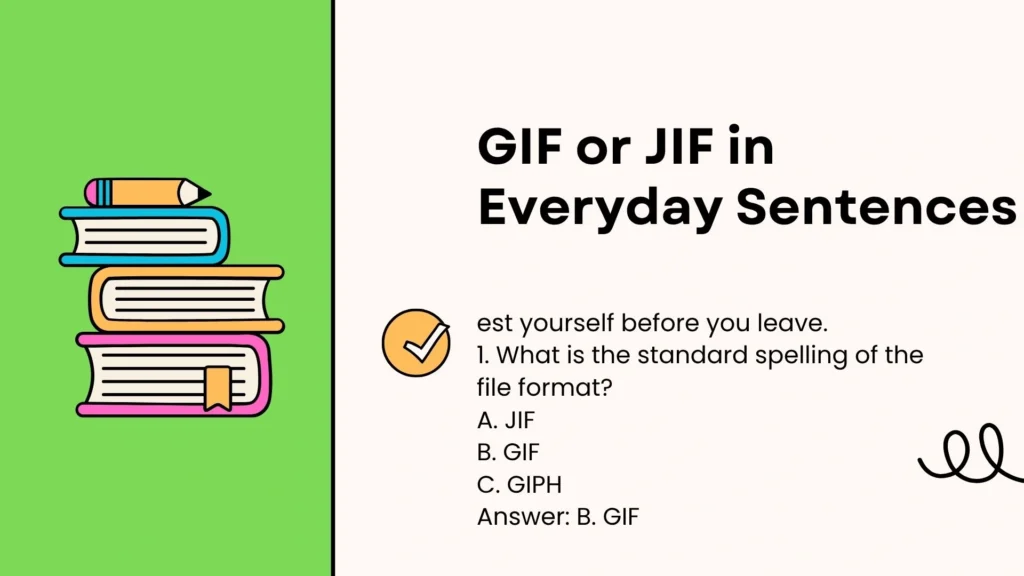
Test yourself before you leave.
1. What is the standard spelling of the file format?
A. JIF
B. GIF
C. GIPH
Answer: B. GIF
2. Which two pronunciations are commonly used?
A. “gif” and “jif”
B. “geef” and “gaff”
C. “gife” and “jife”
Answer: A. “gif” and “jif”
3. Which pronunciation did Steve Wilhite prefer?
A. Hard G
B. Soft G
C. Neither
Answer: B. Soft G
4. What is the standard plural spelling?
A. JIFs
B. GIFes
C. GIFs
Answer: C. GIFs
5. Are GIF and JIF two different file formats?
A. Yes
B. No
Answer: B. No
6. Does GIF always mean an animation?
A. Yes
B. No
Answer: B. No
Frequently Asked Questions About GIF or JIF
Is GIF pronounced “gif” or “jif”?
Both pronunciations are used. Oxford lists /ɡɪf/ and /dʒɪf/, while Merriam-Webster also records both forms.
Which pronunciation did the creator of GIF prefer?
Steve Wilhite preferred the soft-G pronunciation, “JIF.” He publicly reinforced that preference at the 2013 Webby Awards.
Is JIF the correct spelling of GIF?
No. GIF is the standard spelling of the file format. “JIF” is commonly used to represent the soft-G pronunciation when discussing the pronunciation debate.
Why do some people pronounce GIF with a hard G?
The hard-G pronunciation may feel natural because GIF comes from Graphics Interchange Format, and “graphics” begins with a hard G. The hard-G pronunciation is also widely established in actual usage.
Why is GIF pronounced JIF?
The soft-G pronunciation is associated with Steve Wilhite’s preference. He explicitly promoted “JIF” as the intended pronunciation.
Can both GIF pronunciations be correct?
Both pronunciations are established and listed by major dictionaries. So in everyday English, both the hard-G and soft-G pronunciations are recognized.
What does GIF stand for?
GIF stands for Graphics Interchange Format, the name of the image file format. Oxford describes it as a computer file containing images and notes its use for making images appear to move.
What is the plural of GIF?
The standard plural is GIFs.
Is “jiff” a real English word?
Yes. Jiff is an informal word meaning a very short period of time. It is separate from the GIF pronunciation debate.
Is every GIF animated?
No. GIF is a file format. Animated GIFs are common, but the term GIF itself refers to the format rather than requiring animation.
Should I write “GIF” or “JIF” in an article?
Use GIF when referring to the file format. If you are discussing the pronunciation, you can use “jif” to describe the soft-G pronunciation.
Conclusion
The GIF or JIF debate is really about pronunciation, not spelling. The standard written form is GIF, short for Graphics Interchange Format. When spoken, it can be pronounced with a hard G, /ɡɪf/, or a soft G, /dʒɪf/. Both pronunciations are recognized by major dictionaries.
Steve Wilhite, the creator credited with developing the GIF format, preferred “JIF,” but that did not eliminate the hard-G pronunciation. Both forms remain part of everyday English usage.
So the easiest rule to remember is: write GIF, and when speaking, either “gif” or “jif” is widely understood. If you want to follow the creator’s preference, choose “jif.”

Ava Collins is a passionate writer who enjoys turning everyday ideas into clear, engaging, and helpful content. She loves exploring language, culture and meaningful stories that connect with readers. Ava is also the fictional author of Beneath the Silver Maple and The Last Lantern of Willow Cove. When she’s not writing, she enjoys reading, traveling and finding inspiration in ordinary moments.
 Daniel Foster