
The short answer is that both “mam” and “ma’am” are correct, but they are not always used in the same way. “Ma’am” is the standard English spelling of the polite form of address for a woman. “Mam” is commonly used in some regions, especially in British English, Irish English, Indian English, and Pakistani English, and is also used in schools and workplaces.
Many people get confused because both words sound almost the same when spoken. You may also see “mam” used in text messages or local speech.
In this article, you’ll learn the difference between mam and ma’am, when to use each one, common mistakes to avoid, and an easy way to remember the correct form.
Quick Answer
Both “mam” and “ma’am” are correct, but they have different uses.
- Ma’am is the standard spelling of the polite word for madam and is widely accepted in formal English.
- Mam is common in some regions and is often used in schools, workplaces, and everyday conversation.
Examples:
- Ma’am, could you please sign this form? ✅
- Good morning, Mam. ✅ (Common in South Asia and some parts of the UK)
Mam vs Ma’am: Main Difference
| Word/Phrase | Meaning | Correct? | Best Used For | Example |
| Mam | A respectful way to address a woman in some regions | Yes | Schools, workplaces, everyday use in South Asia, Ireland, and parts of the UK | Good morning, Mam. |
| Ma’am | A polite short form of madam | Yes | Formal writing, business, customer service, American English | Thank you, Ma’am. |
What Does Mam Mean?
Mam is a respectful title used before or instead of a woman’s name in many English-speaking regions. It is especially common in schools, offices, and everyday conversations in countries like India and Pakistan. In parts of the UK and Ireland, mam can also mean mother.
Examples
- Good morning, Mam.
- Mam, may I ask a question?
- Thank you, Mam, for your guidance.
- Our class teacher asked us to meet the principal, Mam.
- My mam is coming to school today. (UK regional use meaning “mother”)
What Does Ma’am Mean?
Ma’am is the shortened form of madam. It is a polite way to address a woman whose name you do not know or when showing respect.
It is widely used in American English, customer service, official communication, and formal situations.
Examples
- Excuse me, Ma’am, you dropped your wallet.
- Yes, Ma’am, I’ll do it right away.
- May I help you, Ma’am?
- Thank you, Ma’am, for your time.
- Good afternoon, Ma’am.
How to Use Mam or Ma’am
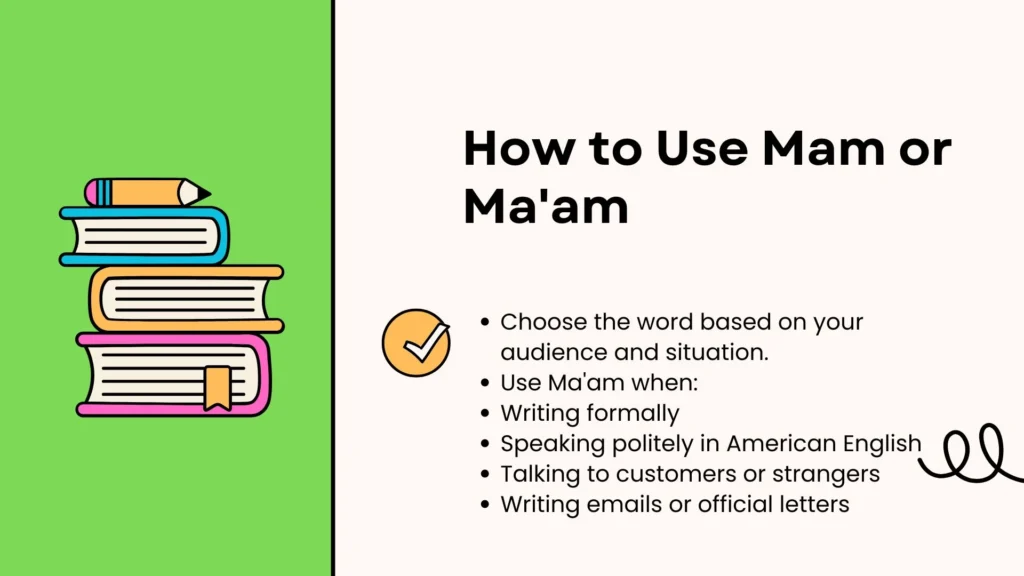
Choose the word based on your audience and situation.
Use Ma’am when:
- Writing formally
- Speaking politely in American English
- Talking to customers or strangers
- Writing emails or official letters
Correct:
- Dear Ma’am,
- Thank you, Ma’am.
Use Mam when:
- Following local school or workplace customs
- Speaking in regions where mam is commonly accepted
- Referring to your mother in some parts of the UK
Correct:
- Good morning, Mam.
- Mam, the meeting is ready to begin.
Avoid changing between mam and ma’am in the same document unless there is a clear reason.
Where to Use Mam or Ma’am
School Writing
- Mam is common in many schools in India and Pakistan.
- Ma’am is also acceptable and is more standard internationally.
Formal Writing
- Ma’am is the safer choice.
Emails
- Use Ma’am if you want a formal and widely accepted style.
- Use Mam if it matches your organization’s usual practice.
Everyday Conversation
- Both are acceptable depending on local usage.
Messages
- Either form may be used, but Ma’am looks more formal.
Professional Communication
- Ma’am is generally preferred in international business communication.
Regional Usage
American English
- Ma’am is the standard spelling.
British English
- Ma’am is used in formal situations, especially when addressing royalty or officials.
- Mam is common in some regional dialects and can also mean mother.
Canada
- Ma’am is generally preferred.
Australia and New Zealand
- Ma’am is used in formal settings but is less common in everyday conversation.
India and Pakistan
- Both Mam and Ma’am are widely understood.
- Mam is especially common in schools, colleges, and offices.
Why People Get Confused
People confuse mam and ma’am because:
- They sound almost the same.
- Both are used respectfully.
- Different countries prefer different spellings.
- Many schools and workplaces use Mam, while dictionaries usually list Ma’am as the standard spelling.
- The apostrophe in ma’am is often forgotten.
Common Mistakes to Avoid
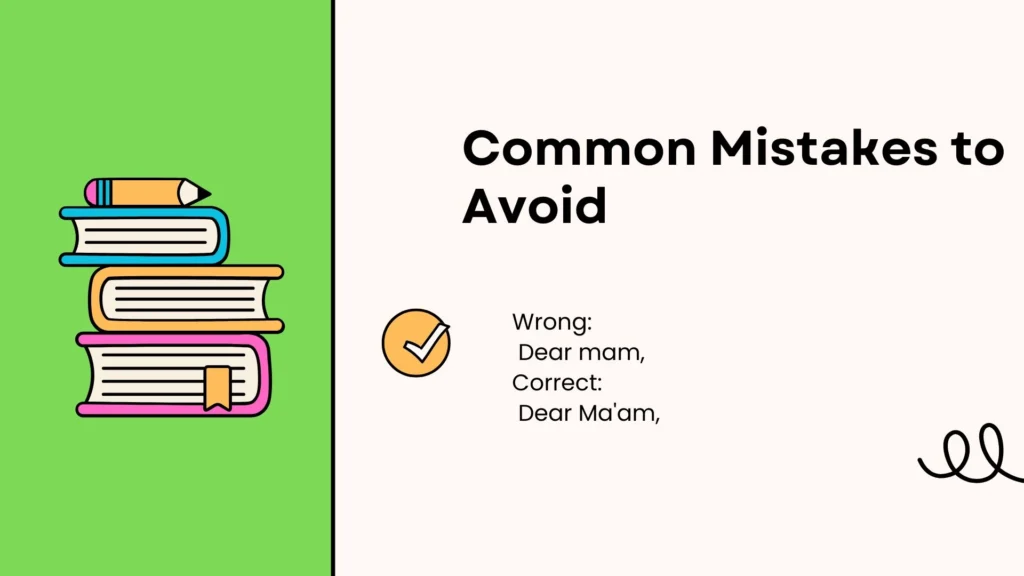
Wrong:
Dear mam,
Correct:
Dear Ma’am,
Explanation: In formal writing, Ma’am is usually the preferred spelling.
Wrong:
Thank you madam.
Correct:
Thank you, Ma’am.
Explanation: Ma’am is the shorter polite form of madam.
Wrong:
Good morning maam.
Correct:
Good morning, Ma’am.
Explanation: The correct spelling includes an apostrophe.
Wrong:
My ma’am is waiting outside.
Correct:
My mam is waiting outside. (Regional meaning: mother)
Explanation: In some parts of the UK, mam means mother.
Real-Life Examples
Meeting
- Good morning, Ma’am. It’s nice to meet you.
- Good morning, Mam. (Common in South Asia)
School
- Mam, may I come in?
- Ma’am, I have completed my assignment.
Travel
- Excuse me, Ma’am, this seat is yours.
Work
- Ma’am, your report is ready.
- Mam, the presentation will begin at 10 a.m.
Message
- Good evening, Ma’am. I have sent the documents.
Conversation
- Yes, Ma’am.
- Yes, Mam. (Regional usage)
Order or Booking
- Ma’am, your booking has been confirmed.
Social Situation
- Thank you for your help, Ma’am.
Easy Trick to Remember
Think of “Ma’am” as a shortened form of “Madam.”
If you are writing formally or speaking to someone respectfully in standard English, choose Ma’am.
If your school, workplace, or region normally uses Mam, it is also acceptable in those contexts.
Mini Quiz
1. Which spelling is the standard polite form of “madam”?
Answer: Ma’am
2. Which form is commonly used in many schools in India and Pakistan?
Answer: Mam
3. Which form is generally preferred in formal international writing?
Answer: Ma’am
4. In some parts of the UK, what can “mam” mean?
Answer: Mother
5. Is “Ma’am” spelled with an apostrophe?
Answer: Yes
6. Are both “Mam” and “Ma’am” correct?
Answer: Yes, but they are used in different contexts.
Related Confusing Words
- madam or ma’am
- sir or mister
- its or it’s
- your or you’re
- there or their
- who or whom
- affect or effect
- compliment or complement
FAQs About Mam or Ma’am
Is mam correct?
Yes. Mam is correct in many regions, especially in India, Pakistan, Ireland, and parts of the UK.
Is ma’am correct?
Yes. Ma’am is the standard English spelling of the polite form of madam.
What is the difference between mam and ma’am?
Ma’am is the standard formal spelling, while mam is commonly used in certain regions and local styles.
Which one should I use?
Use Ma’am for formal and international communication. Use Mam if it matches your local or workplace practice.
Is ma’am formal or informal?
Ma’am is generally considered a polite and formal way to address a woman.
Conclusion
Both mam and ma’am are correct, but they are used differently. Ma’am is the standard spelling in formal English and is the best choice for international communication. Mam is widely accepted in many regions, especially in schools and workplaces in South Asia, and it can also mean mother in parts of the UK. When in doubt, use “Ma’am” for formal situations and “Mam” where it is the local convention.

Nicholas Turner is a dedicated writer who enjoys creating clear, engaging and well-researched content for readers around the world. He has a passion for exploring language, culture and everyday topics that spark curiosity. Nicholas is also the fictional author of The Silent Ember Road and Where Morning Echoes Rest, two original story concepts created exclusively for his author profile. Outside of writing, he enjoys traveling, reading, and discovering new perspectives. His goal is to make every article informative, approachable, and genuinely useful.
 Ava Collins
 Daniel Foster