
Octopuses and octopi are both accepted plural forms of octopus, but octopuses is the safest and most straightforward choice in modern English.
People often get confused because octopus looks like a Latin word ending in -us.
However, the word ultimately comes from Greek, not Classical Latin.
In this guide, you will learn why both forms exist, which one is preferred, how to use them correctly, and why octopodes sometimes appears too.
You will also see simple examples, common mistakes, and an easy way to remember the correct plural.
Quick Answer
Octopuses is the most natural plural form for everyday English and is the best choice for most writing.
Octopi is also accepted and has a long history of use, especially because people treated octopus as if it were a Latin noun.
A third form, octopodes, exists but is rare and is usually unnecessary for ordinary writing. Merriam-Webster lists all three forms as accepted, while Oxford gives octopuses as its plural.
- One octopus lives in the aquarium.
- Several octopuses live in the aquarium.
- Several octopi live in the aquarium.
Octopi vs Octopuses: Main Difference
| Word/Phrase | Meaning | Correct? | Best Used For | Example |
| octopus | One eight-armed sea animal | Yes | Singular | I saw an octopus. |
| octopuses | More than one octopus | Yes | General and formal English | The octopuses were hiding. |
| octopi | More than one octopus | Yes | Traditional alternative plural | Scientists studied several octopi. |
| octopodes | More than one octopus | Yes, but rare | Specialized or historical usage | The researchers observed several octopodes. |
The important point is that octopi is not simply “wrong.” It is an established plural form. However, octopuses is easier, clearer, and more widely recommended for general English.
What Does Octopus Mean?
Octopus is a singular noun for a marine animal belonging to the cephalopod group. It has a soft body and eight arms.
The word comes ultimately from the Greek oktōpous, meaning roughly “eight-footed.” It entered English in the 18th century.
Examples
- I saw an octopus at the aquarium.
- The octopus changed color.
- An octopus was hiding under a rock.
- We watched an octopus move across the tank.
- The chef prepared a dish containing octopus.
When you are talking about one, use octopus, not octopuses or octopi.
What Does Octopuses Mean?
Octopuses is the regular English plural of octopus. It simply means more than one octopus.
English often forms plurals by adding -s or -es. In this case, adding -es gives us octopuses.
Examples
- The aquarium has several octopuses.
- The researchers observed two octopuses.
- These octopuses live in shallow water.
- The children watched the octopuses swim.
- Several octopuses were hiding between the rocks.
This form is especially useful when you want your writing to sound natural and uncomplicated.
Oxford lists octopuses as the plural of octopus, and Cambridge also lists octopuses as an accepted plural while noting octopi as another form.
How to Use Octopi or Octopuses
The basic rule is simple:
- One: octopus
- Two or more: octopuses or octopi
Best practice
Use octopuses when you want the clearest choice for school assignments, general writing, professional communication, or everyday English.
Use octopi if you encounter it in a book, article, conversation, or other context. It is not an error simply because octopuses is more straightforward.
Correct
The marine center has three octopuses.
Scientists studied several octopi.
Incorrect meaning
The aquarium has one octopuses.
The problem is number agreement. Octopus is singular, while octopuses and octopi are plural.
A useful distinction
Do not assume that every English noun ending in -us should form its plural with -i.
For example:
- cactus → cactuses or cacti
- fungus → fungi or funguses
- octopus → octopuses or octopi
Plural formation depends on the history and usage of the individual word.
Where to Use Octopus, Octopuses, and Octopi
School writing
Octopuses is an excellent choice for essays, reports, homework, and classroom assignments because it is clear and widely accepted.
The study examined how octopuses respond to changes in their environment.
Formal writing
Use octopuses when you want a simple, modern form.
The research team observed several octopuses in their natural habitat.
Octopi is also grammatically accepted, so seeing it in formal writing does not automatically make the sentence incorrect.
Emails and professional communication
For ordinary business or academic communication, octopuses is usually the easiest form.
The museum’s new exhibit features several octopuses.
Everyday conversation
Both octopuses and octopi can be understood easily.
I saw two octopuses at the aquarium.
Messages and casual writing
Either form can work, although octopuses avoids unnecessary debate about the plural.
American vs British English
This is not mainly an American-versus-British spelling difference like color and colour.
Both octopuses and octopi appear in English varieties. Dictionary sources differ in how they present the forms and which one they emphasize. Oxford lists octopuses as the plural, while Merriam-Webster says octopuses, octopi, and octopodes are accepted.
The rare form octopodes has a stronger connection to the word’s Greek origin and has appeared particularly in British usage, but it is uncommon in ordinary modern English.
So you do not need to choose octopi simply because you are writing American English or octopuses simply because you are writing British English.
Why People Get Confused
The confusion comes mainly from the ending -us.
Many people learn Latin plurals such as:
- alumnus → alumni
- radius → radii
- stimulus → stimuli
Because octopus ends in -us, it looks as though its plural should naturally be octopi.
There is a historical reason for this. Octopi arose from treating octopus as though it were a Latin word requiring a Latin-style plural. But the word is ultimately Greek, from oktōpous.
That history helps explain why English ended up with several plural forms.
Key takeaway: spelling a plural with -i does not automatically make it more correct.
Common Mistakes to Avoid
Mistake 1
Wrong:
I saw three octopus at the aquarium.
Correct:
I saw three octopuses at the aquarium.
A plural noun is needed because the sentence refers to three animals.
Mistake 2
Wrong:
The aquarium has two octopuseses.
Correct:
The aquarium has two octopuses.
Do not add another -es to octopuses.
Mistake 3
Wrong:
One octopi was hiding.
Correct:
One octopus was hiding.
Octopi is plural, so it cannot normally follow one.
Mistake 4
Wrong:
Three octopuses was swimming.
Correct:
Three octopuses were swimming.
The plural subject requires the plural verb were.
Mistake 5
Wrong:
Every octopuses needs food.
Correct:
Every octopus needs food.
Words such as every and each normally take a singular noun.
Real-Life Examples
At an aquarium
We saw four octopuses in the new exhibit.
At school
Our science class learned how octopuses use their arms.
At work
The documentary team filmed several octopuses for the project.
In a conversation
“How many octopuses did you see?”
“I think there were three.”
In a message
“The aquarium has some amazing octopuses!”
In academic writing
The researchers compared the behavior of several octopuses under different conditions.
In a book
You may also encounter octopi:
The divers reported seeing several octopi near the reef.
That sentence is acceptable. The alternative plural does not change the meaning.
A Simple Decision Guide
Are you talking about one?
↓
Use octopus
Are you talking about more than one?
↓
Use octopuses for the safest general choice
Did you use octopi instead?
↓
That is also accepted
Are you considering octopodes?
↓
Use it only when the specialized or historical context calls for it
For most readers, octopuses is the easiest choice.
Easy Trick to Remember
Think:
One octopus → two octopuses.
Just treat octopus like an ordinary English noun and add -es.
If you remember only one rule, remember:
When in doubt, use “octopuses.”
It is simple, natural, and accepted in standard English.
Mini Quiz
Choose the best answer.
1. I saw two ______ at the aquarium.
A. octopus
B. octopuses
Answer: B. octopuses
2. One ______ was hiding under a rock.
A. octopus
B. octopi
Answer: A. octopus
3. Which plural form is also accepted?
A. octopi
B. octopuse
C. octopuss
Answer: A. octopi
4. Which form is the safest choice for general English?
A. octopuses
B. octopuss
Answer: A. octopuses
5. Is “octopi” always wrong?
A. Yes
B. No
Answer: B. No. It is an established and accepted plural form.
6. Which sentence is correct?
A. Three octopus were swimming.
B. Three octopuses were swimming.
Answer: B. Three octopuses were swimming.
Related Confusing Words
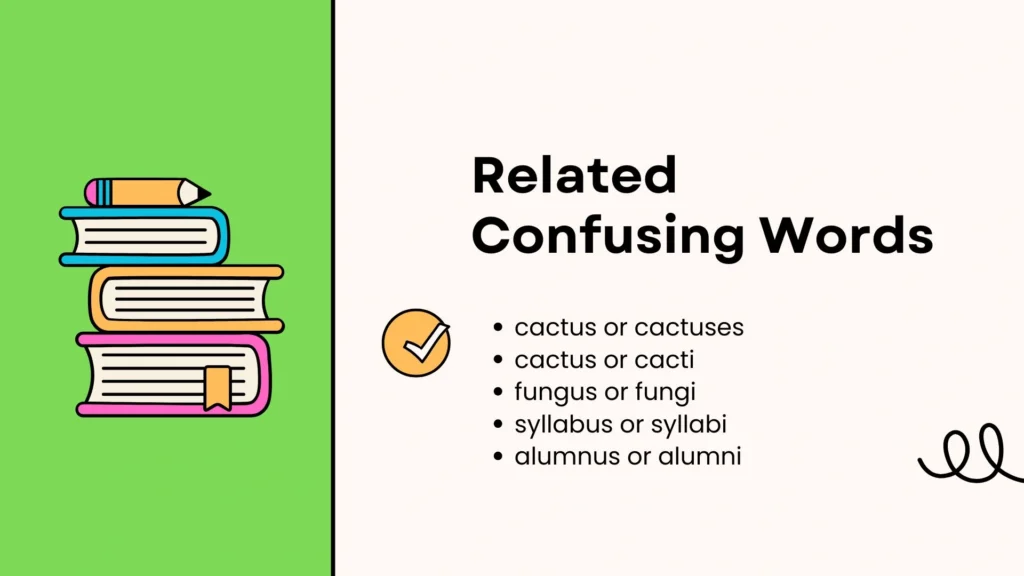
- cactus or cactuses
- cactus or cacti
- fungus or fungi
- syllabus or syllabi
- alumnus or alumni
- criterion or criteria
- phenomenon or phenomena
- medium or media
FAQs About Octopi or Octopuses
Is octopi correct?
Yes. Octopi is an accepted plural of octopus, although octopuses is generally the simpler choice for modern English.
Is octopuses correct?
Yes. Octopuses is correct and is the regular English plural. Oxford lists it as the plural form, and Cambridge also recognizes it.
What is the difference between octopi and octopuses?
There is no difference in meaning. Both refer to more than one octopus. The difference is mainly historical and stylistic.
Which one should I use?
Use octopuses if you want the clearest, safest choice for general, academic, school, and professional writing.
Is octopodes correct?
Yes, but octopodes is rare. It comes from a Greek-based plural formation and is not normally needed in everyday English.
References
- Merriam-Webster, “The Many Plurals of Octopus” explains the history and usage of octopi, octopuses, and octopodes.
- Merriam-Webster Dictionary, “Octopus” lists octopuses and octopi and notes octopodes as another accepted plural.
- Oxford Advanced Learner’s Dictionary, “Octopus” gives octopuses as the plural and provides the word’s Greek origin.
- Cambridge Dictionary, “Octopus” lists octopuses and octopi as plural forms.
Conclusion
Both octopuses and octopi are correct plural forms of octopus.
For most readers and most types of writing, octopuses is the best choice because it follows the regular English plural pattern.
Octopi is not a mistake, but it comes from a historical Latin-style approach to the word.
When you want a simple rule, remember: one octopus, two octopuses.

Ava Collins is a passionate writer who enjoys turning everyday ideas into clear, engaging, and helpful content. She loves exploring language, culture and meaningful stories that connect with readers. Ava is also the fictional author of Beneath the Silver Maple and The Last Lantern of Willow Cove. When she’s not writing, she enjoys reading, traveling and finding inspiration in ordinary moments.