
If you are wondering whether your’s or yours is correct, the answer is simple: yours is correct.
Your’s is not the standard English spelling and should not be used in normal writing.
The confusion usually comes from the apostrophe in words such as it’s, Mary’s, and John’s.
However, yours is a possessive pronoun, and possessive pronouns such as yours, ours, theirs, hers, and mine do not take an apostrophe.
In this guide, you will learn what your and yours mean, how to use them, common mistakes, and an easy way to remember the rule.
Quick Answer
Yours is the correct form. Your’s is incorrect in standard English.
Use your before a noun:
- This is your book.
- Where is your phone?
Use yours when the noun is already understood:
- This book is yours.
- Is this phone yours?
Easy rule: your + noun, but yours stands alone.
Your’s vs Yours: Main Difference
| Word/Phrase | Meaning | Correct? | Best Used For | Example |
| your’s | Intended to mean “belonging to you” | ❌ No | Avoid in standard English | Your’s is the blue car. |
| yours | Belonging to you | ✅ Yes | Possessive pronoun | The blue car is yours. |
The important difference is the apostrophe. In this case, it does not belong in the word.
Cambridge Grammar lists your as a possessive determiner and yours as a possessive pronoun. It also identifies yours as the form used when the noun does not need to be repeated.
What Does Your Mean?
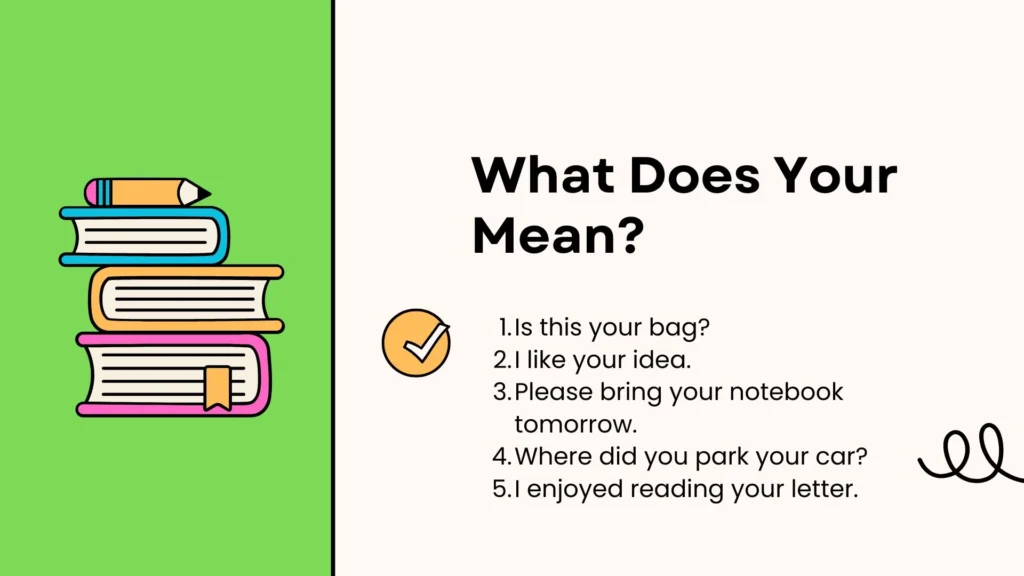
Your shows that something belongs to or is connected with the person or people being addressed. It normally comes before a noun.
For example:
- Is this your bag?
- I like your idea.
- Please bring your notebook tomorrow.
- Where did you park your car?
- I enjoyed reading your letter.
Think of your as a word that introduces the thing that belongs to someone.
Your + noun
- your house
- your name
- your friend
- your answer
- your computer
You would not normally say, “This book is your.” Instead, you would say, “This book is yours.”
What Does Yours Mean?
Yours is a possessive pronoun. It means belonging to you or connected with you.
It can stand alone because the noun is understood from the context.
Examples:
- This pen is yours.
- My room is smaller than yours.
- Is that jacket yours?
- Your answer is different from yours.
- The blue seat is yours.
A better comparison makes the rule clearer:
- This is your seat.
- This seat is yours.
In the first sentence, your comes before seat. In the second, yours replaces the phrase your seat.
Why Is Your’s Wrong?
The apostrophe in your’s is an unnecessary addition. English does not form the possessive pronoun of you by adding an apostrophe and s.
The correct pair is:
your → yours
Not:
your → your’s
This is similar to other possessive pronouns:
- my → mine
- our → ours
- their → theirs
- her → hers
- your → yours
These standard possessive pronouns do not need an apostrophe.
How to Use Your’s or Yours
The best approach is to decide whether a noun comes immediately after the possessive word.
Use your before a noun
Correct: Please bring your passport.
Here, passport is the noun, so your is needed.
Use yours when the noun is understood
Correct: Please bring your passport. I have already packed yours.
Here, yours means your passport, so the noun does not need to be repeated.
Never use your’s as the possessive form
Incorrect: Is this book your’s?
Correct: Is this book yours?
Incorrect: I think that bag is your’s.
Correct: I think that bag is yours.
A useful sentence test
Ask yourself:
Does a noun come after the word?
- Yes → use your.
- No → use yours.
For example:
your car → noun follows, so use your.
The car is yours → no noun follows, so use yours.
Where to Use Your and Yours
There is no American-versus-British spelling difference here. Your and yours are standard forms in both American and British English.
School Writing
Use your before a noun:
Check your answers before submitting the test.
Use yours when the noun is already clear:
My answer is different from yours.
Avoid your’s in essays, assignments, exams, and other academic writing.
Formal Writing
The correct forms are appropriate in professional and formal writing:
Your application has been received.
The final decision is yours.
Emails
You may use both depending on the sentence:
Please send your documents by Friday.
The choice is yours.
Yours can also appear at the end of letters and emails in expressions such as Yours sincerely and Yours faithfully. Cambridge lists these as established letter-closing expressions.
Everyday Conversation
The same rule applies in speech:
Is this your phone?
No, mine is black. That one is yours.
Messages and Social Communication
Informal messages do not change the grammar rule:
Is this your charger?
No, I think it’s yours.
Professional Communication
Use your and yours according to their grammatical roles:
We have received your request.
The final choice is yours.
Why People Get Confused
The main reason is the apostrophe.
English uses apostrophes in some possessive forms:
- Sarah’s book
- the teacher’s desk
- James’s car
Because people see ‘s used to show possession, they may assume that your’s should mean “belonging to you.”
That assumption is understandable, but it does not follow the rule for possessive pronouns.
Another source of confusion is the word it’s. In it’s, the apostrophe represents missing letters in it is or it has. It is not simply an apostrophe showing possession.
Compare:
- your = belonging to you, before a noun
- yours = belonging to you, standing alone
- you’re = you are
- your’s = incorrect standard form
Common Mistakes to Avoid
Mistake 1
Wrong: This laptop is your’s.
Correct: This laptop is yours.
Why: The possessive pronoun is yours, without an apostrophe.
Mistake 2
Wrong: Is this yours book?
Correct: Is this your book?
Why: A noun follows the word, so use your.
Mistake 3
Wrong: That is your’s, not mine.
Correct: That is yours, not mine.
Why: The noun is understood, so yours stands alone.
Mistake 4
Wrong: I like yours new car.
Correct: I like your new car.
Why: Car is the noun being described, so your must come before it.
Mistake 5
Wrong: Your’s sincerely, Ahmed.
Correct: Yours sincerely, Ahmed.
Why: The standard letter-closing expression uses Yours, not Your’s.
Real-Life Examples
At a Meeting
“Is this your seat?”
“No, I think that one is yours.”
At School
“I finished my homework. Did you finish yours?”
Here, yours means your homework.
While Traveling
“Is this your suitcase?”
“No, mine is over there. That suitcase is yours.”
At Work
“Please check your report before the meeting.”
“I reviewed mine. You should check yours.”
In a Message
“I found a charger on the desk. Is it yours?”
At a Restaurant
“Is this your order?”
“Yes, and that drink is yours.”
In a Conversation
“My opinion is different from yours.”
This is a common and completely correct use of yours.
Easy Trick to Remember
Remember this simple rule:
YOUR needs a noun. YOURS does not.
Think:
your book ✅
the book is yours ✅
your’s book ❌
the book is your’s ❌
If you can replace yours with your + noun, the sentence is probably using yours correctly.
For example:
The blue pen is yours.
means:
The blue pen is your pen.
Mini Quiz
Choose your, yours, or your’s.
- Is this ___ phone?
- This phone is ___.
- I like ___ new shoes.
- My answer is different from ___.
- Is that bag ___?
- ___ sincerely, Maria.
Answers
- your — “phone” is the noun.
- yours — it stands alone.
- your — “shoes” is the noun.
- yours — it replaces “your answer.”
- yours — the noun is understood.
- Yours — it is part of a standard letter closing.
Your’s is not the correct answer in any of these examples.
Related Confusing Words
- your or you’re
- its or it’s
- their or they’re
- there or their
- who’s or whose
- yours or your
- who’s or who’s
- its or its’
FAQs About Your’s or Yours
Is your’s correct?
No. Your’s is not the standard English form. The correct possessive pronoun is yours.
Is yours a possessive pronoun?
Yes. Yours is a possessive pronoun. It shows that something belongs to the person or people being addressed.
What is the difference between your and yours?
Your comes before a noun: “your car.”
Yours stands alone: “The car is yours.”
Which one should I use: your or yours?
Use your when a noun follows. Use yours when the noun is already understood.
Is “Yours sincerely” correct?
Yes. Yours sincerely is a standard closing for letters and formal correspondence. Yours faithfully is another established formal closing.
Decision Guide: Your or Yours?
Use this quick guide when you are unsure:
Does a noun come immediately after the word?
↓
Yes → Use YOUR
your book
your house
your answer
No → Use YOURS
The book is yours.
The house is yours.
The answer is yours.
Never choose YOUR’S for the standard possessive form.
Key Takeaways
- Yours is correct.
- Your’s is incorrect in standard English.
- Your is normally used before a noun.
- Yours is a possessive pronoun that can stand alone.
- The apostrophe in your’s is unnecessary.
- The rule is the same in American and British English.
- Remember: your book, but the book is yours.
References
- Cambridge Dictionary, “Yours” definition and examples of the possessive pronoun.
- Cambridge Grammar, “Pronouns: possessive (my, mine, your, yours, etc.)” explanation of possessive determiners and possessive pronouns.
- Cambridge Grammar, “Part of speech: your or yours?” explanation of when your and yours are used.
- Cambridge Dictionary, “Possessive pronoun” definition and examples of possessive pronouns.
Conclusion
Yours is the correct form, while your’s is incorrect in standard English.
Use your before a noun, such as your car or your idea.
Use yours when the noun is understood, such as The car is yours.
The easiest rule to remember is: your needs a noun; yours stands alone.

Ava Collins is a passionate writer who enjoys turning everyday ideas into clear, engaging, and helpful content. She loves exploring language, culture and meaningful stories that connect with readers. Ava is also the fictional author of Beneath the Silver Maple and The Last Lantern of Willow Cove. When she’s not writing, she enjoys reading, traveling and finding inspiration in ordinary moments.