
Recurring and reoccurring are both correct English words, but they are not always used in exactly the same way. Recurring is the more common choice when something happens repeatedly, especially as a regular or repeated pattern. Reoccurring means something happens again or happens repeatedly.
The confusion comes from the very similar meanings and spellings of the two words. Both are related to the verb recur, meaning to happen again or a number of times.
This guide explains the difference, shows when to use each word, and gives simple examples to help you choose the right one.
Quick Answer
Recurring and reoccurring are both correct.
Use recurring for something that happens repeatedly, especially when it is a regular or continuing pattern.
Use reoccurring when you want to emphasize that something has happened again or happened another time. Oxford defines reoccur as meaning “to happen again or a number of times.”
- We have a recurring meeting every Monday.
- The same problem is reoccurring after the repair.
For most everyday and professional writing, recurring is the safer and more natural choice when you mean “happening repeatedly.”
Recurring vs Reoccurring: Main Difference
| Word/Phrase | Meaning | Correct? | Best Used For | Example |
| Recurring | Happening repeatedly or again and again | Yes | Regular, repeated, or ongoing patterns | We have a recurring monthly meeting. |
| Reoccurring | Happening again or happening repeatedly | Yes | Emphasizing that something has happened again | The issue is reoccurring after the update. |
A useful distinction is pattern versus repetition. Recurring often describes an established or repeated pattern, while reoccurring can place more emphasis on something happening again. The meanings overlap, so they are sometimes interchangeable.
What Does Recurring Mean?
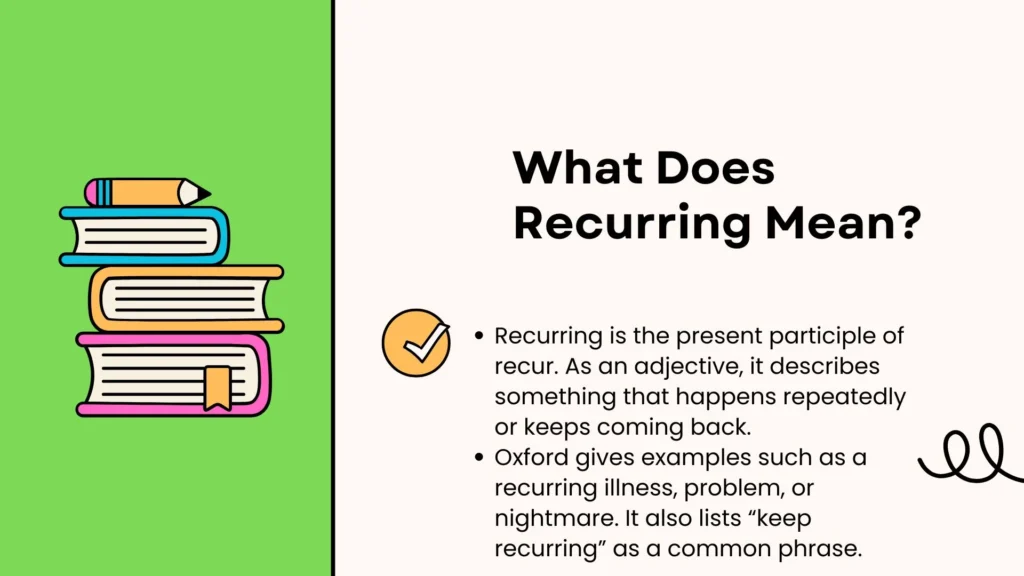
Recurring is the present participle of recur. As an adjective, it describes something that happens repeatedly or keeps coming back.
Oxford gives examples such as a recurring illness, problem, or nightmare. It also lists “keep recurring” as a common phrase.
Examples:
- She has a recurring appointment with her dentist.
- The company has recurring monthly expenses.
- A recurring theme appears throughout the novel.
- We need to solve this recurring problem.
- He keeps having recurring dreams about school.
Recurring is especially natural with words such as:
- recurring payment
- recurring problem
- recurring event
- recurring meeting
- recurring expense
- recurring theme
- recurring dream
- recurring issue
It can describe something that happens on a schedule or something that repeatedly appears without a fixed schedule.
What Does Reoccurring Mean?
Reoccurring is the present participle of reoccur. It means happening again or happening a number of times. It is a legitimate English word, not simply a spelling mistake.
Examples:
- The error is reoccurring after every restart.
- The same complaint is reoccurring among customers.
- The problem stopped for a while but is now reoccurring.
- The symptoms may be reoccurring in the future.
- The issue is reoccurring despite several attempts to fix it.
The word can be useful when you want to highlight the idea of occurring again.
However, many writers would naturally choose recurring in these sentences instead. That does not make reoccurring incorrect; it simply means recurring is often the more established choice.
How to Use Recurring or Reoccurring
Choose the word based on the meaning you want to emphasize.
Use “recurring” for an established pattern
- The software has a recurring error.
- I pay a recurring subscription fee.
- The team holds a recurring meeting every Friday.
Here, the repeated nature is the main idea.
Use “reoccurring” when emphasizing that something happens again
- The error is reoccurring after we thought it was fixed.
- The same disagreement keeps reoccurring.
Here, the focus is on the return of something that happened before.
A practical rule
If you are unsure, recurring will usually be the better choice when you simply mean “happening repeatedly.”
Do not assume that reoccurring is wrong. It is a valid word, but it is less commonly needed in ordinary writing.
Where to Use These Words
Both forms can appear in different types of communication.
School writing
Recurring is especially useful in academic descriptions:
The author uses a recurring image throughout the poem.
Reoccurring can also be grammatically correct when discussing something happening again.
Formal writing
For reports, business documents, and professional communication, recurring is often the clearer choice:
The department must review its recurring expenses.
Emails
Both are possible:
We have identified a recurring issue with the system.
Everyday conversation
You may hear either word:
That problem keeps recurring.
The problem is reoccurring.
The first sounds especially natural when describing a repeated problem.
Professional communication
Use recurring for established schedules, costs, tasks, and processes:
- recurring payment
- recurring invoice
- recurring meeting
- recurring maintenance
- recurring task
Why People Get Confused
The confusion is easy to understand because the words are closely related.
Recur means to happen again or a number of times. Reoccur also means to happen again or a number of times.
The prefixes also make the words look almost identical:
- recur → recurring
- reoccur → reoccurring
Another reason is that re- commonly means “again,” so some people assume reoccur must be more precise. In practice, the two verbs overlap considerably.
There is also a useful related word: recurrent. It means something that happens again and again, such as a recurrent problem, recurrent infection, or recurrent cost.
Common Mistakes to Avoid
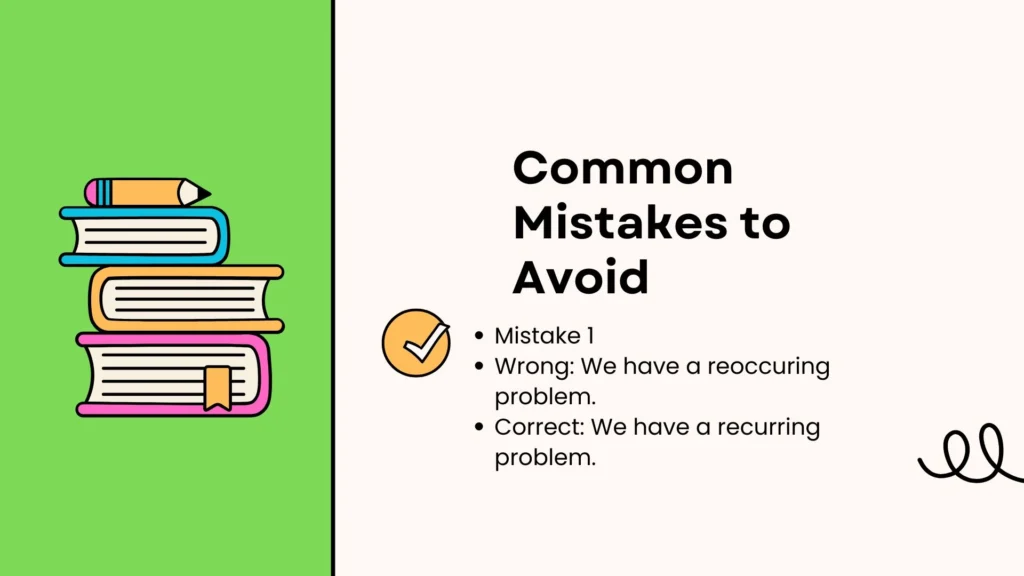
Mistake 1
Wrong: We have a reoccuring problem.
Correct: We have a recurring problem.
The spelling reoccuring is incorrect. If you use reoccur, the r is retained before -ing: reoccurring.
Mistake 2
Wrong: I have a recuring payment.
Correct: I have a recurring payment.
The correct spelling has two r’s before the ending: recurring.
Mistake 3
Wrong: The meeting is recurring every Monday.
Better: The meeting recurs every Monday.
Or:
The meeting is a recurring Monday event.
Use recur as the verb and recurring as the adjective or participle.
Mistake 4
Wrong: We need to stop this recurring again.
Correct: We need to stop this recurring problem.
A noun is often needed after recurring when it is being used as an adjective.
Real-Life Examples
Meeting:
Our team has a recurring meeting every Tuesday.
School:
The novel contains a recurring theme of family and responsibility.
Work:
The accounting team tracks all recurring expenses.
Travel:
Flight delays became a recurring problem during the winter.
Message:
I’m getting the same error again. The problem keeps recurring.
Customer service:
Several customers reported a recurring issue with the payment system.
Booking:
The hotel offers a recurring reservation for long-term guests.
Conversation:
“Why does this problem keep happening?”
“It seems to be a recurring issue.”
Easy Trick to Remember
Think of recurring as repeating.
Recurring = repeated pattern
Think of reoccurring as occurring again.
Reoccurring = occurring again
When you simply mean “happening repeatedly,” choose recurring.
Simple Decision Guide
Does something happen repeatedly or regularly?
↓
Yes → Use recurring.
Do you specifically want to emphasize that something has happened again?
↓
Yes → Reoccurring may fit.
Still unsure?
↓
Choose recurring for most general, academic, and professional situations.
Mini Quiz
Choose recurring or reoccurring.
- We have a ______ monthly payment.
- The same technical problem keeps ______.
- The novel has a ______ theme of friendship.
- The error is ______ after the software update.
- The company reviews its ______ expenses every quarter.
- She complained about a ______ problem with the website.
Answers
- recurring
- recurring
- recurring
- reoccurring or recurring
- recurring
- recurring
Both choices can work in some contexts, but recurring is generally the natural choice for a repeated pattern.
Related Confusing Words
- recur or reoccur
- recurrent or recurring
- occurrence or recurrence
- repeat or recur
- repeated or recurring
- regular or recurring
- every day or everyday
- continual or continuous
FAQs About Recurring and Reoccurring
Is “reoccurring” correct?
Yes. Reoccurring is a correct English word. It comes from reoccur, meaning to happen again or a number of times.
Is “recurring” correct?
Yes. Recurring is correct and is the more common choice for something that happens repeatedly.
What is the difference between recurring and reoccurring?
The meanings overlap. Recurring commonly describes something that repeatedly happens or forms a pattern. Reoccurring can emphasize that something is happening again.
Which should I use in formal writing?
Recurring is usually the safest choice when you mean something happens repeatedly. For example, recurring costs, recurring meetings, and recurring problems are natural expressions.
Is “recurring” the same as “recurrent”?
They are closely related. Recurrent is an adjective meaning something that happens again and again, while recurring is commonly used for repeated events, problems, themes, payments, and similar situations.
Conclusion
Both recurring and reoccurring are correct words. Recurring is usually the better choice when you mean something happens repeatedly or follows a pattern. Reoccurring is useful when you want to emphasize that something has happened again. When in doubt, choose recurring for clear everyday and professional writing.
References
- Oxford Advanced Learner’s Dictionary, “recur” — definition and examples.
- Oxford Advanced Learner’s Dictionary, “reoccur” — definition and usage.
- Oxford Advanced Learner’s Dictionary, “recurrent” — definition and examples.

Ava Collins is a passionate writer who enjoys turning everyday ideas into clear, engaging, and helpful content. She loves exploring language, culture and meaningful stories that connect with readers. Ava is also the fictional author of Beneath the Silver Maple and The Last Lantern of Willow Cove. When she’s not writing, she enjoys reading, traveling and finding inspiration in ordinary moments.
 Daniel Foster