
If you are confused about s’ or s’s, the answer depends on what you are trying to show. Both forms can be correct, but they are used in different situations.
S’ is normally used for the possessive form of a plural noun ending in s.
S’s is generally used when a singular noun ends in s and you want to show possession.
For example, the students’ books means the books belong to several students.
But James’s car means the car belongs to one person named James.
Let’s look at the rules, examples, and easy ways to remember the difference.
Quick Answer
Both s’ and s’s can be correct.
- Use s’ after a plural noun ending in s: the teachers’ room.
- Use s’s after a singular name or noun ending in s in most modern style guides: James’s phone.
- The key question is whether the noun is singular or plural.
Example:
The players’ uniforms = uniforms belonging to several players.
Chris’s jacket = a jacket belonging to one Chris.
S’ vs S’s: Main Difference
| Word/Phrase | Meaning | Correct? | Best Used For | Example |
| s’ | Possession by a plural noun ending in s | Yes | Plural possessives | The girls’ bags |
| s’s | Possession by a singular noun ending in s | Yes | Singular possessives | James’s book |
The apostrophe changes position depending on whether the noun is singular or plural.
What Does S’ Mean?
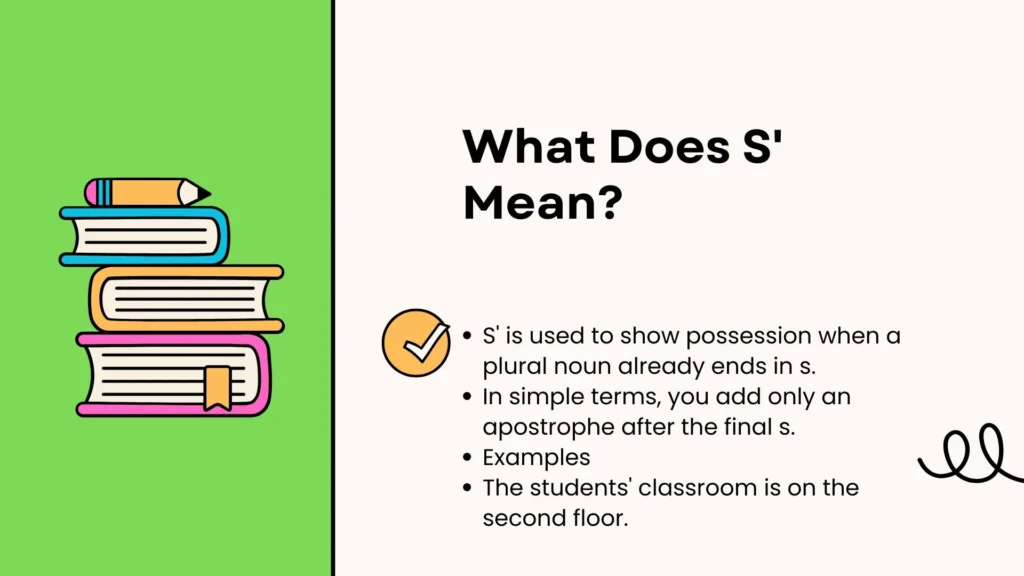
S’ is used to show possession when a plural noun already ends in s.
In simple terms, you add only an apostrophe after the final s.
Examples
- The students’ classroom is on the second floor.
- The teachers’ meeting starts at 3 p.m.
- The players’ uniforms are ready.
- The parents’ car is outside.
- The dogs’ bowls are in the kitchen.
Here, students, teachers, players, parents, and dogs are plural nouns ending in s.
A useful rule
Plural noun ending in s + apostrophe = possessive
- students → students’
- teachers → teachers’
- players → players’
- parents → parents’
What Does S’s Mean?
S’s is commonly used to show possession when a singular noun or name ends in s.
For example:
- James’s car is new.
- Chris’s phone is on the desk.
- The boss’s office is upstairs.
- The class’s schedule has changed.
- The actress’s dress was beautiful.
In each case, the person or thing is singular, even though the word ends in s.
Why does this cause confusion?
People often think that any word ending in s should take only an apostrophe. However, that is not always true.
Compare:
- The students’ books → books belonging to several students.
- James’s book → a book belonging to one James.
The number of people or things matters.
How to Use S’ or S’s
Start by asking:
Is the noun singular or plural?
1. Singular noun ending in s
Usually add ‘s.
- James → James’s
- Chris → Chris’s
- boss → boss’s
- class → class’s
Example:
The boss’s decision surprised everyone.
2. Plural noun ending in s
Add only an apostrophe.
- students → students’
- teachers → teachers’
- players → players’
- workers → workers’
Example:
The workers’ tools were stored outside.
3. Plural nouns that do not end in s
These usually take ‘s, not just an apostrophe.
- children → children’s
- men → men’s
- women → women’s
- people → people’s
Example:
The children’s toys are everywhere.
This is an important distinction because children’s and students’ follow different patterns.
Where to Use S’ or S’s
You may use these possessive forms in almost any type of English writing.
School Writing
- The students’ projects were displayed.
- James’s answer was correct.
Formal Writing
Possessive forms are completely normal in formal writing.
- The company’s policy has changed.
- The employees’ responsibilities are clearly explained.
Emails
- I have attached the clients’ documents.
- Chris’s request has been approved.
Everyday Conversation
- That’s James’s bag.
- The kids’ room is upstairs.
Professional Communication
- The managers’ meeting starts at 10 a.m.
- The business’s records were updated.
American and British English
The basic rule is similar in both American and British English. However, style guides can differ when a singular proper name ends in s.
For example:
- James’s book is widely accepted.
- James’ book is also used by some writers and style systems.
If you want a simple modern rule, James’s is a safe choice in most situations. Always follow your school, employer, publisher, or style guide if it has a specific preference.
Why People Get Confused
The confusion usually comes from the apostrophe.
People see James ending in s and may assume they should write James’. But the important question is not simply whether the word ends in s.
You must first decide whether the noun is singular or plural.
Compare these:
- James’s car → one James
- the boys’ cars → several boys
Another source of confusion is pronunciation. In everyday speech, the possessive ending may sound similar, so it can be difficult to know where the apostrophe belongs when writing.
Common Mistakes to Avoid
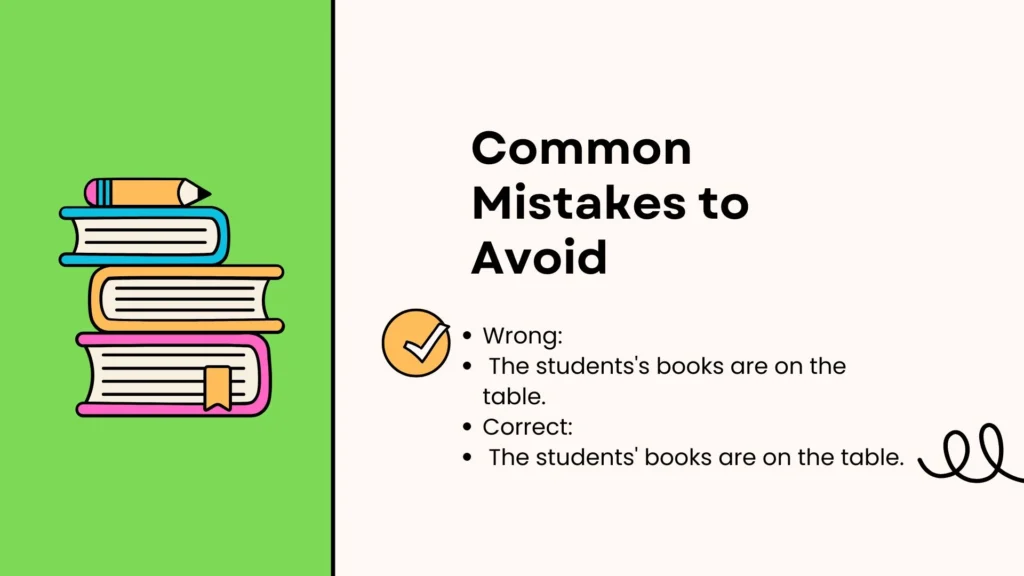
Mistake 1
Wrong:
The students’s books are on the table.
Correct:
The students’ books are on the table.
Why?
Students is already plural and ends in s, so add only an apostrophe.
Mistake 2
Wrong:
James’ car is outside.
Correct:
James’s car is outside.
Why?
James is a singular name. James’s is the standard choice in many modern style guides.
Mistake 3
Wrong:
The teacher’s are meeting today.
Correct:
The teachers are meeting today.
Why?
No possession is being shown. You simply need the plural noun teachers.
Mistake 4
Wrong:
The childrens’ toys are missing.
Correct:
The children’s toys are missing.
Why?
Children is already an irregular plural, so its possessive form is children’s.
Real-Life Examples
At a Meeting
The managers’ meeting will begin at noon.
At School
The students’ notebooks are on the teacher’s desk.
At Work
The boss’s office is closed today.
While Traveling
The passengers’ bags were checked before boarding.
In a Message
“Is this Chris’s phone?”
In Conversation
“Those are the girls’ bicycles.”
For an Order
The customers’ orders are ready for delivery.
In a Social Situation
“That’s James’s seat.”
These examples show why identifying the number of people or things is so important.
Easy Trick to Remember
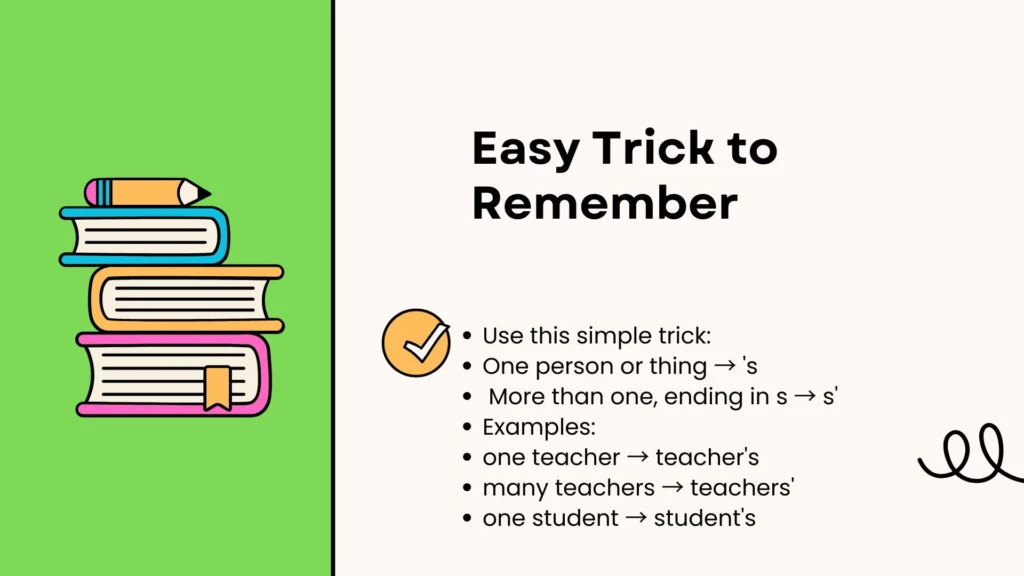
Use this simple trick:
One person or thing → ‘s
More than one, ending in s → s’
Examples:
- one teacher → teacher’s
- many teachers → teachers’
- one student → student’s
- many students → students’
- one James → James’s
Think: Singular gets ‘s; plural ending in s gets only ‘.
Mini Quiz
Choose the correct form.
1. The ______ books are on the desk.
A. students’
B. students’s
Answer: A. students’
2. ______ car is parked outside.
A. James’
B. James’s
Answer: B. James’s in the standard modern usage.
3. The ______ meeting starts at 9.
A. teachers’
B. teachers’s
Answer: A. teachers’
4. The ______ office is upstairs.
A. boss’s
B. bosses’
Answer: A. boss’s if there is one boss.
5. The ______ uniforms were washed.
A. players’
B. players’s
Answer: A. players’
6. The ______ toys are in the box.
A. children’s
B. childrens’
Answer: A. children’s
Related Confusing Words
- your or you’re
- its or it’s
- there or their
- who’s or whose
- teachers’ or teacher’s
- parents’ or parent’s
- girls’ or girl’s
- students’ or student’s
FAQs About S’ or S’s
Is s’ correct?
Yes. S’ is correct when showing possession for a plural noun that already ends in s, such as students’ books.
Is s’s correct?
Yes. S’s is commonly correct for a singular noun or name ending in s, such as James’s car.
What is the difference between s’ and s’s?
S’ normally follows a plural noun ending in s, while s’s normally follows a singular noun ending in s.
Which one should I use?
First determine whether the noun is singular or plural. Use ‘s for a singular noun ending in s and s’ for a plural noun ending in s.
Is James’ or James’s correct?
Both forms appear in English style guides, but James’s is the standard choice in many modern writing styles. Follow the style guide required for your writing.
Conclusion
The difference between s’ and s’s becomes easy once you identify whether the noun is singular or plural.
Use s’s for a singular noun ending in s, such as James’s book.
Use s’ for a plural noun ending in s, such as the students’ books.
Remember: one → ‘s; plural ending in s → s’.

Ava Collins is a passionate writer who enjoys turning everyday ideas into clear, engaging, and helpful content. She loves exploring language, culture and meaningful stories that connect with readers. Ava is also the fictional author of Beneath the Silver Maple and The Last Lantern of Willow Cove. When she’s not writing, she enjoys reading, traveling and finding inspiration in ordinary moments.
 Daniel Foster