
Both ser and estar are correct, but they are used in different situations in Spanish. They both mean “to be” in English, which is why many learners mix them up.
The main difference is simple: ser is usually used for permanent or lasting qualities, while estar is used for temporary conditions, locations, and changing states.
In this guide, you’ll learn the meaning of each verb, when to use them, common mistakes, helpful examples, and an easy way to remember the difference.
Quick Answer
Use ser for identity, origin, personality, time, and permanent characteristics.
Use estar for location, temporary conditions, emotions, and ongoing results.
Examples:
- Ella es doctora. (She is a doctor.)
- Ella está cansada. (She is tired.)
Ser vs Estar: Main Difference
| Word/Phrase | Meaning | Correct? | Best Used For | Example |
| Ser | To be | ✅ Yes | Identity, origin, permanent traits, time | Él es alto. |
| Estar | To be | ✅ Yes | Location, temporary states, emotions | Él está feliz. |
What Does Ser Mean?
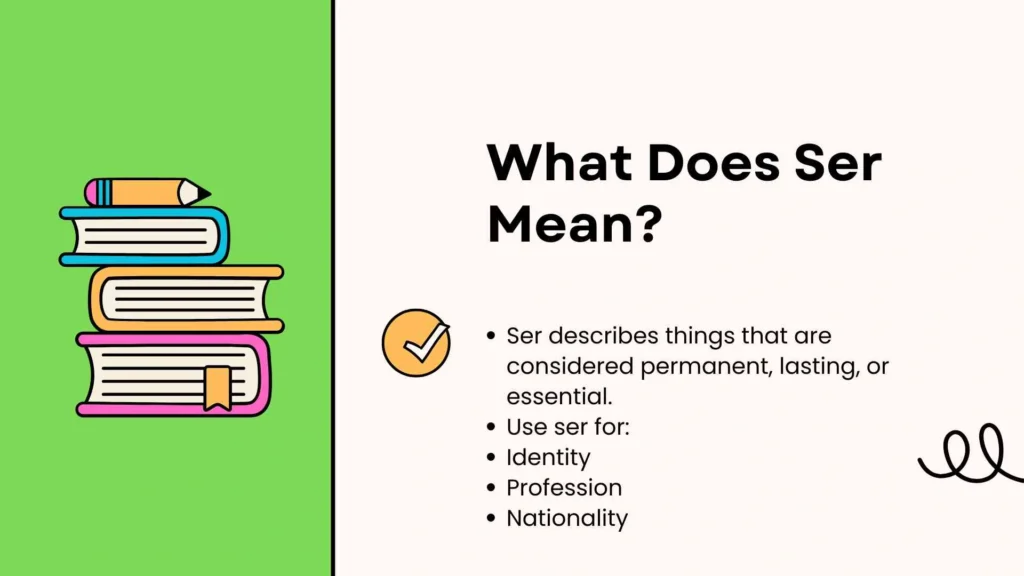
Ser describes things that are considered permanent, lasting, or essential.
Use ser for:
- Identity
- Profession
- Nationality
- Physical traits
- Personality
- Time and dates
- Origin
Examples
- María es estudiante.
- Nosotros somos amigos.
- El libro es interesante.
- Hoy es lunes.
- Ellos son de México.
What Does Estar Mean?
Estar describes temporary conditions, locations, emotions, or situations that can change.
Use estar for:
- Feelings
- Health
- Location
- Temporary conditions
- Results of actions
Examples
- Estoy cansado.
- Ella está en casa.
- Los niños están felices.
- La puerta está abierta.
- Nosotros estamos ocupados.
Why People Confuse It
Since ser and estar both translate as “to be” in English, English speakers often use the wrong one because English does not make this distinction.
How to Use Ser or Estar
Here are the basic rules.
Use ser when talking about:
- Who someone is
- What something is
- Jobs
- Nationality
- Time and dates
- Relationships
- Permanent characteristics
Correct
- Mi padre es médico.
- Ella es inteligente.
Incorrect
- Mi padre está médico. ❌
Use estar when talking about:
- Where someone or something is
- Feelings
- Health
- Temporary conditions
- Results of actions
Correct
- Estoy enfermo.
- El café está caliente.
Incorrect
- Estoy profesor. ❌
Where to Use Ser or Estar
You will use ser and estar in almost every type of Spanish communication.
School Writing
Use the correct verb depending on the meaning.
Formal Writing
Both are common in reports, essays, and official documents.
Emails
Use whichever fits the sentence.
Example:
- Espero que estés bien.
Everyday Conversation
People naturally switch between ser and estar depending on what they mean.
Messages
Both appear frequently in texts and chats.
Professional Communication
Use ser for roles and identity.
Example:
- Soy ingeniero.
Use estar for availability or condition.
Example:
- Estoy disponible mañana.
Regional Usage
Unlike American and British spelling differences, ser and estar are used the same way throughout the Spanish-speaking world, including Spain, Mexico, Argentina, Colombia, and most other Spanish-speaking countries. Small regional expressions exist, but the basic grammar rules stay the same.
Why People Get Confused
People confuse ser and estar because:
- Both mean “to be” in English.
- English has only one main verb for “to be.”
- Some adjectives change meaning depending on the verb.
- Beginners often memorize translations instead of learning usage.
For example:
- Es listo. = He is clever.
- Está listo. = He is ready.
Common Mistakes to Avoid
Wrong:
Ella está doctora.
Correct:
Ella es doctora.
A profession uses ser.
Wrong:
Madrid es aquí.
Correct:
Madrid está aquí.
Locations use estar.
Wrong:
Estoy de México.
Correct:
Soy de México.
Origin uses ser.
Wrong:
La sopa es caliente.
Correct:
La sopa está caliente.
Temperature is a temporary condition.
Wrong:
Hoy está martes.
Correct:
Hoy es martes.
Days and dates use ser.
Real-Life Examples
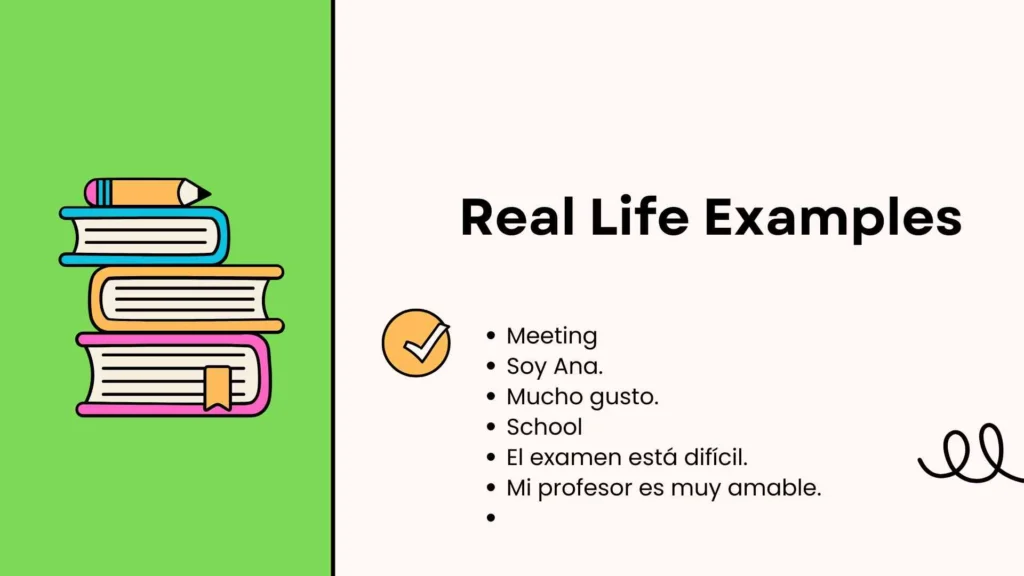
Meeting
- Soy Ana.
- Mucho gusto.
School
- El examen está difícil.
- Mi profesor es muy amable.
Travel
- El hotel está cerca del aeropuerto.
Work
- Soy gerente.
- Estoy ocupado esta tarde.
Message
- Hola, ¿cómo estás?
Conversation
- Mi hermano es alto.
- Hoy está muy feliz.
Booking
- La habitación está lista.
Social Situation
- Somos vecinos.
- Todos están emocionados.
Easy Trick to Remember
Think of this simple rule:
- Ser = what something is.
- Estar = how or where something is right now.
If it can change, estar is often the better choice.
Mini Quiz
1. Which verb is correct?
I am a teacher.
Answer: Soy profesor.
2. Which verb describes location?
Answer: Estar.
3. Which verb is used for nationality?
Answer: Ser.
4. Which sentence is correct?
A. Estoy estudiante.
B. Soy estudiante.
Answer: B. Soy estudiante.
5. Which sentence is correct?
A. El libro está en la mesa.
B. El libro es en la mesa.
Answer: A.
6. Which verb is used for emotions?
Answer: Estar.
Related Confusing Words
- por or para
- saber or conocer
- muy or mucho
- qué or cuál
- tú or tu
- porque or por qué
- tan or tanto
- bien or bueno
FAQs About Ser or Estar
Is ser correct?
Yes. Use ser for identity, origin, profession, time, and lasting characteristics.
Is estar correct?
Yes. Use estar for location, temporary conditions, emotions, and changing states.
What is the difference between ser and estar?
Ser describes what something is, while estar describes how or where something is.
Which one should I use?
Choose ser for permanent facts and estar for temporary situations and locations.
Are ser and estar formal or informal?
Both are standard Spanish verbs and are used in formal and informal communication.
Conclusion
Both ser and estar are correct, but they are not interchangeable. Use ser for identity, origin, profession, time, and lasting characteristics. Use estar for location, emotions, temporary conditions, and changing states. Learning this simple difference will make your Spanish much more natural and accurate.

Nicholas Turner is a dedicated writer who enjoys creating clear, engaging and well-researched content for readers around the world. He has a passion for exploring language, culture and everyday topics that spark curiosity. Nicholas is also the fictional author of The Silent Ember Road and Where Morning Echoes Rest, two original story concepts created exclusively for his author profile. Outside of writing, he enjoys traveling, reading, and discovering new perspectives. His goal is to make every article informative, approachable, and genuinely useful.
 Ava Collins
 Daniel Foster