
The correct form is “yours.” “Your’s” is not a correct English word.
Many people get confused because they think every possessive word needs an apostrophe. However, some possessive pronouns, including yours, his, hers, ours, and theirs, never use an apostrophe.
In this article, you’ll learn the difference between yours and your’s, when to use yours, why your’s is incorrect, common mistakes to avoid, and an easy way to remember the rule.
Quick Answer
The correct word is yours.
Your’s is always incorrect because possessive pronouns do not take an apostrophe.
Examples:
- This book is yours.
- Is this seat yours?
Yours vs Your’s: Main Difference
| Word/Phrase | Meaning | Correct? | Best Used For | Example |
| Yours | Belonging to you | ✅ Yes | All types of writing and speech | This pen is yours. |
| Your’s | Not a correct English word | ❌ No | Never | ❌ This pen is your’s. |
What Does Yours Mean?
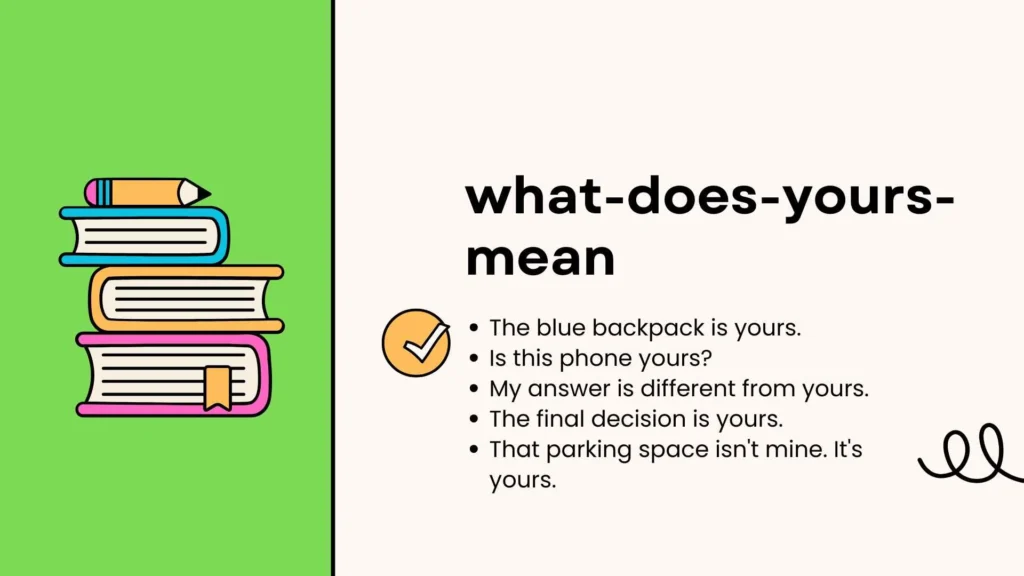
Yours is a possessive pronoun. It replaces a noun and shows that something belongs to you.
Instead of repeating the noun, you can simply use yours.
Examples
- The blue backpack is yours.
- Is this phone yours?
- My answer is different from yours.
- The final decision is yours.
- That parking space isn’t mine. It’s yours.
What Does Your’s Mean?
Your’s is not a correct English word.
People often write your’s because they mistakenly believe the apostrophe shows possession. In reality, the apostrophe is unnecessary here.
English possessive pronouns already show ownership without an apostrophe.
Incorrect Examples
- ❌ This jacket is your’s.
- ❌ Is this notebook your’s?
- ❌ The choice is your’s.
- ❌ That desk is your’s.
- ❌ The responsibility is your’s.
Each sentence should use yours instead.
How to Use Yours or Your’s
Always use yours when something belongs to the person you are speaking to.
Simple Rules
- Use yours by itself.
- Never add an apostrophe.
- Use your before a noun.
- Use yours without a noun.
Correct Examples
- This laptop is yours.
- Is that bag yours?
- Your phone is ringing.
- That phone is yours.
Incorrect Examples
- ❌ This laptop is your’s.
- ❌ That bag is your’s.
Where to Use Yours or Your’s
Use yours everywhere English is written or spoken.
School Writing
- This project is yours.
Formal Writing
- The final approval is yours.
Emails
- The attached document is yours to review.
Everyday Conversation
- Is this bottle yours?
Messages
- I think this charger is yours.
Professional Communication
- The decision is yours to make.
American English
American English always uses yours.
British English
British English also always uses yours.
Other English-Speaking Regions
Canada, Australia, New Zealand, India, Pakistan, and other English-speaking regions all use yours. Your’s is incorrect everywhere.
Why People Get Confused
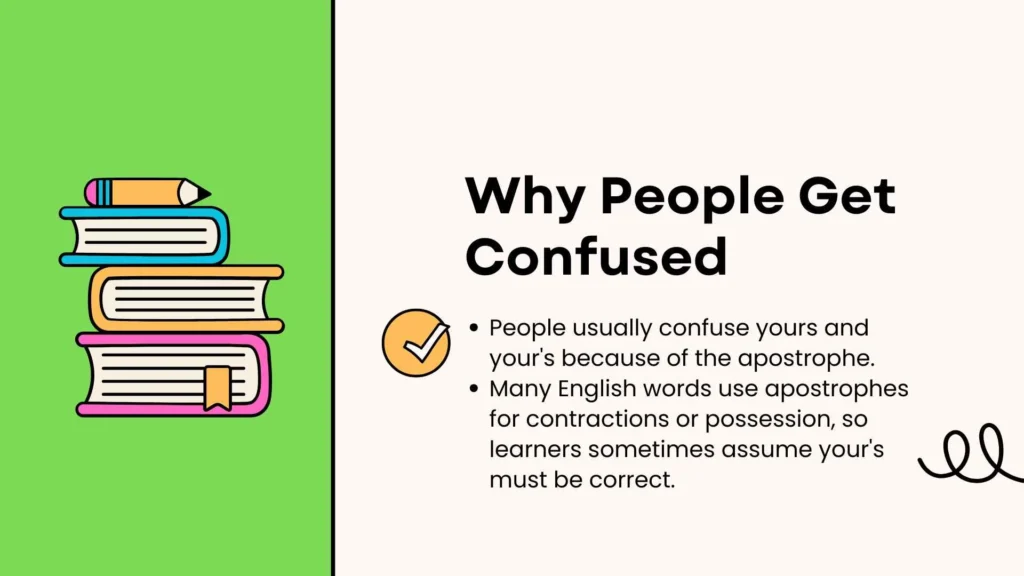
People usually confuse yours and your’s because of the apostrophe.
Many English words use apostrophes for contractions or possession, so learners sometimes assume your’s must be correct.
For example:
- it’s → it is
- don’t → do not
However, possessive pronouns are different.
Words like yours, hers, ours, theirs, and its never need an apostrophe.
Common Mistakes to Avoid
Wrong:
This notebook is your’s.
Correct:
This notebook is yours.
Explanation: Possessive pronouns do not use apostrophes.
Wrong:
The choice is your’s.
Correct:
The choice is yours.
Explanation: Use yours to show ownership.
Wrong:
Is this pen your’s?
Correct:
Is this pen yours?
Explanation: Your’s is not a valid English word.
Wrong:
That car is your’s, right?
Correct:
That car is yours, right?
Explanation: Never add an apostrophe to yours.
Real-Life Examples
Meeting
Is this notebook yours?
School
The science project is yours.
Travel
I think this suitcase is yours.
Work
The final presentation is yours to deliver.
Message
Your package has arrived. It’s yours.
Conversation
That seat is yours if you want it.
Order or Booking
This reservation is yours.
Social Situation
This gift is yours. Happy birthday!
Easy Trick to Remember
Think of this simple rule:
If it belongs to you, use “yours”—never “your’s.”
Also remember:
His, hers, ours, theirs, and yours all have no apostrophe.
Mini Quiz
1. Which word is correct?
A. Yours
B. Your’s
Answer: A. Yours
2. Is this sentence correct?
“This bag is your’s.”
Answer: No. It should be “This bag is yours.”
3. Fill in the blank:
The decision is ______.
Answer: yours
4. Which sentence is correct?
A. Is this pen your’s?
B. Is this pen yours?
Answer: B.
5. Does “yours” need an apostrophe?
Answer: No.
6. Which word is never correct?
Answer: Your’s
Related Confusing Words
- your or you’re
- its or it’s
- there or their
- affect or effect
- who’s or whose
- then or than
- to or too
- accept or except
FAQs About Yours or Your’s
Is yours correct?
Yes. Yours is the correct possessive pronoun.
Is your’s correct?
No. Your’s is not a correct English word.
What is the difference between yours and your’s?
Yours is correct and shows ownership. Your’s is incorrect.
Which one should I use?
Always use yours.
Is yours formal or informal?
Yours is correct in both formal and informal English.
Conclusion
The rule is simple: always use “yours.” “Your’s” is never correct.
Use yours whenever you want to show that something belongs to the person you are speaking to. This rule is the same in American, British, and all other varieties of English. If you remember that possessive pronouns never use apostrophes, you’ll avoid this common mistake every time.

Daniel Foster is a writer who enjoys breaking down complex topics into simple, engaging and easy-to-understand content. He has a passion for research, storytelling, and creating articles that help readers find clear answers. Daniel is also the fictional author of Beyond the Quiet Compass and Shadows of the Forgotten Tide. When he’s away from the keyboard, he enjoys hiking, reading, and exploring new ideas. His goal is to create content that is informative, trustworthy and enjoyable to read.
 Ava Collins